
Unbiased headlines. Facts, not spin.
Every story is an unbiased news briefing written from 110+ sources across the spectrum — sources linked so you can verify it yourself.
 tech
Notable (5/10)
May 30, 2026 at 10:40 PM
tech
Notable (5/10)
May 30, 2026 at 10:40 PM
NASA's X-59 Quiet Supersonic Jet Is Days Away From Breaking the Sound Barrier for the First Time
The Setup
NASA has been quietly building a supersonic aircraft for over a decade. The X-59 is a research platform with a specific, consequential mission: prove that supersonic flight over land doesn't have to rattle your windows.
According to NASA, the plane is now targeting early June 2026 for its first supersonic flight. That's approximately seven months after its debut flight in October 2025.
What the X-59 Actually Is
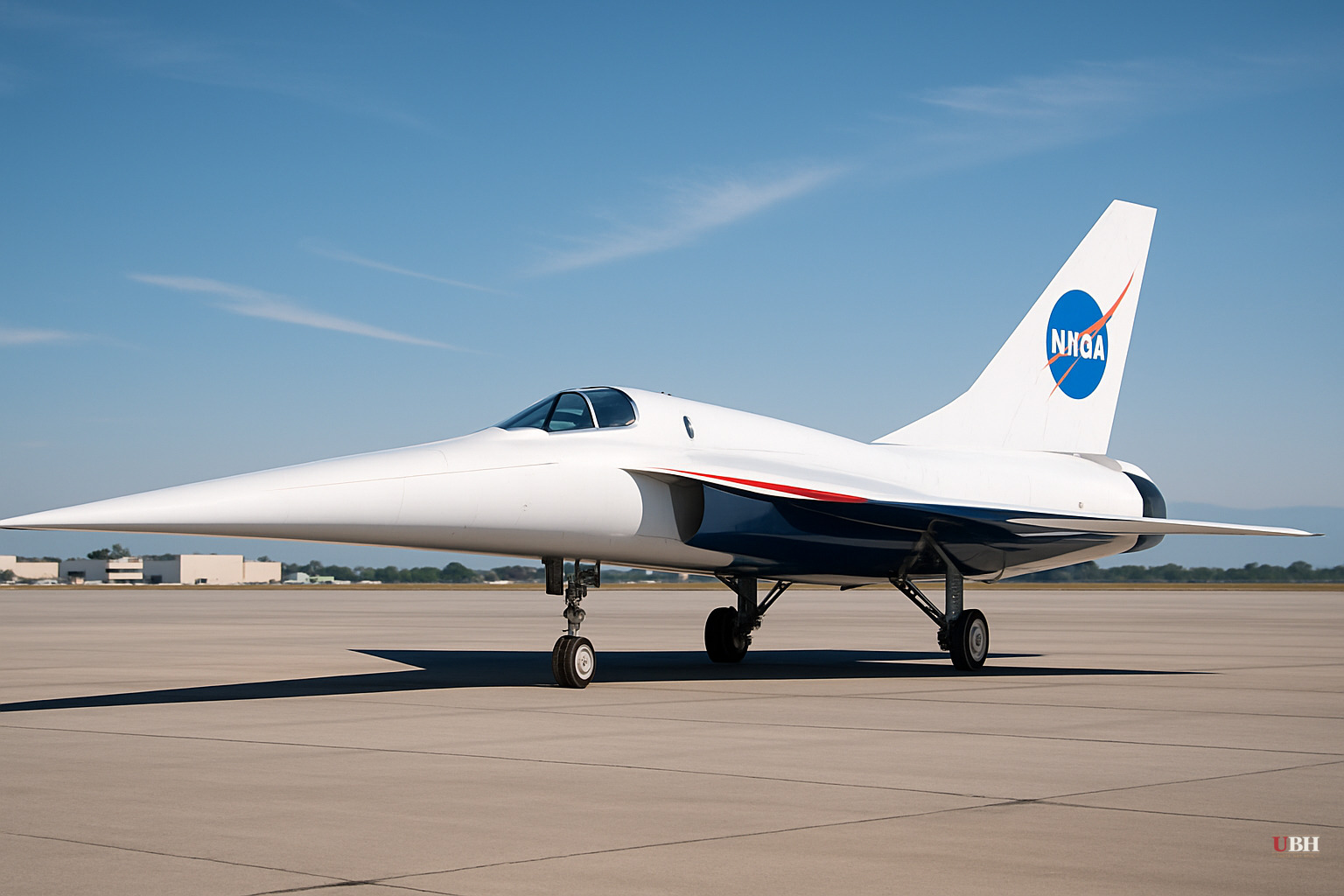
Built in partnership with Lockheed Martin, the X-59 looks like nothing you've ever seen at a commercial airport. The aircraft stretches nearly 100 feet in total length — and a significant portion of that is its extraordinarily elongated nose, which extends roughly 38 feet. That absurd snout is engineered to break apart shock waves before they merge and explode into a traditional sonic boom.
The engine is a top-mounted F-18 Super Hornet powerplant. Putting it on top gives the aircraft a smooth underside, which again prevents shock wave merging. According to Flying Magazine, the pilot can't see forward through a traditional windshield — the nose physically blocks the view. So NASA replaced the windshield entirely with a digital monitor fed by external cameras, called the eXternal Vision System.
The Flight Plan
Here's the three-step progression NASA has laid out, per NASA's own blog post and reporting by Engadget:
Step 1: First supersonic flight at 630 mph and 43,000 feet altitude — in early June 2026.
Step 2: A "mission conditions" flight reaching Mach 1.4, or 925 mph, at 55,000 feet.
Step 3: Maximum speed: Mach 1.6, which is 1,218 mph, at 60,000 feet.
Before this, the X-59's top speed was Mach 0.95 — just short of the sound barrier — achieved during subsonic test flights that began in March 2026, according to Flying Magazine. NASA completed 14 flights in that phase, including the first flight with retracted landing gear and the first two-flight day on April 30.
The plane last flew May 12, according to FlightAware tracking data cited by Flying Magazine.
What This Is Actually For
The X-59 isn't an end in itself. It's a data-collection machine built to crack open a regulatory door that's been shut for 53 years.
The FAA banned supersonic flight over land in 1973. That ban killed any chance of a Concorde successor operating transcontinental routes inside the U.S. The Concorde flew trans-Atlantic only — New York to London — because over-land flight was legally off the table.
NASA's Quiet SuperSonic Technology project, known as Quesst, is designed to generate the scientific evidence needed to challenge that ban. According to Flying Magazine, NASA plans to fly the X-59 over communities, record the noise levels on the ground, survey residents about what they actually heard, and hand that data to lawmakers and FAA regulators.
If the public says "yeah, that sounded like a car door" instead of "that sounded like an explosion," the regulatory case for lifting the ban gets a lot stronger.
The Chase Plane Problem
NASA disclosed an important limitation in its testing plan. According to a NASA blog post referenced by Engadget, the upcoming supersonic tests will NOT demonstrate the X-59's quiet boom technology in a measurable way — yet.
The reason is straightforward: a traditional supersonic chase plane will be flying alongside the X-59 for safety monitoring. That chase plane produces a conventional sonic boom, which will drown out whatever quiet thump the X-59 generates.
The real community noise survey — the one that matters for the FAA — comes later, once the X-59 is flying the Mach 1.4 mission conditions profile solo.
What Mainstream Coverage Is Missing
Most outlets are treating this as a cool science story. Fine. It is cool. But they're underselling the economic stakes.
A reversal of the FAA's over-land supersonic ban would not just affect NASA experiments. It would open the door for commercial operators — companies like Boom Supersonic — to operate actual passenger routes coast to coast at supersonic speeds. New York to Los Angeles in under two hours. That's not science fiction. That's the logical outcome if the X-59's data holds up and the FAA moves.
No one is asking the obvious question: Who benefits from the ban staying in place? Incumbent airlines running 5-hour transcontinental routes on wide-body jets have zero incentive to see faster competition emerge. The regulatory history of the 1973 ban deserves scrutiny it isn't getting.
What's Next
NASA has spent years and significant taxpayer dollars building a plane specifically designed to give regulators a scientific reason to modernize a 53-year-old rule. The engineering is legitimate. The testing has been methodical. The early June supersonic milestone is real and approaching fast.
Whether the FAA and Congress actually act on the data when it arrives remains uncertain. Based on how Washington typically handles anything that disrupts entrenched industries, change could take years.
Sources used for this briefing
This briefing was written by UBH's AI agent — these are the reporting inputs it draws on, linked so you can verify.


