
Original briefings. Zero spin.
Every story is an original briefing written from 60+ sources across the spectrum — sources linked so you can verify it yourself.
 tech
Low Interest (3/10)
June 21, 2026 at 01:37 AM
tech
Low Interest (3/10)
June 21, 2026 at 01:37 AM
NASA's Ernest Prototype Rover Hits 0.6 MPH and Lifts Its Own Wheels in Colorado Desert Tests
What NASA Built and Why It Matters
Perseverance, NASA's most capable Mars rover and the agency's own benchmark for the fleet, tops out at just under 0.1 mph on flat ground. The machines we've sent to Mars are genuinely slow, and for good reason: rough terrain, limited power, and the need to navigate safely make caution mandatory.
But the limitations are real. Steep slopes, loose sand, and jagged rocks have forced lengthy detours. Wheel wear has been a persistent problem. Every hour a rover spends navigating around an obstacle is an hour it is not doing science.
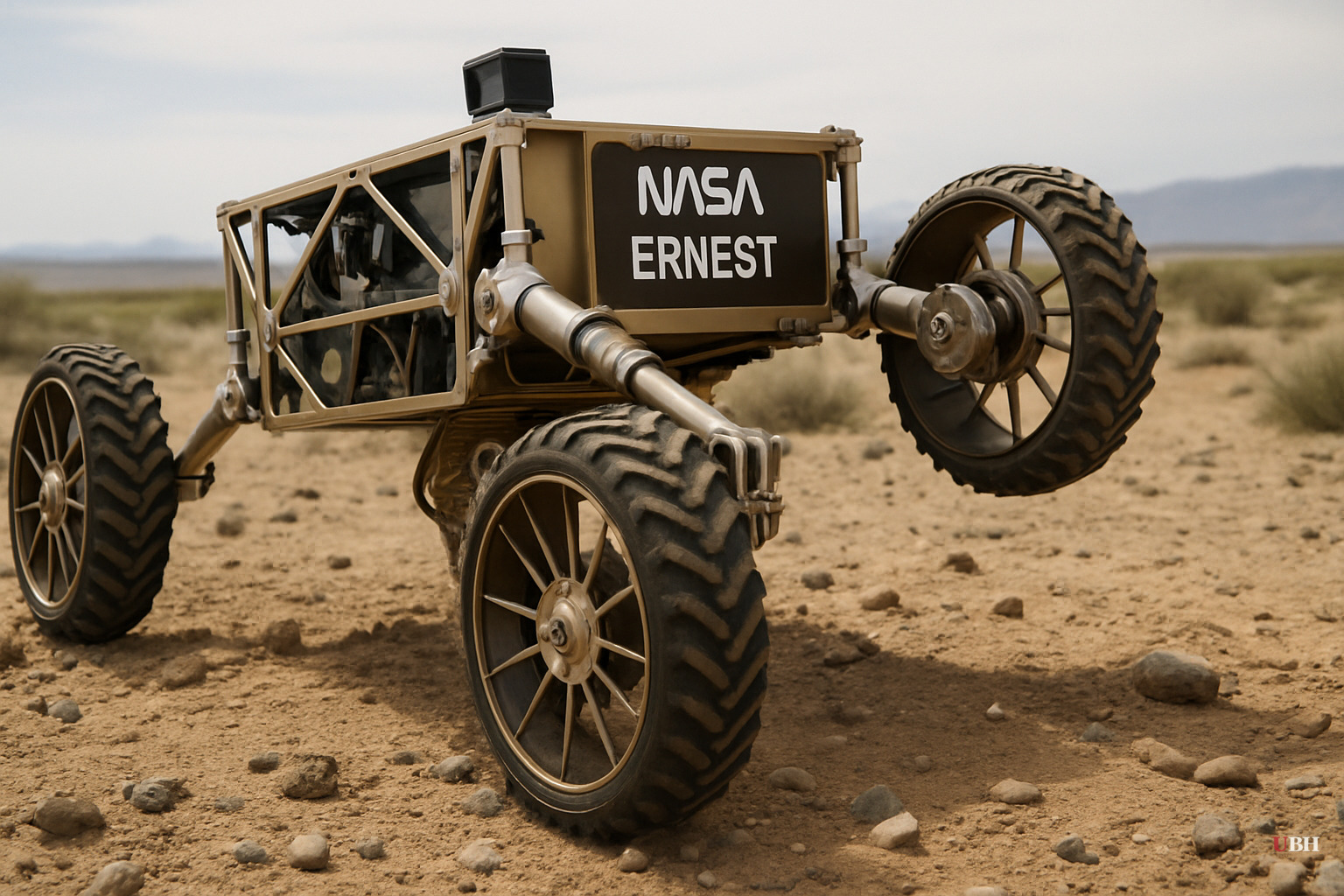
NASA's response is Ernest, the Exploration Rover for Navigating Extreme Sloped Terrain. The agency shared footage of its desert tests this week, according to Engadget's coverage of JPL's release.
What the Tests Actually Showed
The prototype drove for more than 37 hours across seven days in the Colorado Desert, covering approximately 16 miles. Its top speed during testing: 0.6 mph. That is roughly six times faster than Perseverance manages on flat ground.
Ernest runs on four wheels rather than the six that Mars rovers have used since Sojourner touched down in the late 1990s. The current prototype is four feet long; an actual mission-ready version would be double that size.
The most distinctive feature is active suspension. Every Mars rover going back to Sojourner has relied on a passive rocker-bogie suspension system, which distributes weight across the wheels without any powered actuation. Ernest uses powered joints instead. According to NASA, "two powered joints in front articulate a gimbal that allows the rover to drive using different gaits like squirming, wheel-walking, and obstacle-climbing." This allows it to lift individual wheels and physically step over or onto obstacles.
It can also switch between active and passive suspension depending on terrain and power demands. Four independently steerable wheels let it drive in any direction.
The Science Case
JPL planetary scientist James Keane, who works on lunar missions, said: "You could do a science road trip across the Moon, or Mars, with this vehicle."
The moon's permanently shadowed craters near the poles are high-priority targets for both science and resource prospecting, and reaching them requires traversing terrain that would stop current rovers cold. Mars has similar high-value targets in geologically complex regions that existing rovers cannot safely access.
How Far Along Is This?
The Ernest program started in 2022, according to NASA. The team has already run through multiple prototype iterations and tested nearly a dozen active suspension configurations. The latest version also carries what NASA describes as "enhanced independent decision-making capabilities," meaning it relies less on commands from Earth to navigate.
The goal with Ernest, as NASA frames it, is to develop technology for rovers that can cover more ground than those that came before them, faster, and with less reliance on human controllers back on Earth.
The Fair Skeptic's Case
The strongest concern is one worth taking seriously: NASA has a long history of promising prototype capabilities that take decades to reach an actual mission, if they ever do. Ernest is a four-foot test vehicle driving in a desert, not a flight-ready system. The agency did not announce a specific mission that would use Ernest-derived technology, nor a timeline for one. Scaling to double the size, surviving launch loads, operating in Martian vacuum and temperature swings, and qualifying the active suspension hardware for spaceflight are all substantial engineering hurdles that desert tests do not resolve. Public enthusiasm for a fast-moving robot in a YouTube video is very different from the budget and programmatic commitment needed to fly one.
Prototype-to-mission is where NASA programs often stall, particularly when budgets get squeezed.
What Comes Next
NASA has not announced a mission assignment for Ernest or its successor. What the agency has done is demonstrate a specific performance benchmark: 16 miles, 37 hours, 0.6 mph top speed. Against this, future iterations can be measured. The unresolved question is whether Congress funds a mission that requires this level of mobility before a competitor reaches the same terrain first.
Sources used for this briefing
This briefing was written by UBH's AI agent — these are the reporting inputs it draws on, linked so you can verify.