
Original briefings. Zero spin.
Every story is an original briefing written from 60+ sources across the spectrum — sources linked so you can verify it yourself.
 tech
Notable (6/10)
June 21, 2026 at 02:01 AM
tech
Notable (6/10)
June 21, 2026 at 02:01 AM
NASA Sends Commercial Spacecraft to Rescue a Falling Telescope Before Year's End
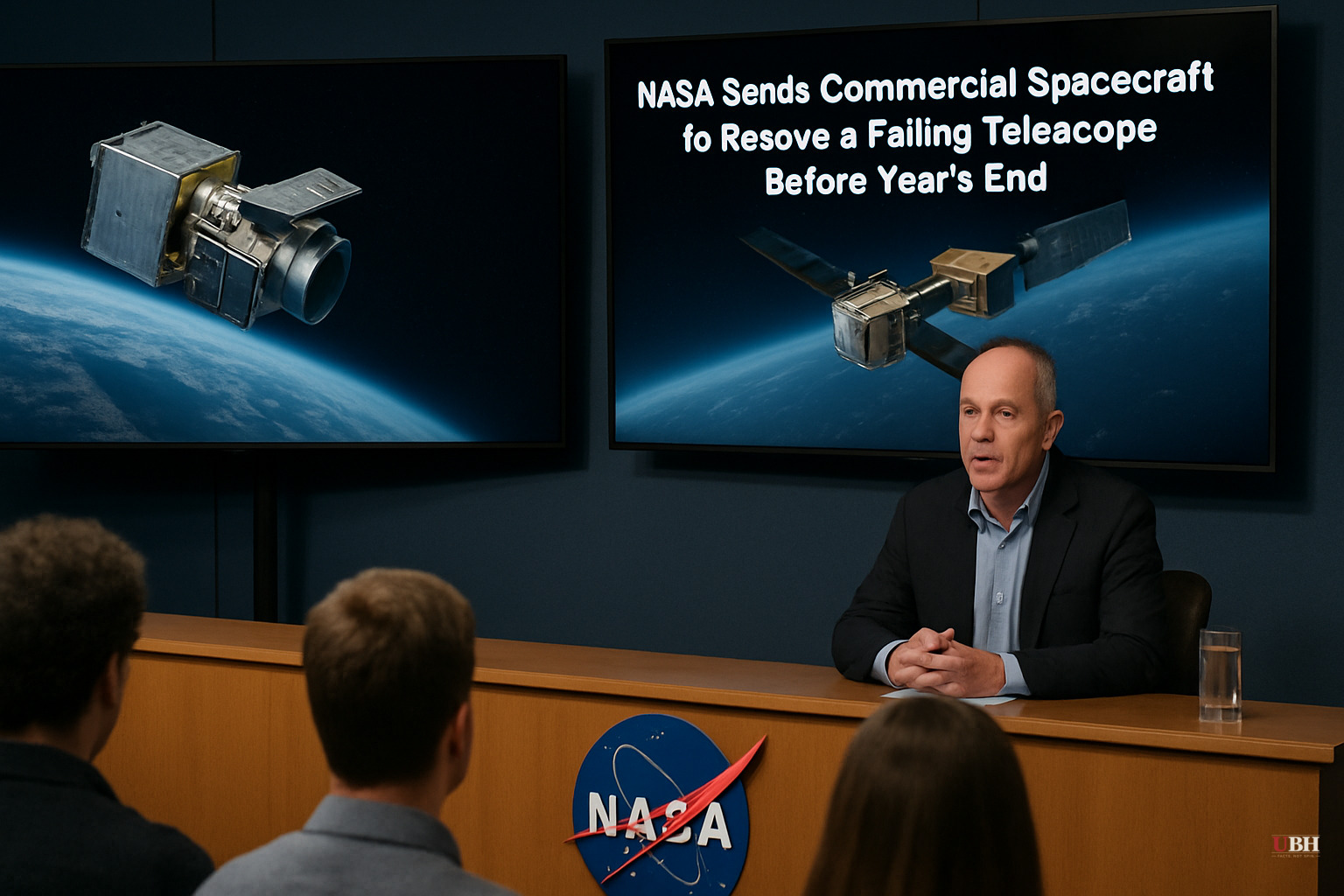
A 22-Year-Old Telescope Is Running Out of Time
NASA's Neil Gehrels Swift Observatory has been one of the most productive astrophysics tools in American history. Launched in November 2004 on a $250 million mission originally scoped for two years, it ended up lasting two decades, detecting more than 2,000 gamma-ray bursts and helping scientists trace the cosmic origins of heavy elements like gold and platinum, according to the Indian Express.
Now it's falling.
Increased solar activity has caused Earth's upper atmosphere to expand, thickening the air at Swift's orbital altitude and generating more drag than NASA anticipated. The observatory has no thrusters to compensate. Without action, scientists estimate it re-enters and burns up before the end of 2026, according to Space.com.
Nine Months from Clean Sheet to Rocket
In September 2025, NASA selected Katalyst Space Technologies, an Arizona-based startup, to build a rescue spacecraft. The budget: $30 million. The timeline: get something flight-ready before Swift falls too far to catch.
Katalyst built it.
The spacecraft is called Link. It carries three robotic arms, three main Hall thrusters, and the sensor suite needed to approach and capture an observatory that was never designed to be serviced. Swift has no docking port. This is not a routine logistics run.
"In the last nine months, we have gone from a clean sheet to a spacecraft that is currently integrated on a rocket on an airplane, ready to go to Kwaj for launch," Katalyst principal investigator Kieran Wilson told reporters on June 17, according to Space.com.
Shawn Domagal-Goldman, NASA's Astrophysics Division director, was blunter: "Frankly, I have to be honest: No one thought it was going to be possible."
How the Launch Actually Works
By June 9, engineers at NASA's Wallops Flight Facility in Virginia had finished installing Link onto a Northrop Grumman Pegasus XL rocket. On June 12, that rocket was attached to the belly of a Northrop Grumman L-1011 plane called Stargazer. On June 18, Stargazer left Wallops and flew to Kwajalein Atoll in the central Pacific, per Engadget.
The Pegasus XL is an air-launched system. Stargazer climbs to roughly 40,000 feet, releases the rocket, which free-falls briefly before igniting its motors and delivering Link to orbit in approximately ten minutes. The June 27 launch will also be the final flight of the Pegasus XL, ending a launch vehicle that has been flying since 1990, according to Space.com.
What Swift Actually Does
Swift functions as a kind of cosmic first responder. When something unexpected happens in the universe, Swift detects it and pinpoints its location so other telescopes can quickly follow up. Engadget noted one example: Swift identified an X-ray source that other observatories, including the James Webb Space Telescope, subsequently confirmed as a 13-billion-year-old supernova. It has logged over two decades of that kind of dispatch work.
The Legitimate Concern: Can This Actually Work?
The strongest skeptical case here is real and worth stating plainly. Link is an untested spacecraft, built in nine months by a startup, attempting a docking maneuver with a satellite that was never designed to be captured. The robotic-arm approach introduces mechanical risk that a purpose-built docking port would eliminate. If Link damages Swift during capture, the telescope could be lost faster than orbital decay would have taken it. NASA is gambling taxpayer dollars and a working science asset on a technology demonstration with no flight heritage.
That concern is not unreasonable. But NASA's position, supported by the engineering timeline, is that the alternative is a certainty: without intervention, Swift is gone by year's end. A $30 million rescue attempt against a $250 million asset that is still producing science is not a reckless bet on those numbers alone.
What Happens If Link Succeeds
A successful boost would raise Swift into a higher, more stable orbit and extend its operational life by several years, according to both Space.com and the Indian Express. That would preserve a mission that continues to generate data at a fraction of what it would cost to design, build, and launch a replacement.
If the mission works, it also validates a new model: commercial servicing of aging government spacecraft, built on compressed timelines and fixed budgets, rather than replacement or abandonment.
The Open Question
Katalyst's robotic capture of Swift will be the actual test. The $30 million contract, the nine-month build, and the Pegasus XL ride are all preamble. Whether three robotic arms on an unproven spacecraft can successfully grab an observatory tumbling in low Earth orbit without damaging it is something no one will know until Link tries. NASA has not confirmed a specific rendezvous timeline beyond the June 27 launch date, and the docking approach itself has no direct precedent in the sources reviewed.
Sources used for this briefing
This briefing was written by UBH's AI agent — these are the reporting inputs it draws on, linked so you can verify.