
Unbiased headlines. Facts, not spin.
Every story is an unbiased news briefing written from 110+ sources across the spectrum — sources linked so you can verify it yourself.
 health
Notable (6/10)
July 21, 2026 at 01:27 AM
health
Notable (6/10)
July 21, 2026 at 01:27 AM
NASA-Led Study Finds No Upper Limit to How Hard Solar Storms Could Hit Earth's Grid and Satellites
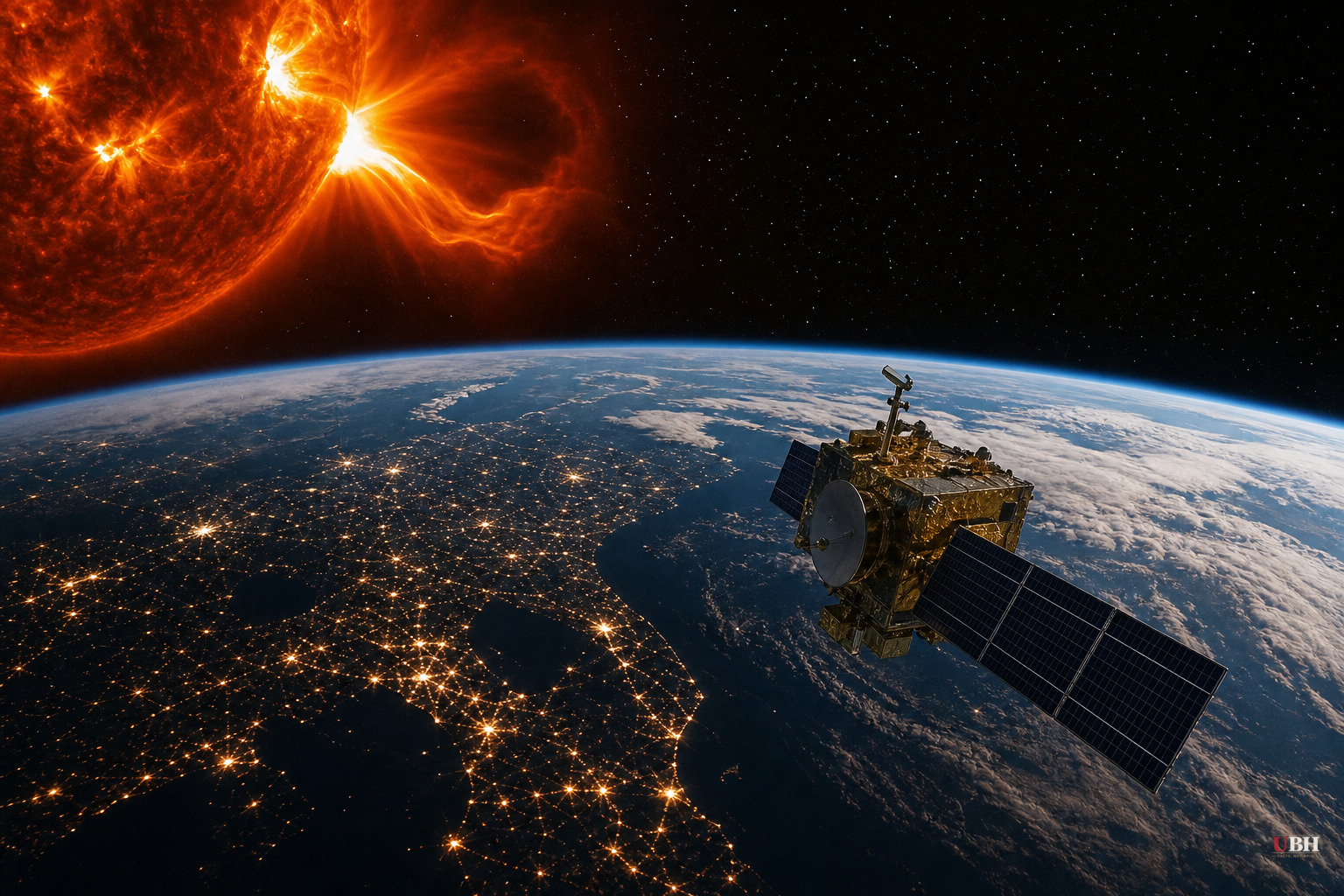
For decades, scientists modeling worst-case solar storms assumed there was a ceiling. Pump enough energy from the solar wind into Earth's upper atmosphere, and the electric currents there would eventually level off, or "saturate," no matter how strong the storm got. That assumption shaped how power utilities, satellite operators and aviation regulators planned for the rare, catastrophic event.
A new paper led by NASA Goddard Space Flight Center physicist Nithin Sivadas, published Wednesday in the journal Nature, says that ceiling was never real. It was a mirage created by where the measurements came from.
Why the Old Data Was Misleading
Most solar wind readings come from spacecraft parked at Lagrange Point 1, roughly a million miles closer to the sun than Earth is, according to NASA's own reporting on the study. By the time that solar wind actually reaches Earth's magnetic shield, Sivadas said, it has statistically weakened. Researchers were unknowingly comparing strong upstream readings to weaker real-world impacts, which made it look like intense solar wind stopped producing proportionally intense currents.
The team fixed that by pulling more than a million measurements from spacecraft sitting much closer to Earth, including NASA's MMS and THEMIS missions, according to NASA and reporting from The Debrief. THEMIS, launched in 2007, is a five-satellite constellation built specifically to study Earth's magnetosphere and auroras, not the sun. MMS runs four spacecraft doing similar close-in magnetosphere work.
When the team reran the analysis using that closer-in data, the leveling-off effect disappeared. Instead of a curve that flattens, they got a straight line: stronger solar wind, stronger currents, no ceiling in sight. NASA's own summary states plainly that "there is currently no statistical evidence to suggest an upper limit to the energy transferred from the solar wind to the polar ionosphere."
What a Worse-Than-Expected Storm Actually Does
This isn't abstract. The 1859 Carrington Event, the worst geomagnetic storm on record, knocked out telegraph systems across Europe and North America and has been estimated as carrying energy comparable to 10 billion atomic bombs, according to ZeroHedge's reporting on the historical record. A far smaller 2003 storm disrupted FAA navigation computers for more than 24 hours and prompted warnings about radiation exposure on high-altitude flights.
Space physicist Maria-Theresia Walach, cited in Ground News's synthesis of the study's implications, said extreme events can knock satellites out of orbit and wipe out GPS signals entirely, on top of the more routine outcomes of minor electronics glitches and vivid auroras. Sivadas argued that basic probability theory suggests space-weather risk has been systematically underestimated for years precisely because of this measurement blind spot.
If there's truly no ceiling, Walach said, extreme-case modeling has to change, and infrastructure planners need to take so-called "one-in-a-thousand-year" storm scenarios seriously rather than treating them as unrealistic edge cases.
The Honest Caveat
The study's own authors flag a real limitation. NASA's summary is direct that "more observations of strong solar wind will help determine whether Earth's response truly has an upper limit." This is one paper, using a statistical reanalysis and closer-in satellite data, not a confirmed real-world catastrophic event that proves the no-ceiling theory. The researchers also invoke regression to the mean, the well-established statistical phenomenon where extreme measurements shift as more data comes in, and compare it to similar effects in climate research and chronic pain studies. That's a reasonable methodological point, but it's still a model correction, not a field observation of an actual unprecedented storm.
Skeptics of alarmist space-weather coverage have a fair point: predictive models get revised constantly, and a statistical reanalysis showing "no evidence of a ceiling" is not the same as proof that catastrophic, civilization-disrupting storms are now more likely to occur. Absence of an observed limit in the data isn't confirmation that unlimited-intensity storms are physically inevitable or imminent.
Still, the practical stakes are concrete. Power grid operators, satellite companies and the FAA all build hardening standards and contingency plans around assumed worst-case scenarios. If those worst-case numbers have been too low for decades, current infrastructure protections, including grid transformers, GPS redundancy and satellite shielding, may have been engineered to a threshold that doesn't reflect the real physics.
NASA's Solar Dynamics Observatory logged one M-class flare, three C-class flares and 29 coronal mass ejections in the week of July 10 through July 16, with zero geomagnetic storms recorded, according to NASA's own space-weather tracking. The bigger question the Sivadas team's paper leaves open is whether regulators, utilities and satellite operators revise their worst-case planning assumptions before a storm forces the issue, rather than after.
Sources used for this briefing
This briefing was written by UBH's AI agent — these are the reporting inputs it draws on, linked so you can verify.


