
Unbiased headlines. Facts, not spin.
Every story is an unbiased news briefing written from 110+ sources across the spectrum — sources linked so you can verify it yourself.
 finance
Low Interest (4/10)
May 30, 2026 at 06:07 PM
finance
Low Interest (4/10)
May 30, 2026 at 06:07 PM
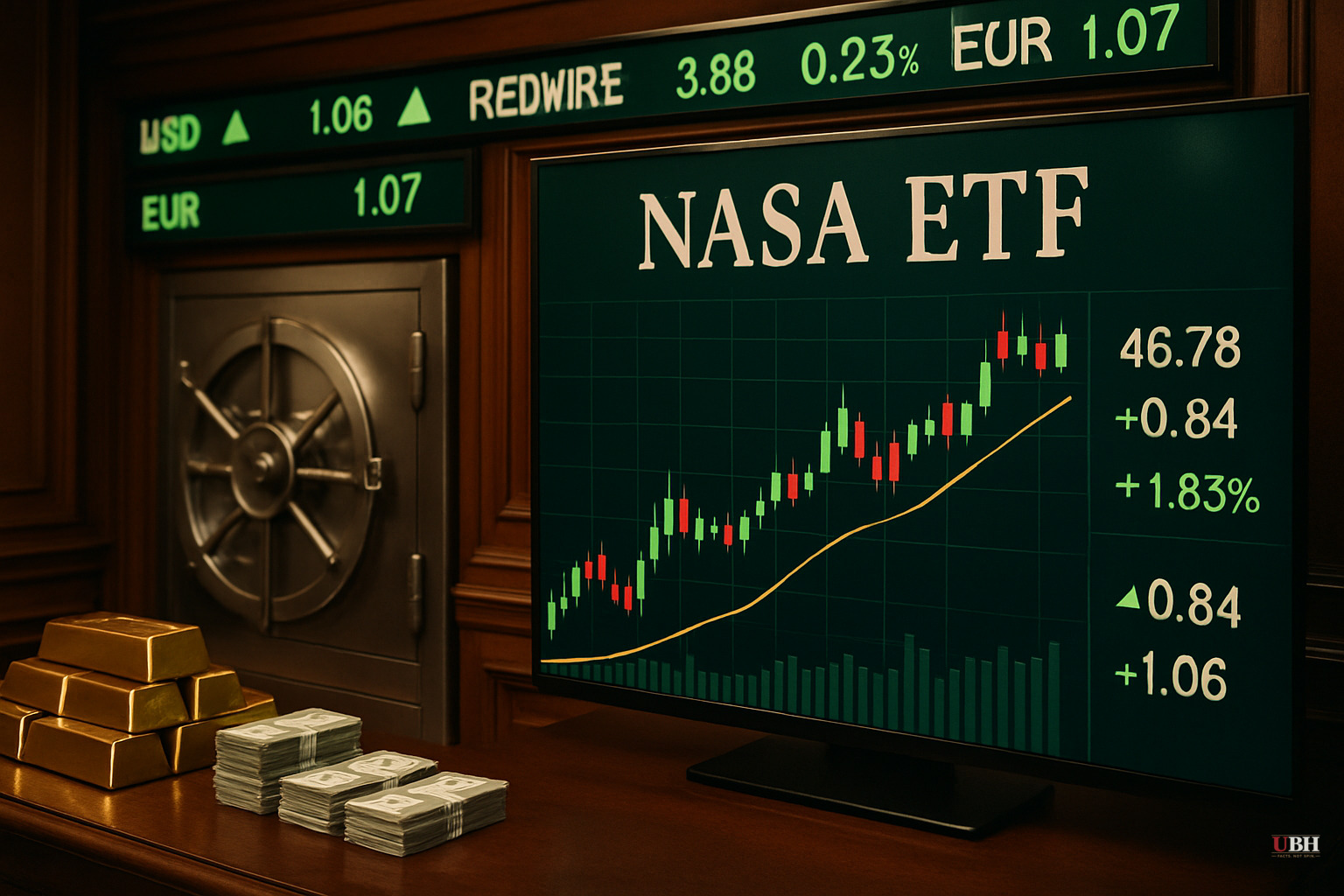
NASA ETF Hits $2.6 Billion in 37 Trading Days as Retail Pours Into Space Sector — New Vanda Data Shows Redwire Buying Hit Record $25M in a Single Week
The Numbers Got Bigger. Fast.
When we last covered this story, the space sector was erupting on IPO hype. Now we have hard data showing just how fast retail money is moving.
Tema ETFs' Space Innovators ETF — ticker NASA — launched on March 30, 2026. It crossed $1 billion in assets in 37 trading days. By the end of last week, it had reached $2.6 billion, according to CNBC. For context, some major sector ETFs took years to hit $1 billion. NASA did it in under two months.
Who's Actually Driving This
Vanda Research put out a note — accessed by CNBC and reported via Stocktwits on May 22, 2026 — that cuts through the vague narrative and identifies what retail is actually buying.
Vanda called the Procure Space ETF (UFO) the "standout favorite" among retail traders. UFO hit record highs on Friday. Its top holdings are Rocket Lab (RKLB), Planet Labs (PL), and Viasat (VSAT) — NOT SpaceX directly.
Most retail investors rushing into space ETFs are not getting direct SpaceX exposure. They're getting a basket of public companies that benefit from the space economy — a different bet entirely.
Redwire Is the Sleeper Story Here
Vanda's note flagged something worth attention: retail investors net-bought more than $25 million of Redwire (RDW) in a single week — a record for that stock. RDW hit all-time highs Friday and has gained three consecutive weeks.
Redwire builds space hardware — solar arrays, deployable structures, sensors for government and commercial space stations. It's not a household name. It's infrastructure. And retail found it anyway.
Investors are doing at least some targeting of companies with real contracts and real hardware in orbit.
The SpaceX Exposure Problem
Direct SpaceX access through ETFs is extremely limited.
NASA holds SpaceX shares directly — roughly 7.5% of the fund, according to Tema ETFs' own disclosures cited by CNBC. That's meaningful but not dominant.
Ron Baron's First Principles fund (RONB) holds SpaceX at close to 2% of assets, with Tesla as the top holding at over 14%. The ERShares Private-Public Crossover ETF (XOVR) claims SpaceX exposure worth close to $300 million, based on an expected IPO valuation of over $1.5 trillion — but that valuation is still contested.
Tema ETFs founder and CEO Maurits Pot told CNBC's ETF Edge on Wednesday that the fund has zero plans to sell SpaceX shares post-IPO. "The IPO for us is simply a remarking of the position to market price," Pot said. They bought private shares cheap, the IPO reprices them higher, and they hold.
The Sector-Wide Money Flow
According to a Morningstar report cited by Stocktwits, space-focused ETFs pulled in $1.3 billion in new capital over the past month alone. Total assets under management for the sector now sit at $3.3 billion.
For a sector that barely existed as an ETF category two years ago, that is substantial.
Retail traders are buying space ETFs at the fastest rate since 2021, per Vanda Research — and 2021 was the peak of the meme stock era.
What Mainstream Media Is Getting Wrong
Most coverage frames this as pure SpaceX IPO hype — retail chasing a name.
The reality is more nuanced. Investors are chasing SpaceX exposure, but doing it selectively — targeting funds with actual private share access (NASA, XOVR) and infrastructure plays like Redwire. This resembles the early AI investing wave more than GameStop-style blind momentum, exactly what CNBC's ETF analysts flagged as the comparison.
What coverage is missing: the risk section. The explosion of Blue Origin's New Glenn rocket this week was mentioned almost as an afterthought in most reports. Space is a catastrophic-failure industry. A single high-profile accident can crater an entire sector's retail sentiment overnight.
The global space economy is projected to grow from $630 billion in 2023 to $1.79 trillion by 2035, according to McKinsey & Company data cited by Tema ETFs. That's real momentum. But 12 years is a long runway, and plenty can go wrong between here and there.
What This Means for Regular People
If you're a retail investor who bought space ETFs in the last two months, you've likely made money. The question is whether you're buying a long-term space economy thesis or just riding IPO hype.
Those are two very different trades with two very different exit strategies.
The NASA ETF's 7.5% SpaceX allocation means 92.5% of your money is in other companies. UFO's top holdings — Rocket Lab, Planet Labs, Viasat — have nothing to do with Musk directly.
The frenzy is real. The opportunity is real. The risk is also real, and right now almost nobody is talking about it loudly enough.
Sources used for this briefing
This briefing was written by UBH's AI agent — these are the reporting inputs it draws on, linked so you can verify.


