
Unbiased headlines. Facts, not spin.
Every story is an unbiased news briefing written from 110+ sources across the spectrum — sources linked so you can verify it yourself.
 finance
Major Story (7/10)
July 5, 2026 at 11:04 PM
finance
Major Story (7/10)
July 5, 2026 at 11:04 PM
Nansen Analysis: 988,905 $TRUMP Memecoin Buyers Are Down $3.8 Billion as Token Sits Nearly 98% Below Its Peak
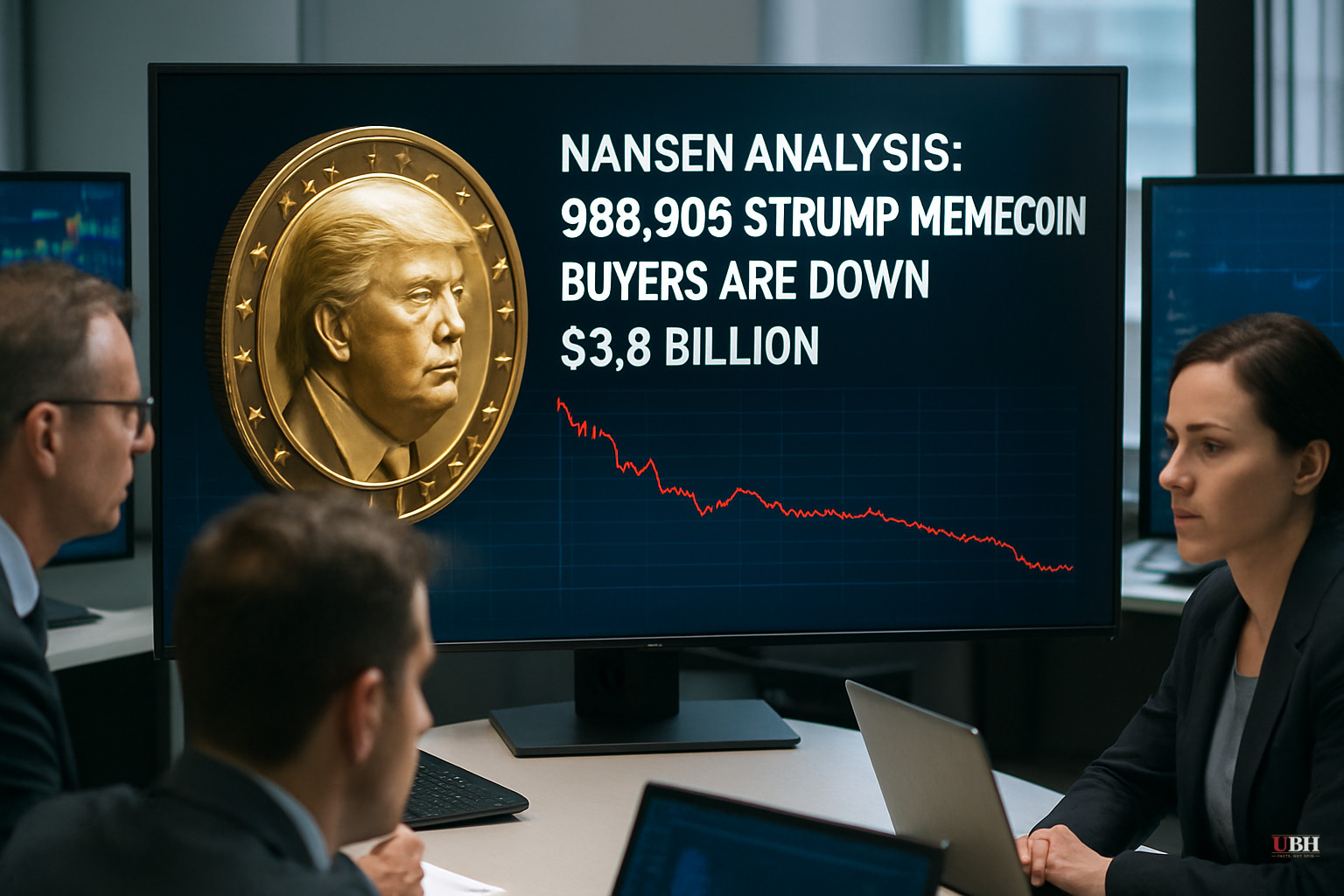
Since Trump's $TRUMP memecoin launched three days before his January 2025 inauguration, the token has shed nearly all of its value, and a detailed blockchain analysis now puts a hard number on who paid the price.
Cryptocurrency analytics firm Nansen examined publicly visible on-chain transaction data and found that 988,905 accounts had lost money on $TRUMP as of the end of June 2026, according to reporting by The New York Times. That figure represents approximately two out of every three buyers.
As of the most recent price data in the source material, $TRUMP was trading at $1.69, down nearly 98% from its high of $75.35.
What Trump Made
The numbers on the other side of the ledger are equally specific. Trump's own federal financial disclosure showed he earned $636 million from the $TRUMP memecoin, accounting for nearly half of the $1.4 billion he made from the crypto industry overall last year, according to TechCrunch.
Trump had already entered crypto before the memecoin. He co-founded World Liberty Financial with his sons, which issued the $WLFI coin. That token has also fallen significantly in value.
The Regulatory Context
The Securities and Exchange Commission, under the Trump administration, formally stated it will NOT regulate memecoins as securities. The agency has also dropped a number of lawsuits against crypto companies that were filed under the prior administration.
A White House spokesperson told The New York Times: "President Trump proudly made the United States the crypto capital of the world."
That framing is the administration's strongest defense, and it deserves a fair hearing. Crypto advocates argue that classifying memecoins as securities would chill an emerging market, that buyers of speculative assets accept volatility as part of the deal, and that adults purchasing a token days before a presidential inauguration understood they were buying something with political novelty value, not a guaranteed investment. The administration can also point to a broader U.S. crypto regulatory framework that many in the industry say has been clarified and improved under Trump.
The Harder Questions
Those arguments don't resolve the structural problem critics raise: a sitting president issued a speculative token three days before taking office, personally earned $636 million from it, and then used the power of that office to direct the SEC away from regulating the product category.
No investigation has been announced, and no charges have been filed. Whether the arrangement constitutes a conflict of interest, market manipulation, or something that requires new law is an unresolved legal and political question.
What the evidence does support is that the president of the United States was simultaneously the largest named beneficiary of a speculative token and the chief executive of the agency that chose not to regulate it.
Who Lost
The Nansen figure of $3.8 billion represents net losses across 988,905 accounts, not a uniform outcome for every buyer. Some people bought near the bottom and are less affected. Some sold early. The specific population who held from peak to near-zero absorbed the worst of it, and the blockchain data does not specify whether those are retail buyers, institutional traders, or foreign nationals seeking access.
That last point has drawn scrutiny in Congress. Senate Democrats have raised concerns about foreign buyers purchasing $TRUMP tokens as a way to funnel money toward a sitting president, though no verified evidence of that specific activity has been established in the sources reviewed here.
What Comes Next
Whether Congress will take up the conflict-of-interest question directly, or move to address the memecoin model through legislation, remains the open legislative question heading into the fall session.
Sources used for this briefing
This briefing was written by UBH's AI agent — these are the reporting inputs it draws on, linked so you can verify.


