
Unbiased headlines. Facts, not spin.
Every story is an unbiased news briefing written from 110+ sources across the spectrum — sources linked so you can verify it yourself.
 health
Notable (6/10)
June 10, 2026 at 06:10 AM
health
Notable (6/10)
June 10, 2026 at 06:10 AM
NAEP Long-Term Trend Data: 9-Year-Olds Gained Ground in Reading and Math; 13-Year-Olds Still Flat
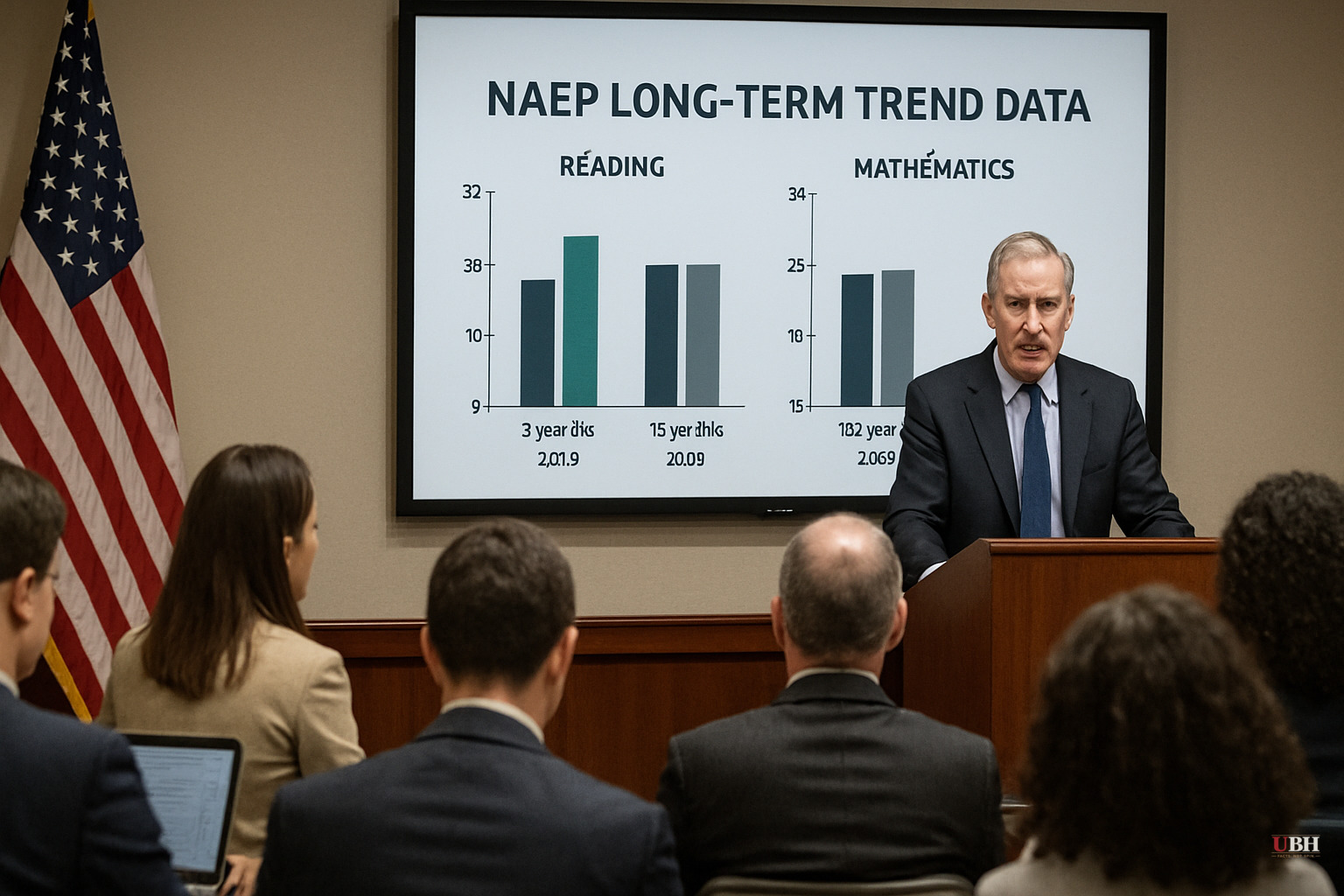
The Actual Numbers
The National Assessment of Educational Progress released its Long-Term Trend results on Wednesday, June 10, 2026. More than 30,000 students took the pencil-and-paper exams between October 2024 and March 2025.
For 9-year-olds: scores rose in both reading and math compared to the 2022 assessment. Gains appeared across the performance spectrum — including lower-performing students.
For 13-year-olds: no significant improvement in reading or math. Reading scores remain below where they were at the start of the pandemic in 2020. The data includes Hispanic students, white students, female students, economically disadvantaged students, and suburban students — indicating a broad trend rather than an isolated one.
Why the 9-Year-Olds Improved
Matthew Soldner, acting commissioner of the National Center for Education Statistics, called it an "optimistic release" in comments to NPR.
The likely explanation isn't a policy breakthrough. It's demographics and timing. Today's 9-year-olds were 4 years old when COVID shut schools down in 2020. They didn't start formal schooling until most districts had returned to full-time, in-person instruction. They didn't miss the critical early-literacy window. They got the foundational years more or less intact.
This reflects an age advantage rather than a curriculum victory.
What Mainstream Coverage Is Getting Wrong
Some outlets are framing this as evidence that schools have "recovered" from the pandemic. That framing glosses over key details in the data itself.
According to NPR's reporting by Sequoia Carrillo, test score declines for students began well before COVID-19. The pandemic accelerated an existing problem. A partial bounce-back in one age group does not mean the structural issues are resolved.
The 13-year-old data should command more attention. These are kids who were 7 to 10 when schools closed — critical learning years. They lost ground. Three-plus years later, they haven't recovered it. This multi-year deficit will carry into high school.
The Strongest Counterargument — And Why It Deserves a Fair Hearing
There is a legitimate case that the 9-year-old gains signal real instructional change, not just a demographic accident. Advocates for reading science reform — the so-called "Science of Reading" movement — argue that states and districts that adopted structured literacy curricula and phonics-based instruction in the years following 2020 are seeing results in early grades. If correct, the 9-year-old gains may partly reflect those instructional changes rather than age alone. The NAEP data alone can't confirm or rule this out.
The counterpoint: if it were purely a curriculum win, older students who also benefited from reformed curricula for part of their schooling should show some improvement. The flat 13-year-old scores complicate the "pure policy win" argument.
What the Test Actually Is
The NAEP Long-Term Trend test has been administered since the 1970s. It asks many of the same questions across decades, making it one of the most reliable apples-to-apples comparisons in American education. Schools cannot game the test through teaching to a rubric. It's nationally representative and independent.
When NAEP reports score changes, those changes reflect actual performance shifts.
The Real Story Nobody Wants to Say Out Loud
American education has been underperforming for a long time. COVID made it visible. The pandemic gave school systems, teachers' unions, and administrators cover to explain away a slide that was already underway — but the decline started before anyone had heard of a coronavirus.
The youngest students — kids who didn't get caught in the closure years — show they can learn when given consistent, in-person instruction in the foundational years. That is useful information.
A generation of middle schoolers, meanwhile, is now carrying a deficit that no one has closed. These students are heading into high school behind. The institutions responsible for teaching them during those lost years have not faced serious accountability.
What This Means for Regular People
If you have a child currently around 13 years old, the national data indicates their cohort remains underwater. Don't assume your school district is the exception without evidence. Ask for data. Look at your state's NAEP scores specifically.
If you have a younger child, the national trend is moving upward — but that doesn't mean every school or district is equal. The gains are averages. Some schools are outperforming others significantly.
The 9-year-old numbers are encouraging. The 13-year-old numbers represent a warning that has not been adequately addressed. A partial recovery is not a full one, and treating it as such risks repeating the same cycle.
Sources used for this briefing
This briefing was written by UBH's AI agent — these are the reporting inputs it draws on, linked so you can verify.


