
Unbiased headlines. Facts, not spin.
Unbiased Headlines is an independently owned news organization. We bring you the facts, not opinions, written fresh from 110+ named sources. Sources linked so you can verify it yourself.
 finance
Major Story (7/10)
Event date: October 16, 2026 ·
Morgan Stanley Sees Hyperscaler Free Cash Flow at Its Weakest in 2027, With $255 Billion in Bonds Already Sold
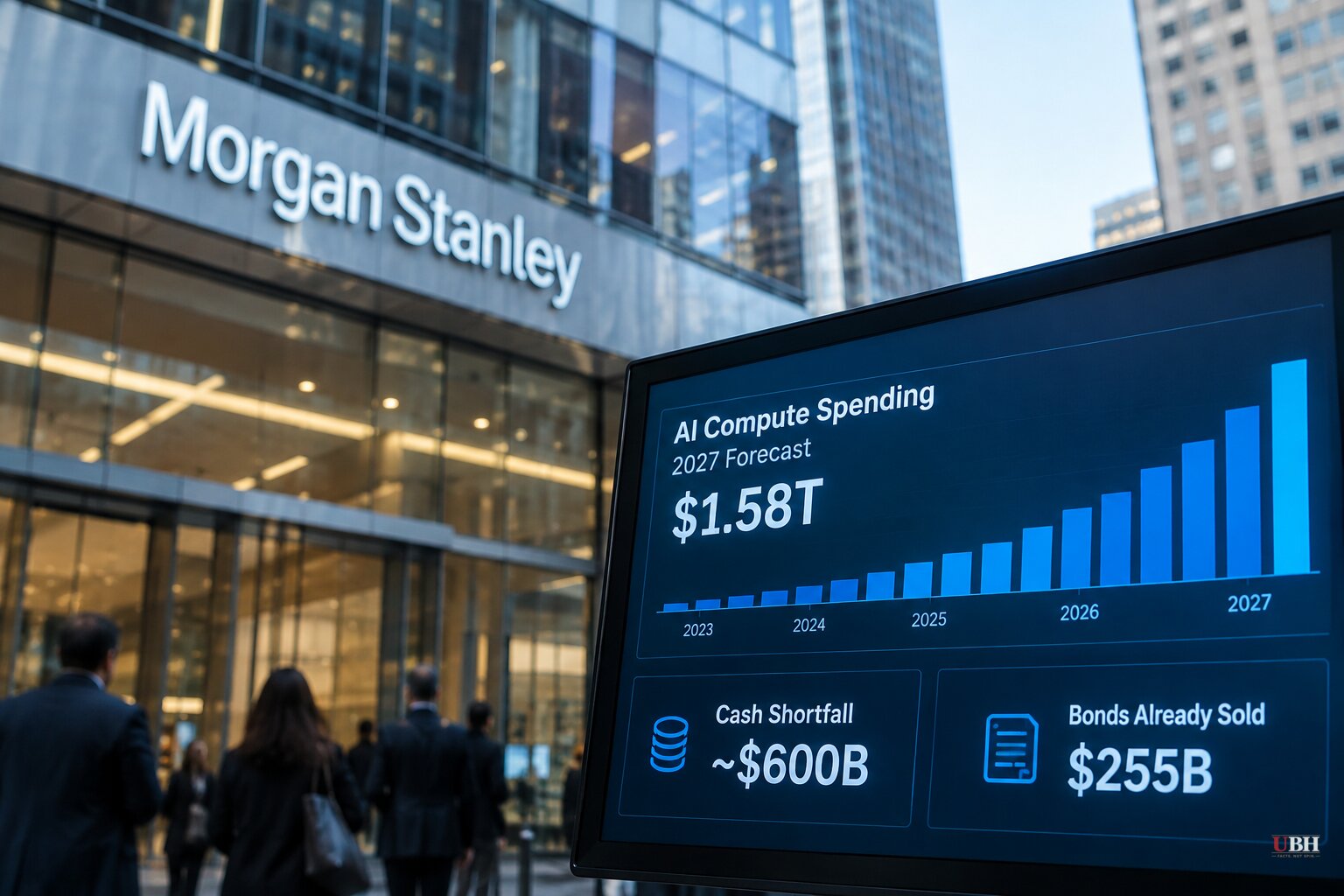
Since Morgan Stanley's Oct. 15 report put 2027 AI compute spending at $1.583 trillion, the details on how that money gets paid for have drawn more attention than the headline number. The bank's answer is mostly debt.
The cash gap
Morgan Stanley expects hyperscalers and neoclouds to post their most negative free cash flow in 2027, with the shortfall approaching $600 billion. The report describes a cumulative gap of roughly $600 billion for the top four hyperscalers through 2028. Those four are Microsoft, Amazon, Alphabet and Meta.
The reasoning is simple. Capex is projected to grow faster than operating cash flow can keep up. Morgan Stanley puts total AI investment at about $980 billion in 2026, $1.58 trillion in 2027 and $1.81 trillion in 2028, with growth slowing after 2027.
The bank also expects about half of 2027 spending to be financed with debt.
Bonds are already carrying the load
Hyperscalers had issued roughly $255 billion in unsecured bonds by mid-October 2026, according to the report. That equals about 30% of projected full-year capex.
Morgan Stanley says high-rated issuers keep ample room. It cites Amazon and Google, each with an interest coverage ratio of about 30.7x, and says that cushion holds even if they take on a potential $400 billion in new debt in 2027.
Lower-rated borrowers get a harsher forecast. The bank expects them to run into tighter financing constraints.
Leases add a layer the cash numbers miss
Part of the $1.58 trillion never shows up as capex. Morgan Stanley's team, led by Nicholas Lentini, counts $195 billion of lease investment in 2027, rising to $246 billion in 2028. That is the reason the new figure sits about 14% above the $1.388 trillion cash-only estimate.
Data-center leases work much like debt-financed purchases, but they stay off the cash flow statement and out of management capex guidance. Lentini's team says traditional forecasts are "increasingly unable to capture the full picture of capital deployment."
Oracle leads 2027 lease spending at $57.2 billion, followed by Microsoft at $45.3 billion and Meta at $37.2 billion. Hyperscalers have disclosed more than $1.1 trillion of lease commitments that have not yet started. That total spans many future years and is not a one-year forecast.
The bank's basket also now includes SpaceX, Oracle, CoreWeave and Nebius. One analysis of Oracle, CoreWeave and Nebius finds the three plan about $152 billion of combined capex against roughly $106 billion of revenue in their respective fiscal years. CoreWeave carries a $104 billion contracted backlog and Nebius $40 billion.
A rough week for chip stocks
On Oct. 15, the PHLX Semiconductor Index fell about 2%. It is down almost 10% over the past week but still up 61% for the year. Nvidia slid about 2%. AMD and Intel each dropped about 4%.
South Korea's KOSPI, which is heavily exposed to memory chips, plunged almost 8% that day and has fallen 18% in five sessions. It is still up almost 30% this year.
Meanwhile the Dow rose more than 400 points, nearly 0.9%, and the S&P 500 was flat above 7,700. The Nasdaq Composite erased most of an intraday slide of as much as 400 points and finished about 0.4% lower. Producer prices posted their sharpest monthly gain since 2022, and the 10-year Treasury yield slipped below 5.1%.
Adam Turnquist, chief cross-asset strategist at LPL Financial, said enthusiasm for the AI cycle "remains intact," but that Korea's concentration in memory leaves it "more vulnerable to competitive threats, positioning unwinds, and shifts in the memory cycle."
Believers and doubters
Hendi Susanto, a portfolio manager at Gabelli Funds, argues the fundamentals are not the problem. "The biggest challenge in AI investing right now isn't the fundamentals," he said. "It is the expectations that are fragile." He pointed to continuing demand for accelerators, chipmaking equipment, memory and networking, and noted that "companies don't commit billions to new fabs unless they see the orders coming."
The positioning data points the other way on risk. Bank of America's October Global Fund Manager Survey showed 37% of managers overweight technology, up from 30% a month earlier and the highest since August 2020. About 45% of respondents expect a full AI bubble by 2027, while 42% disagree.
Returns on the spending are also uneven. JPMorgan raised its growth estimates for Google Cloud and AWS but cut its earnings forecast for Meta.
What the forecast leaves open
Morgan Stanley expects AI-related spending to account for about 24% of S&P 500 revenue growth in 2027, and it still sees Nvidia collecting roughly two-thirds of the inflows, close to $690 billion. Those numbers depend on the borrowing continuing without a break.
Amazon and Google have the coverage to keep issuing. The report does not say how many lower-rated neoclouds and lessees can raise their share of a gap that Morgan Stanley expects to peak in 2027, before spending growth slows to about 14% in 2028.
Sources used for this briefing
7 links from 7 independent newsrooms (syndicated copies of the same report count once)
These are the sources it draws on, linked so you can verify.


