
Unbiased headlines. Facts, not spin.
Unbiased Headlines is an independently owned news organization. We bring you the facts, not opinions, written fresh from 110+ named sources. Sources linked so you can verify it yourself.
 finance
Major Story (8/10)
Event date: October 16, 2026 ·
finance
Major Story (8/10)
Event date: October 16, 2026 ·
CoreWeave Bonds Fall to Distressed Levels and BlackRock Cuts U.S. Stocks as AI Selloff Heads Into Earnings Week
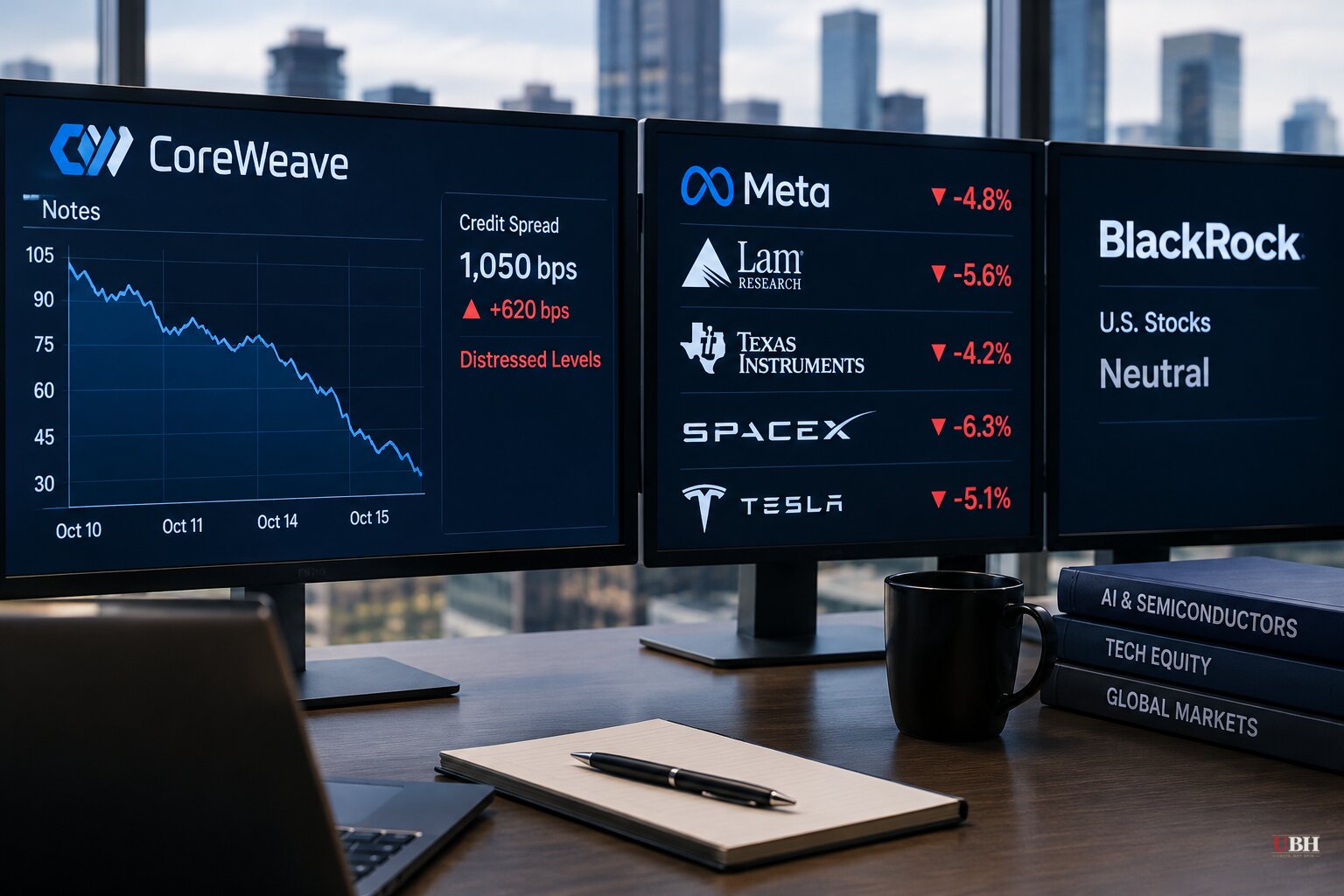
The AI selloff that dragged chip stocks down for at least seven straight sessions has moved beyond equities. It now touches junk bonds, the world's biggest asset manager and the IMF's growth forecasts.
U.S. markets are closed today, Sunday, Oct. 18. They reopen Monday with a heavy slate of earnings ahead.
CoreWeave's debt takes the hit
The sharpest damage is in the credit of AI infrastructure companies. CoreWeave's unsecured notes traded into distressed territory on Oct. 14 and again on Thursday, Oct. 15, according to pricing from S&P IHS cited by credit research firm Octus. Three of its four dollar-denominated notes traded at spreads above 1,000, and some issues changed hands at or below 80 cents on the dollar.
The notes lost about 4 points on Oct. 14. Bids were hit again the next morning, pushing them down roughly 3 more points.
One high-yield investor told Octus that CoreWeave holds the highest-beta position for AI exposure and trades heavily in hedge fund books, both long and short. Another investor said the exodus from the debt was likely triggered by a large exit by a hedge fund. A third said the bonds are pricing in roughly even odds of a bankruptcy event. These are investor opinions, not a finding.
Bonds tied to data centers also fell. Octus named the Jane Street-leased Zenith Arc and CoreWeave-linked Galaxy Helios issues as leaders of the decline.
Reuters reported that CoreWeave carries about $50 billion in debt and that its shares tumbled this week. Octus put the stock's drop at approximately 15.5% on Oct. 14.
The IMF puts numbers on the downside
The IMF's World Economic Outlook, released Oct. 13 at the Bangkok annual meetings, forecasts global growth of 3.1% in 2026 and 3.4% in 2027. It also lays out a downside scenario. A steep drop in AI investment could lead to a sharp fall in asset prices, cutting global GDP by 1.1% by 2028, including a 1.8% drop in U.S. output.
The fund's separate analysis, published Oct. 12, reviewed 14 circular financing deals among AI firms. Since 2023 they involve about $300 billion in equity investment and $650 billion in debt, in exchange for $1.4 trillion in future revenue commitments.
Jason Wu, assistant director of the IMF's Global Markets Analysis Division, said that if there are questions about the monetization of AI, "the equity investments will deplete in value, the debt may be difficult to service, and the revenue commitments in the future may not materialize."
Managing director Kristalina Georgieva told a Bretton Woods Committee event: "We now have an economy that is standing on one leg, the AI leg."
Chief economist Silvana Tenreyro said trade in AI goods grew 29% from 2023 to 2025, against 8.3% for global trade overall. Without it, trade growth would have been only 4.6%.
Money managers start to move
BlackRock said late Monday that it reduced its U.S. stocks recommendation from overweight to neutral for the first time in more than six months because of the risk of AI volatility ahead. It also upgraded Treasuries to lock in income at current yields, with a bias to short-dated paper. The note came from Jean Boivin, Wei Li and Rick Rieder.
They described the move as "managing near-term risk" and said they remain optimistic on AI more broadly. They also pointed to what they see as excessive expectations for Fed rate hikes.
Deutsche Bank strategists said Oct. 9 that the rotation into tech had "run far and the risk-reward no longer looks favorable in the near term." RBC Capital Markets strategists separately pulled back on tech as well.
Broadcom CEO Hock Tan said AI investors knew little about the technology and that their behavior was "casino-like." Samsung and SK Hynix each fell almost 10% on Tuesday.
On Thursday, TSMC CEO C.C. Wei told analysts that rising component prices and macroeconomic uncertainty were challenging demand in some segments. TSMC shares finished 2% lower despite strong earnings.
Neil Wilson, a strategist at Saxo, cited slowing revenue growth at Anthropic and OpenAI as an added worry. Multiple outlets reported that Anthropic told investors at a presentation ahead of its planned IPO that sales grew 45% to $17 billion last quarter, after growth more than doubled in the second quarter.
The damage so far, and the case against panic
A closely watched index of chip stocks is down roughly 20% from its June peak. The S&P 500 had its biggest weekly drop since June, yet it sits only about 2% below the record high set this month. Health care and consumer staples gained on the week.
The bulls have a number to point to. LSEG IBES expects S&P 500 earnings to have grown more than 30% in the third quarter, with massive outlays on AI data centers and infrastructure underpinning the profit jump. Garrett Melson of Natixis Investment Managers Solutions called it an "on-off switch type of market" where AI "sucks all the oxygen out of the room for the rest of the sectors" when it is working.
That same spending is what the IMF flagged. Goldman Sachs expects five hyperscalers to lift combined capital spending to about $1.2 trillion next year.
Next week's tests
Meta leads the hyperscaler reports. Lam Research and Texas Instruments report Wednesday, and SpaceX and Tesla also report. Investors want evidence that returns on AI spending are keeping pace with the outlays.
Macro data adds pressure. Independent analyst Michael Kramer notes the Fed is in its blackout period, so there will be no speeches. He flags Friday's S&P Global flash PMI as a potential bond-market mover, since the September report sent yields soaring. He also points to Japan's CPI and a Bank of Korea meeting, and argues the Korean won's strength has weighed on SK Hynix and Samsung.
Hot inflation data this week boosted bets on another Fed rate increase. If Meta and the chipmakers cannot show profits growing faster than capex, the CoreWeave repricing will be a test of how far that stress spreads.
Sources used for this briefing
6 links from 6 independent newsrooms (syndicated copies of the same report count once)
These are the sources it draws on, linked so you can verify.


