
Unbiased headlines. Facts, not spin.
Unbiased Headlines is an independently owned news organization. We bring you the facts, not opinions, written fresh from 110+ named sources. Sources linked so you can verify it yourself.
 finance
Major Story (7/10)
Event date: October 16, 2026 ·
finance
Major Story (7/10)
Event date: October 16, 2026 ·
Morgan Stanley Projects $1.58 Trillion in 2027 AI Spending, About a Quarter of S&P 500 Sales Growth
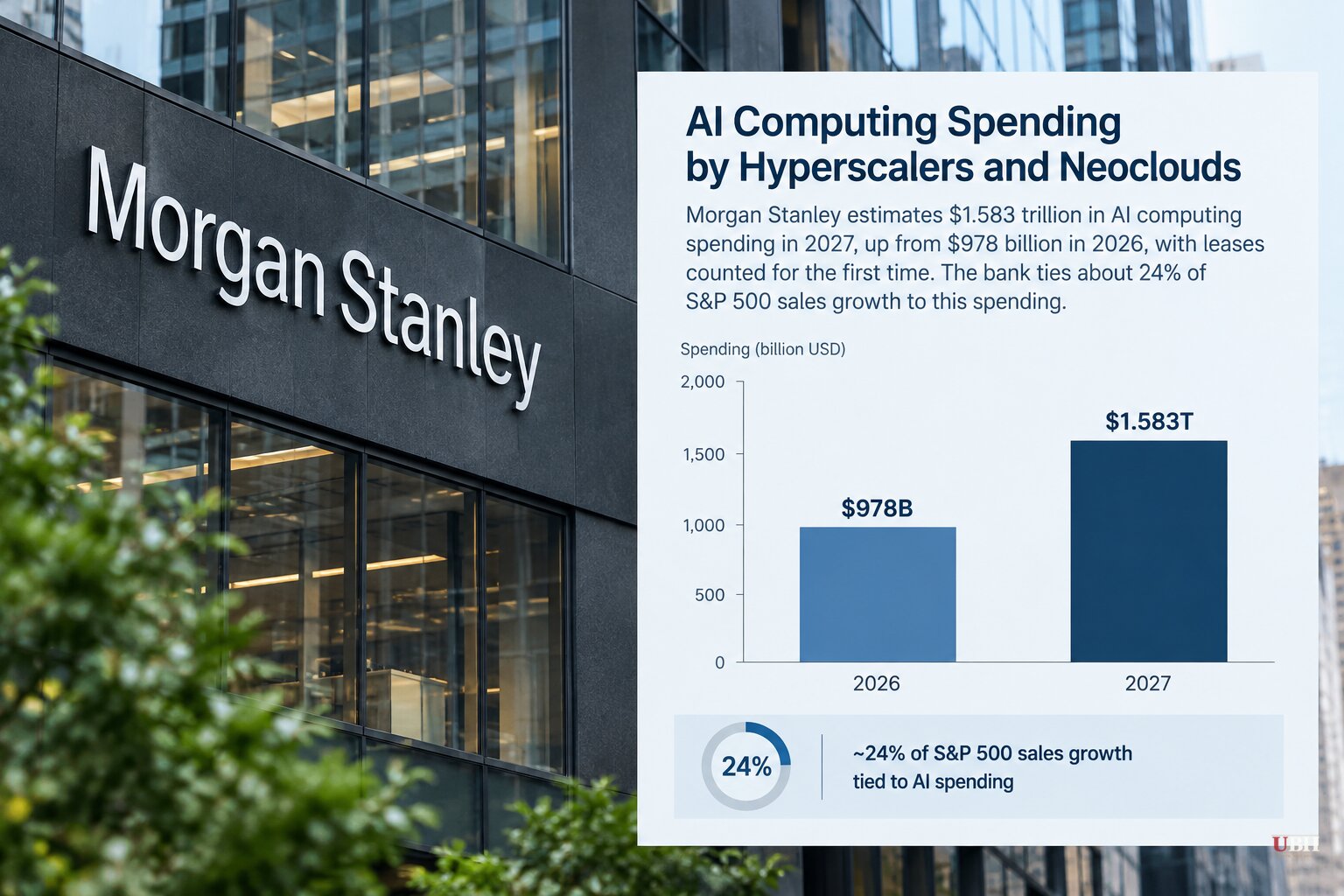
Morgan Stanley now projects that hyperscalers and so-called neocloud providers will spend $1.583 trillion on AI computing in 2027. Its model puts 2026 at $978 billion and 2028 at $1.812 trillion, with the pace of growth slowing after next year.
The total combines $1.388 trillion in cash capital spending with $195 billion in lease investment. Lease spending is projected to reach $246 billion in 2028.
What the number means for the S&P 500
Morgan Stanley estimates that about 65% of the 2027 outlay, roughly $1.029 trillion, lands as supplier revenue at S&P 500 companies. That equals about 4.9% of projected index revenue.
The bank says direct AI investment would add about 2 percentage points to S&P 500 revenue growth, lifting it from roughly 6.6% to 8.6%. That is about 24% of the growth rate, not 24% of total sales.
A separate Morgan Stanley analysis of 42 AI enablers and adopters assigns them about 78% of projected S&P 500 profit growth in 2027 and about 37% of projected net profit. Again, that is a share of growth, not of total earnings.
Goldman Sachs has found the same dependence in recent results: AI-related capital spending has driven nearly half of the S&P 500's latest earnings growth.
Leases and debt
The new figure is bigger than Morgan Stanley's July outlook, which put the five largest U.S. tech companies at nearly $800 billion in 2026, about $1.2 trillion in 2027 and $1.4 trillion in 2028. The two are not directly comparable. The October projection covers more companies, now including Oracle, CoreWeave, Nebius and SpaceX, and counts leased buildout.
Oracle leads on leases at $57.2 billion. Microsoft, Meta, Amazon and Google follow. Hyperscalers hold about $1.118 trillion in signed but unfulfilled lease commitments. That total spans future periods and is not a one-year forecast.
Leases function like debt-financed asset purchases but do not show up as capex, so traditional cash-flow statements can understate the buildout. Morgan Stanley's research says about half of the projected 2027 investment is expected to be debt-financed. It also says high-rated hyperscalers keep substantial borrowing capacity but face free cash flow pressure because the spending is front-loaded.
The bank has separately flagged a $1.5 trillion data center financing gap. It estimates about $200 billion in corporate bonds, $150 billion in ABS and CMBS, and an $800 billion private credit opportunity to fill it.
Chip stocks took a beating this month
The projection landed after a rough stretch for the sector. Over six sessions measured from Oct. 6 closing prices, the Philadelphia Semiconductor Index fell 12%, its longest losing run since May 2025. The slide wiped about $1.6 trillion from a widely watched basket of chip stocks. A 4.3% drop on Wednesday, Oct. 14, was part of it.
Arm fell 21%, Applied Materials 16% and Intel 13%. GlobalFoundries was the only gainer in the group. The Nasdaq 100 dropped more than 2% in a day, its worst since late July, and the S&P 500 fell 1.1%.
The selloff came as a hotter-than-expected September inflation reading raised the risk of further Fed rate hikes. It also followed Broadcom CEO Hock Tan's comparison of some AI-chasing investors to gamblers and his warning that the sector could run into funding constraints.
The bull case and the bubble case
The bull case rests on real revenue. Nvidia posted $75.2 billion in quarterly data center revenue, up 92% from a year earlier. Morgan Stanley's model sends the largest slice of 2027 spending, $672 billion, to semiconductors and servers.
Skeptics say the cash flows will not keep up. Agar Capital, an independent analyst writing on Seeking Alpha, argues that three overlapping bubbles are forming: inflated earnings expectations, interconnected financial risk and concentrated capital. He cites a Gartner estimate that cumulative AI revenue could fall far short of what is needed to justify a 12% return. He says he has sold his semiconductor exposure and holds about 15% in cash. That is one investor's view, not a forecast from a firm.
The macro worry is inflation. Columbia economist Stijn Van Nieuwerburgh, in a Brookings paper, projects AI infrastructure spending of $10.3 trillion through 2032, averaging 3.6% of U.S. GDP per year. Goldman Sachs puts this year's share at 1.9%. JPMorgan expects about $1 trillion in AI infrastructure spending this year.
A buildout that size lands on an economy with low unemployment and strong consumer spending. Prices and rates are already rising because of the energy shock from the wars in Iran and Ukraine and an escalating trade war, in CNN's account of the economists' concerns.
Concentration risk
This is private capital, not federal money. Shareholders and lenders bear the risk of a bad bet, not taxpayers. But when one investment theme supplies about a quarter of an index's sales growth and most of its profit growth, retirement accounts that hold the index are tied to it whether the holders chose that or not.
The near-term test is the Fed's meeting later this month, where officials are expected to weigh the inflation data. The longer-term question is the one Morgan Stanley's own numbers raise: how a projected $1.81 trillion in 2028 spending gets financed when the bank itself already sees a $1.5 trillion funding gap.
Sources used for this briefing
7 links from 6 independent newsrooms (syndicated copies of the same report count once)
These are the sources it draws on, linked so you can verify.


