
Unbiased headlines. Facts, not spin.
Unbiased Headlines is an independently owned news organization. We bring you the facts, not opinions, written fresh from 110+ named sources. Sources linked so you can verify it yourself.
 finance
Major Story (8/10)
Event date: October 16, 2026 ·
finance
Major Story (8/10)
Event date: October 16, 2026 ·
Chip Index Falls Eight Straight Sessions, Down 16% Since Oct. 6, Longest Streak Since 2008
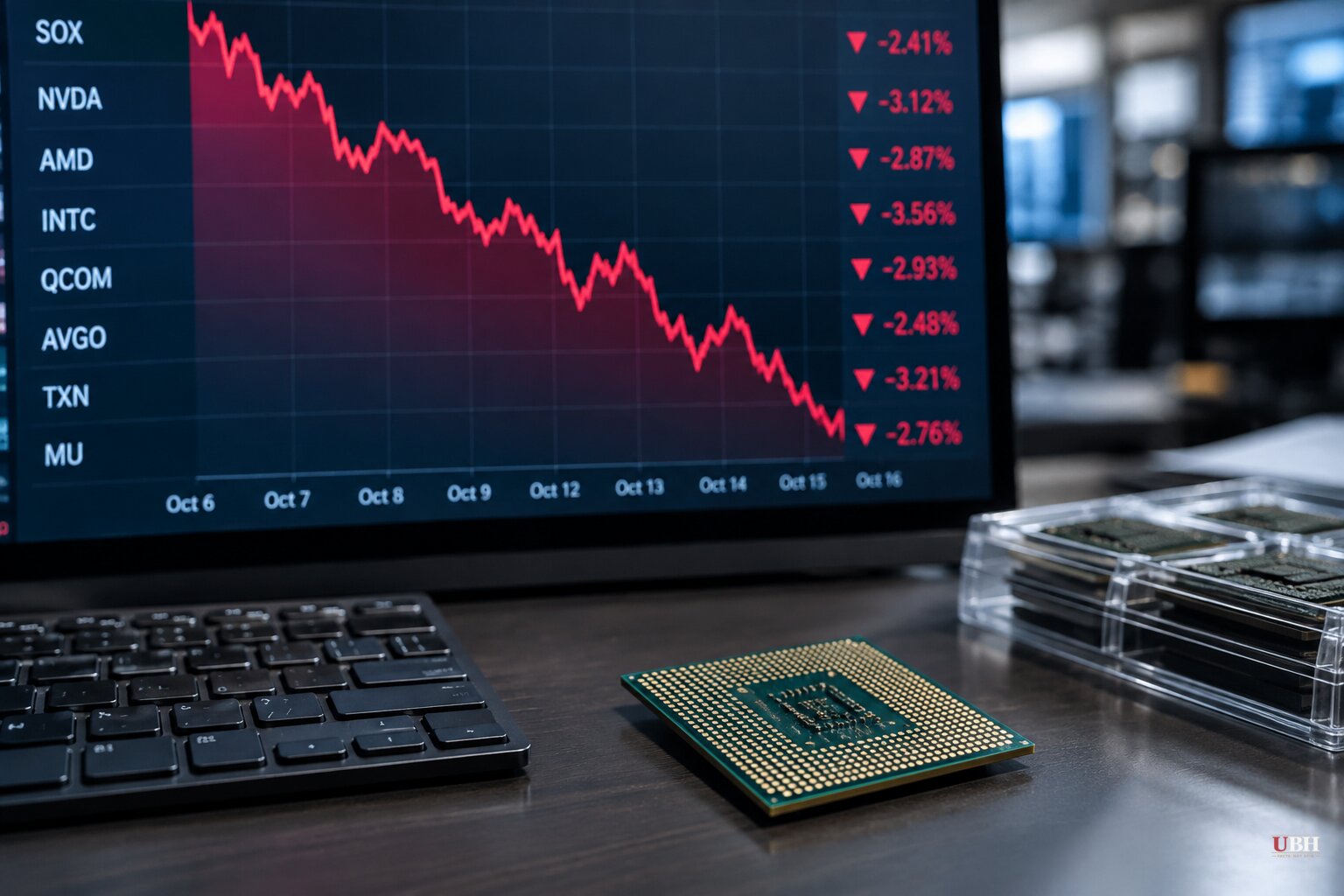
Since the Oct. 6 close, the Philadelphia Semiconductor Index, or SOX, has fallen eight sessions in a row. The streak ended the week at 11,137.29 after a 3.83% drop on Friday, Oct. 16. That is a decline of roughly 16% and the longest run of daily losses since October 2008.
For most of 2026, chips were the best trade on Wall Street. The index was up more than 60% for the year before the slide began. It is now down roughly 20% from its June peak, according to CNN's tally.
How the week unfolded
The worst U.S. day came Wednesday, Oct. 14. A hotter-than-expected September inflation reading reinforced bets on further Federal Reserve rate hikes. The S&P 500 fell 1.1%, and the Nasdaq 100 dropped more than 2% in its worst session since late July. The semiconductor index lost 4.3%.
Over the first six sessions, the index lost about 12%. Bloomberg estimated that its constituents shed roughly $1.6 trillion in market value in that stretch. Arm fell 21%, Applied Materials 16% and Intel 13%. GlobalFoundries was the only gainer among the group tracked.
Thursday brought a brief rotation. The S&P 500 rose 0.33% and the Dow gained 556 points, or 1.08%, as investors moved into health care and Treasuries. The chip index still slipped 0.88% for a seventh loss, after falling as much as 4.4% intraday.
Friday erased the calm. Every one of the index's 30 stocks closed lower, according to Crypto Briefing's session tally. Arm fell about 7%. Broadcom, Micron, AMD, Intel, Lam Research and KLA each shed roughly 5%. The Nasdaq 100 dropped 2.5%.
Asia took the first hit
The overnight damage in Asia was severe. South Korea's KOSPI closed down 7.57% on Thursday, Oct. 15, after circuit breakers triggered, per BigGo Finance's tally of exchange figures. Samsung Electronics fell 9.48% and SK Hynix 11.06%. Japan's Nikkei 225 closed down 4.9%.
TSMC reported earnings Thursday. Khan Capital described the quarter as a record. CEO C.C. Wei still told analysts that rising component prices and macroeconomic uncertainty were challenging demand in some segments. The shares finished 2% lower.
The debt question around CoreWeave
Much of the selling traces to financing rather than orders. CoreWeave, the AI cloud provider that borrows to buy GPUs and leases out the compute, became the focal point. Its shares fell nearly 12% in one session and about 25% over five.
Khan Capital's figures show more than $50 billion of debt and an S&P rating of B+. Its 9.75% notes due 2031 reached a yield to maturity of 15.78%. Five-year credit default swaps touched more than 1,140 basis points before settling near 1,040.
Chipmakers have a stake in that. AI cloud operators buy chips in huge volume, and a meaningful share of the purchasing has been debt-funded. Pricier borrowing could shrink future orders.
CoreWeave CEO Mike Intrator called the market reaction irrational. Khan Capital notes the company's compute is contracted to some of the largest buyers in technology, though it adds that a marginal cost of debt above 15% can become self-fulfilling.
Broadcom CEO Hock Tan added to the unease by likening some AI-chasing investors to gamblers and warning the sector could run into funding constraints.
Doubts about the payoff
Neil Wilson, a strategist at Saxo, wrote that worries about the AI buildout, bubbly valuations, lower-than-expected earnings growth at leading U.S. frontier labs, Chinese competition, inflation and rates "sent investors running for the covers." He pointed to signs of slowing revenue growth at Anthropic and OpenAI. Multiple outlets reported that Anthropic told investors ahead of its planned IPO that sales grew 45% to $17 billion last quarter.
Bank of America strategist Sebastian Raedler framed the risk more bluntly in a note reported Oct. 16. He argued that AI technology can succeed while investors in AI stocks still earn poor returns, as happened with 1870s railroads and 1990s fiber.
Raedler said 12-month forward hyperscaler capex expectations have climbed from $330 billion in early 2025 to $1 trillion, about 3% of U.S. GDP. That compares with 2.2% during the railroad boom and 1.1% during the 1990s tech boom. He also said average token prices have fallen around 50% since the summer.
His conclusion: "This monetization disappointment in the face of intense competition is precisely the failure mode seen in past capital cycles."
BigGo Finance cited JPMorgan research projecting that global cloud capex growth will fall from 97% in 2026 to zero by 2029.
What comes next
U.S. stock markets are closed this weekend and reopen Monday, Oct. 19. The next test is whether the SOX can finally post a green session, and whether CoreWeave's bond yields ease from above 15%.
The Federal Reserve meets later this month. Officials may pause, but a hawkish signal on rates would land on a sector whose buyers are already paying double-digit yields to borrow.
Sources used for this briefing
7 links from 6 independent newsrooms (syndicated copies of the same report count once)
These are the sources it draws on, linked so you can verify.


