
Unbiased headlines. Facts, not spin.
Unbiased Headlines is an independently owned news organization. We bring you the facts, not opinions, written fresh from 110+ named sources. Sources linked so you can verify it yourself.
 finance
Notable (5/10)
Event date: July 1, 2026 ·
finance
Notable (5/10)
Event date: July 1, 2026 ·
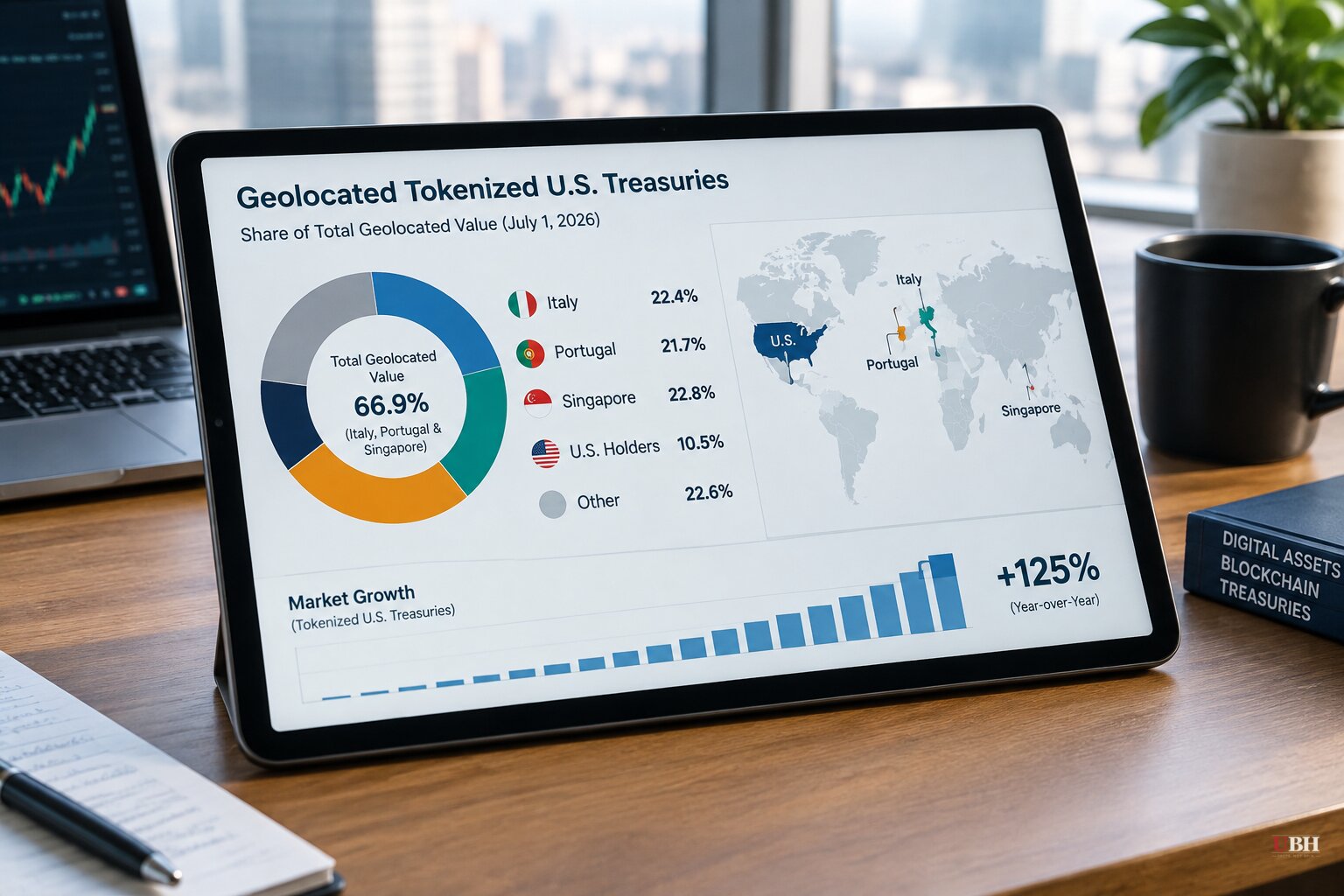
Italy, Portugal and Singapore Held 66.9% of Geolocated Tokenized Treasuries, U.S. Holders 10.5%, Chainalysis Says
The U.S. government issues the debt. On the blockchain version of it, Americans are a minority.
Chainalysis said in its 2026 North America report that holders in Italy, Portugal and Singapore controlled 66.9% of the geolocated value of tokenized U.S. Treasuries as of July 1, 2026. U.S. holders accounted for 10.5%.
The country breakdown
Italy led with 29.9% of geolocated value. Portugal followed at 18.8%, and Singapore at 18.2%.
Japan told a different story. It had the largest share of geolocated holders at 16.4%, yet those holders represented only 0.4% of total value. Lots of wallets, small balances.
The pattern points to a market where a handful of large foreign holders carry most of the dollar value, while the count of holders is spread widely.
A market that doubled
Chainalysis valued tokenized U.S. Treasuries at $15.42 billion, up 125% from $6.86 billion a year earlier.
Treasury products made up 42.8% of the total value of all tokenized real-world assets. That makes them the biggest single piece of the category in the report.
BlackRock's BUIDL fund reclaimed the top spot among tokenized Treasury products in late August 2026.
Not everything grew. Lending activity involving tokenized Treasuries fell 23% over the period, the only real-world-asset lending segment to contract. Other segments held steady or grew.
Why foreign money is showing up
A tokenized Treasury is a blockchain token that gives the holder exposure to U.S. government debt. It can sit in a crypto wallet and move around the clock, rather than sitting inside a brokerage statement.
Chainalysis points to two reasons foreign investors are using it. Tokenization lowers minimum investment thresholds. And it removes the need for overseas investors to open a U.S. brokerage account.
That second point is the crux. An American can already buy Treasury bills or a money-market fund through an ordinary brokerage account. Someone in Lisbon or Singapore may not find that as easy. The tokenized version gives them a dollar-denominated, yield-bearing asset without a U.S. banking relationship.
That is an inference from how the product works, but it matches the reason Chainalysis itself gives: access, not a different underlying asset.
What the 66.9% does and does not measure
The figure applies only to value that Chainalysis could geolocate. Value held in wallets with no identifiable jurisdiction is outside it, so the 10.5% U.S. share is a share of the mapped portion, not of the whole $15.42 billion.
There is a second limit. Wallets that route through custodians, intermediaries or privacy tools can hide the true holder. The mapped slice may skew toward holders using identifiable, regulated venues and away from people using self-custody or offshore structures.
Concentration matters here too. With value this lopsided, one large allocation from a single entity in one of the three countries could move a national percentage by a wide margin. The data does not say whether that is happening.
The Japan numbers show how far holder count and dollar value can diverge. Chainalysis's data describes where balances are located, not how many separate investors stand behind them.
The taxpayer angle
Treasuries are how Washington finances itself, and foreign demand for them is old news. What the report shows is a new route for that demand: a wallet on a public blockchain instead of a U.S. brokerage account.
No regulator or official is cited in the Chainalysis data as raising a concern, and the report describes the trend as an expansion of overseas channels into the Treasury market rather than a risk.
Still open: who sits behind the Italian, Portuguese and Singapore balances, and how much of the remaining value in unmapped wallets belongs to Americans. The July 1 snapshot cannot answer either.
Sources used for this briefing
7 links from 7 independent newsrooms (syndicated copies of the same report count once)
These are the sources it draws on, linked so you can verify.


