
Unbiased headlines. Facts, not spin.
Unbiased Headlines is an independently owned news organization. We bring you the facts, not opinions, written fresh from 110+ named sources. Sources linked so you can verify it yourself.
 finance
Notable (6/10)
Event date: October 13, 2026 ·
finance
Notable (6/10)
Event date: October 13, 2026 ·
BIS Paper Links Higher Bank Deposit Rates to Slower Stablecoin Growth
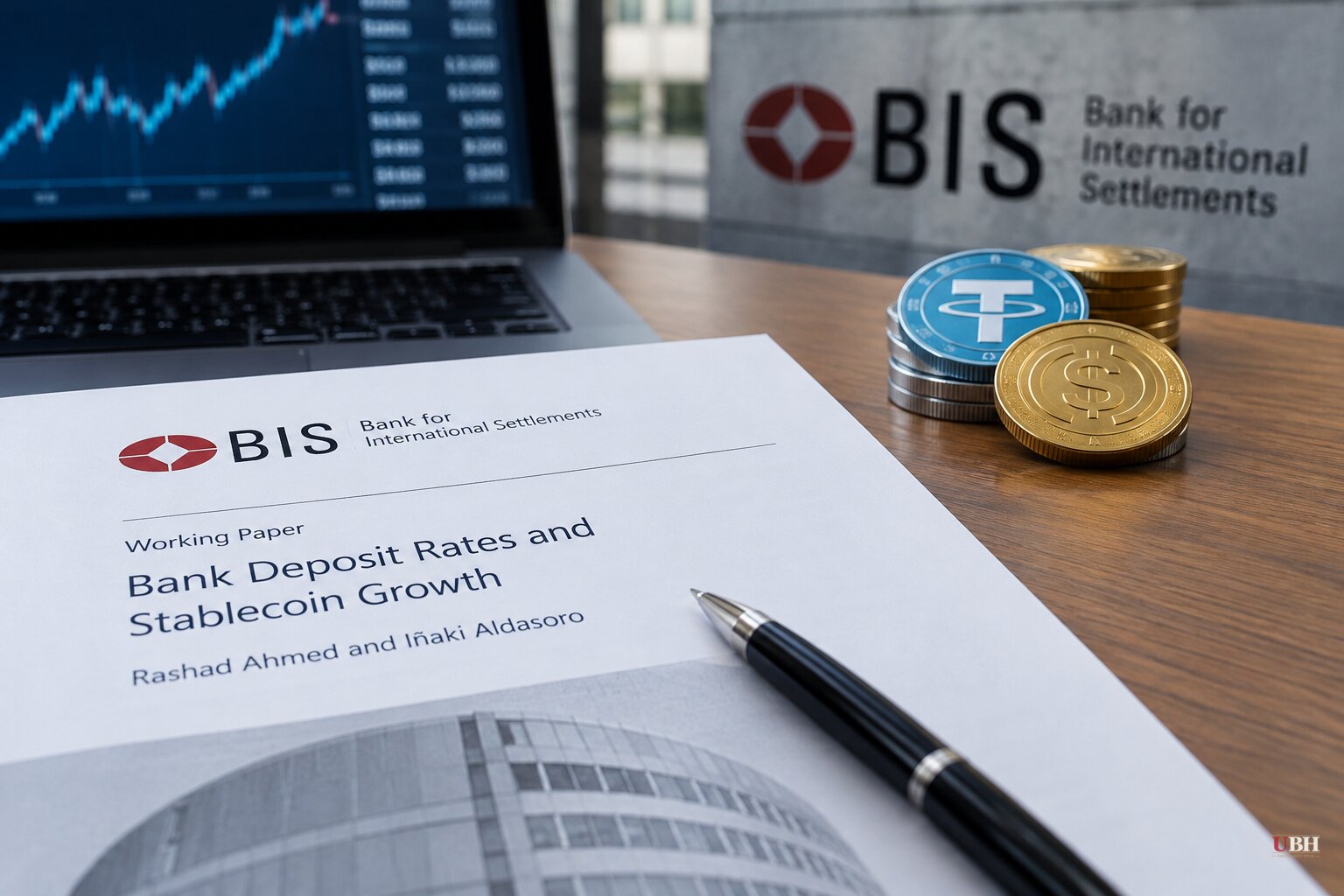
A new Bank for International Settlements study says savers respond to what banks pay them, and stablecoins feel it.
The paper, "Are stablecoins and bank deposits substitutes?", was published October 13, 2026 as BIS Working Paper 1382. Its authors are Rashad Ahmed and Iñaki Aldasoro. An earlier version appeared March 24.
Their answer is a qualified yes. Reserve-backed stablecoins act as partial substitutes for bank deposits.
What the numbers show
The authors used weekly U.S. data from January 2019 through June 2025. Over that span, stablecoin market capitalization grew from under $5 billion to more than $220 billion.
Average growth over a 10-week window in the sample was about 15%.
In the baseline ordinary least squares (OLS) model, a 1 basis point increase in bank deposit rates was associated with roughly 3 percentage points less cumulative stablecoin growth over the next 10 weeks. That is about 12% growth instead of 15%. One basis point is 0.01 percentage points.
The authors' second approach, an instrumental-variable (IV) model, put the effect near 9 percentage points. That would cut 10-week growth to around 6%. The model tries to account for banks raising rates in response to stablecoin growth, rather than the other way around.
In both cases, growth slowed. It did not turn negative.
The deposit-rate measure averages six national savings and money-market deposit-account series. It is not the Federal Reserve's policy rate and not the rate on any single high-yield account.
USDC reacts more than USDT
The effect was not uniform. For USDC, a 1 basis point rise in deposit rates lined up with about 4.8 percentage points less growth over 10 weeks. For USDT, the figure was 1.9.
The authors say the gap fits USDC's closer ties to U.S. institutional and decentralized finance users. USDT, they say, is more tied to offshore and developing-economy use. The data cannot identify which holders switched or which bank accounts were involved, so that explanation is an interpretation of the pattern.
The relationship also held for stablecoins deployed in DeFi protocols. A placebo test using the market cap of other crypto assets found no significant response to deposit rates, which suggests the link is specific to stablecoins rather than a general crypto reaction.
Rates matter more once they rise
The paper points to a nonlinear effect. Bank deposit rates track the federal funds rate more strongly once it climbs above roughly 3%. The IV approach leans on that, using periods when the federal funds target midpoint four weeks earlier was at least 3.125%.
When rates sit near zero, a bank deposit and a stablecoin both pay a saver roughly nothing. Once rates move up, the bank account pays and the typical fiat-backed token generally does not.
The limits the authors flag
The IV estimate comes with a caution. Its first-stage F-statistic was 9.78, slightly under the conventional benchmark of 10 used to judge instrument strength. The authors flagged some weakness in the method.
The paper also does not establish that bank deposits or bank lending fell. It does not show how much money moved directly from deposits into stablecoins. The sample covers a single high-rate episode.
The authors add that the findings may shift as yield-bearing stablecoins and tokenized money market funds gain ground. They conclude that banks "retain some influence over the pace of that adoption through deposit pricing."
The bank-side warning
The paper lands in a live argument. In January, Bank of America CEO Brian Moynihan warned that as much as $6 trillion in deposits could move into stablecoins and related products that offer returns. Moynihan said that could reduce lending capacity and raise borrowing costs.
A December Federal Reserve staff analysis complicates that picture. Money placed in stablecoins can return to banks as issuer deposits, which changes who supplies banks' funding even when total deposits stay flat. Larger, uninsured balances could require banks to hold more liquid assets, leaving less room for long-term loans.
The Fed staff analysis also said paying more to keep customers raises banks' funding costs. It suggested banks could target better rates at customers most likely to switch while holding lower rates for less mobile depositors.
What remains open
The finding cuts both ways for banks. Raising deposit rates appears to slow stablecoin growth, but it also raises their own funding costs. Savers, meanwhile, get paid more when banks compete for their balances.
Whether that lever keeps working is unsettled. If stablecoins and tokenized money market funds start paying holders a return, the comparison the BIS authors measured, interest-bearing deposit versus non-interest-bearing token, no longer applies in the same way. The paper's sample, one high-rate episode ending in June 2025, cannot answer that.
Sources used for this briefing
7 links from 7 independent newsrooms (syndicated copies of the same report count once)
These are the sources it draws on, linked so you can verify.


