
Unbiased headlines. Facts, not spin.
Unbiased Headlines is an independently owned news organization. We bring you the facts, not opinions, written fresh from 110+ named sources. Sources linked so you can verify it yourself.
 finance
Major Story (7/10)
finance
Major Story (7/10)
China's Star50 Is the World's Worst Major Tech Index, Down Nearly 40% as the AI Selloff Spreads
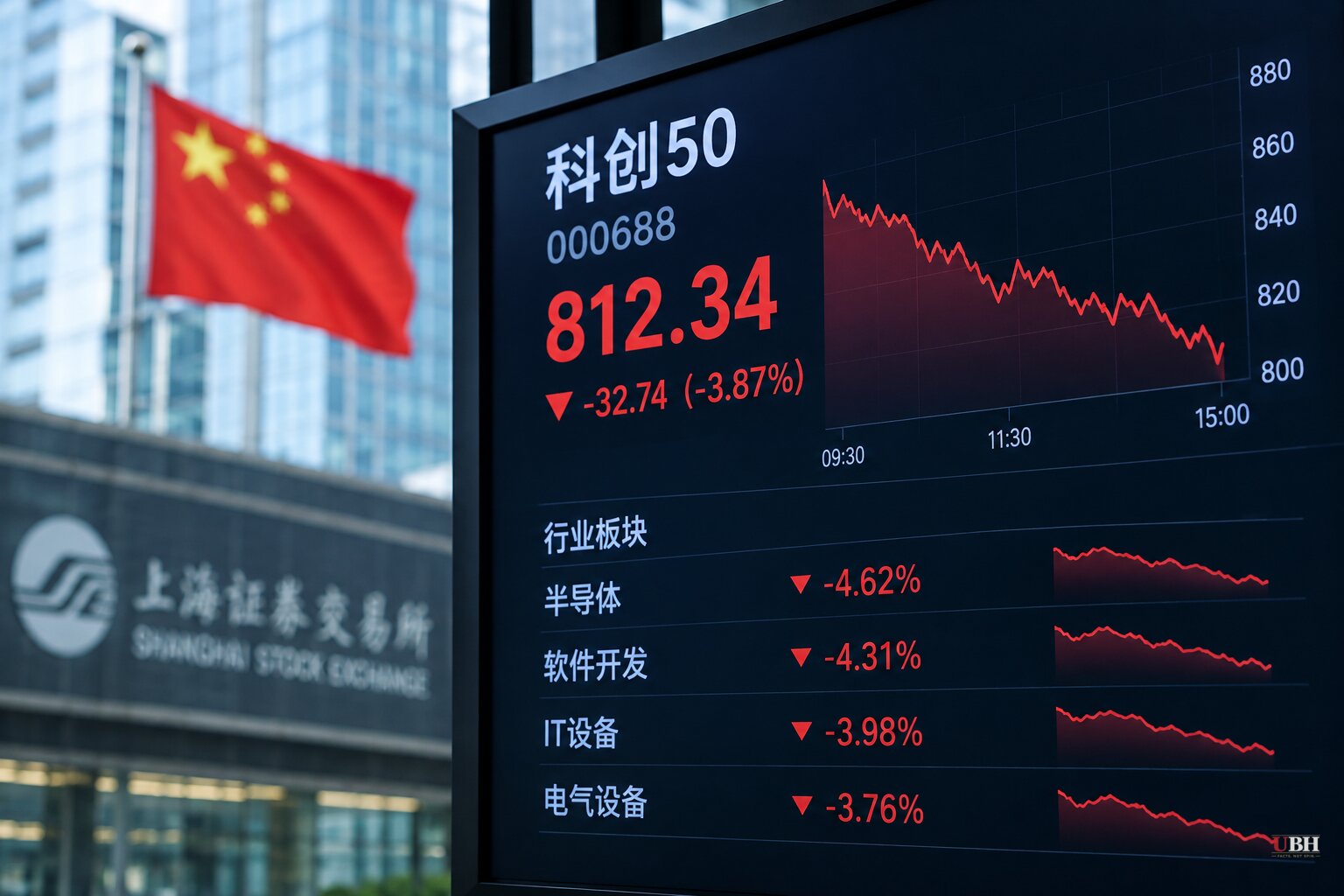
Since the AI-linked selloff dragged the Nasdaq to its worst day since July, the sharpest damage has landed in Shanghai. The Star50 index, China's Nasdaq-style board for tech and innovation, has fallen nearly 40% in the current half year. That makes it the worst-performing major tech gauge anywhere, according to Bloomberg data.
The run-up made the fall steeper. The Star50 surged about 75% between April and June, outpacing Korea's Kospi, on hopes for Chinese technological breakthroughs and strong state backing. At its June 30 peak it traded at more than 80 times forward earnings.
Where the losses are concentrated
Chipmakers MetaX Integrated Circuits Shanghai and Moore Threads Technology have each shed around half their value in the period, Bloomberg's figures show. The ChiNext index, Shenzhen's growth board and also heavy in hardware, is down 36%.
Other names have been hit hard this year. SenseTime, the computer-vision and AI model company, is down about 40%. Kuaishou, the short-video platform pushing into AI tools, has fallen 51%.
Recent listings have not been spared. Memory-chip maker CXMT, which went public in July, is 27% below its post-listing peak. Robotics firm Yushu Technology has lost around 50% from its August high shortly after its IPO.
Chinese companies have raised a combined $37 billion from onshore IPOs this year, the highest annual total in three years. Tech firms accounted for more than a third of it.
The money leaving
Foreign investors are a large part of the story. Outflows through the trading link between Hong Kong and the mainland totaled an estimated 90 billion yuan ($13.5 billion) in the third quarter. That was the biggest in a year and reversed more than half of the inflows from April to June, according to Bloomberg Intelligence analysts Jason Liao and Marvin Chen.
"The global AI-hardware selloff, spanning the Nasdaq and Korea, hit China A-shares hardest after foreign investors crowded into the sector in 2Q," Liao and Chen wrote.
The U.S. side of the slide is well documented. CNN reported that the chip index fell for a seventh straight session Thursday and is down roughly 20% from its June peak. Saxo strategist Neil Wilson cited worries about the AI buildout, bubbly valuations, Chinese competition, inflation and rates. TSMC CEO C.C. Wei told analysts on Thursday's earnings call that rising component prices and macroeconomic uncertainty were weighing on demand in some segments.
Two Chinese tech sectors
Not every Chinese tech stock is falling. A Bloomberg gauge of 30 Chinese tech companies with heavy overseas revenue has climbed 36% in 2026. Domestically focused peers gained just 9%.
Optical transceiver makers, which build the parts that move data between servers in AI data centers, are the clearest example. Some reported that 90% to 96% of their revenue came from overseas earlier this year.
The split tracks where the customers are. Firms tied to the global data center buildout are riding spending decisions made outside China. Domestic chip and AI names face a crowded home market, with many companies chasing the same customers, plus weaker results from some major chipmakers and domestically oriented firms.
Beijing's position, and the funding question
The selloff comes as Chinese AI itself is gaining ground. Bloomberg reports that startups such as Moonshot AI, with its Kimi K3, and DeepSeek have narrowed the gap with U.S. leaders this summer. Their pricing is lower, and many release model weights openly.
Beijing is now moving to rein that in. China's Commerce Ministry proposed adding 23 AI technologies to its export-control list, including large language models, agents, chip designs and computing clusters. The draft would restrict model weights and source code for models with at least 2 trillion parameters, or ranking among the world's top 10 on performance, usage and safety.
A ministry spokesperson said the aim is "the safety and controllability" of AI, citing the risk of misuse against critical infrastructure, defense industries and core government systems. "The Chinese government's necessary management of these technologies aims to solidify the security baseline, prevent misuse and abuse, ensure that AI remains under human control, and promote international governance of AI," the spokesperson said.
The draft lands in an industry already dealing with content controls, a licensing regime and potential U.S. sanctions.
The bigger worry for Beijing is funding. Chinese companies lean more heavily on equity financing than their U.S. peers. Leonid Mironov, a portfolio manager at Gavekal Capital, said the stakes rise the longer this lasts: "It would be much harder for China to achieve its AI ambitions if technology stocks remain under pressure for an extended period. If the weakness goes on for more than six months, this will make fundraising difficult and also imply that the market is unimpressed with the technological progress being achieved."
The Star50's April-to-June gain was large enough that part of the drop is a round trip from stretched prices. Whether the third-quarter outflows continue will matter most. If they do, the six-month mark Mironov flagged arrives in the first quarter of 2027.
Sources used for this briefing
7 links from 7 independent newsrooms (syndicated copies of the same report count once)
These are the sources it draws on, linked so you can verify.


