
Unbiased headlines. Facts, not spin.
Unbiased Headlines is an independently owned news organization. We bring you the facts, not opinions, written fresh from 110+ named sources. Sources linked so you can verify it yourself.
 finance
Major Story (7/10)
Event date: October 16, 2026 ·
finance
Major Story (7/10)
Event date: October 16, 2026 ·
CoreWeave Bond Yields Hit 15% as Credit Costs Climb for AI Buildout
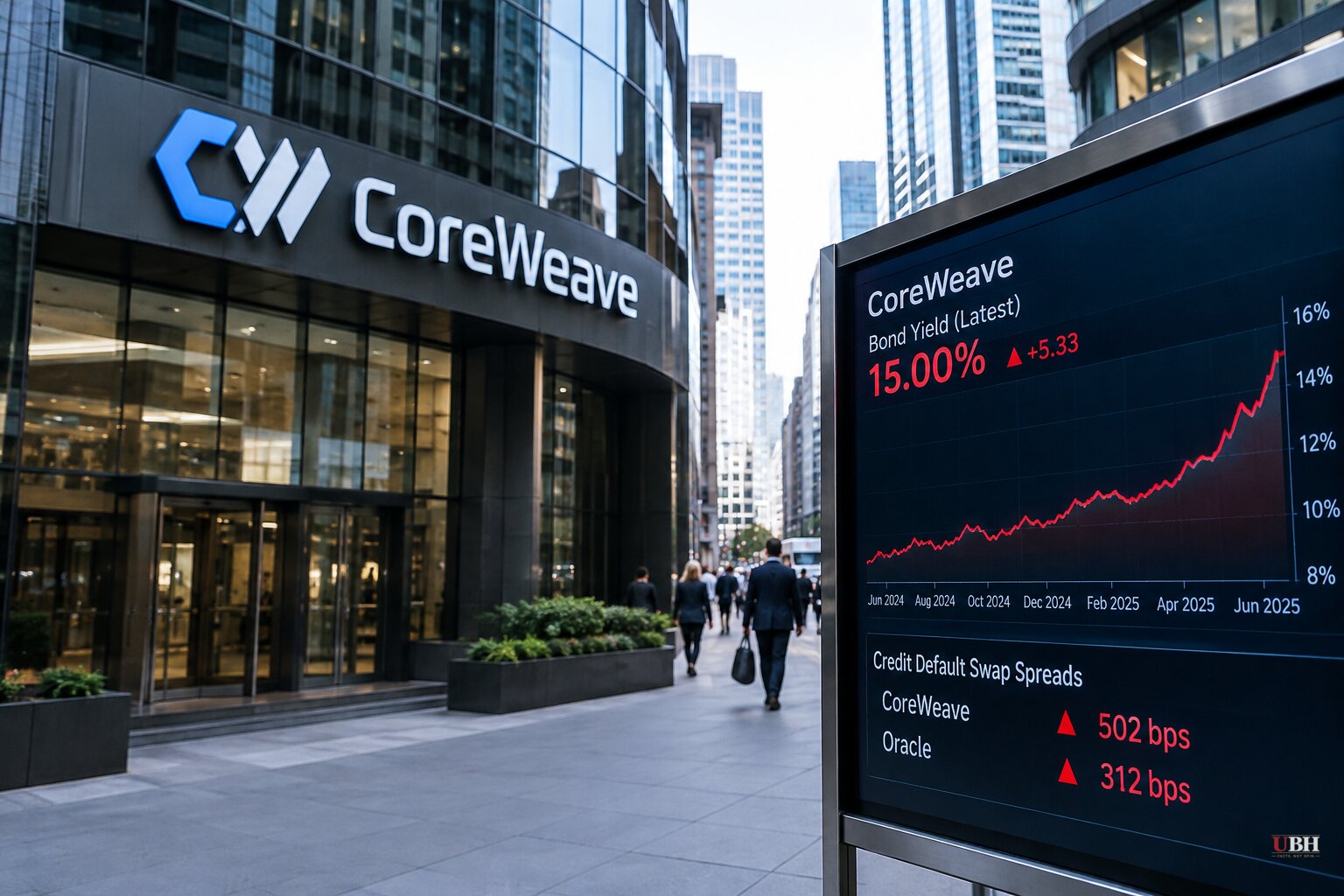
The AI boom runs on borrowed money, and the price of that money jumped this week.
Bonds that CoreWeave issued in June at a yield of 9.675% have fallen sharply in value, pushing their yield to 15% this week, according to Reuters reporting from Oct. 16. Jefferies puts the yield on CoreWeave's bond maturing in 2032 at 14.8%.
CoreWeave runs data centers for AI customers. It depends heavily on outside financing to buy chips and build capacity.
The credit signal
Christopher Wood of Jefferies flagged the move in a research note titled "K-shaped stresses, AI tremors and the Houthis." He told investors to keep a "laser focus" on credit spreads.
The numbers are stark. CoreWeave's five-year credit default swap spread rose from 749 basis points on Sept. 11 to 1,118. Oracle's rose from 186 to 288. Jefferies says both are the highest since the AI capital-spending cycle began in early 2023.
A CDS spread is the price of insuring against default. Higher means lenders want more compensation for the risk.
Max Frumes, global head of distressed and leveraged finance at credit data firm 9fin, called CoreWeave "absolutely the canary in the coal mine." He said this is "going to be a turning point in the pricing and availability and structure of credit that's supporting the AI boom," and expects other AI-linked debt to follow CoreWeave into distressed territory.
John Han, a portfolio manager at F/m Investments, said his firm is "taking another look at our exposures across the AI infrastructure space." F/m holds CoreWeave's unsecured bonds in one ETF only because they sit in the index it tracks.
Stocks follow
CoreWeave shares fell 15.1% from Monday's open through Thursday's close, even after a 6% jump Thursday following a vote of confidence from partner Nvidia. Other so-called neocloud companies such as Nebius and Iren fell by a similar amount.
The wider chip sector is under pressure too. The chip index fell 0.88% Thursday, its seventh straight daily drop. It dropped as much as 4.4% during the session. It is down roughly 20% from its June peak.
The S&P 500 and Nasdaq had their worst day since July on Wednesday. On Thursday the S&P 500 finished up 0.33%, the Dow gained 556 points (1.08%) and the Nasdaq edged up 0.08%. Treasury yields dropped sharply as investors moved into bonds.
TSMC CEO C.C. Wei told analysts Thursday that rising component prices and macroeconomic uncertainty are challenging demand in some segments. TSMC shares closed 2% lower despite strong earnings.
Neil Wilson, a strategist at Saxo, listed the worries in a note: AI buildout costs, "bubbly valuations," lower-than-expected earnings growth at leading U.S. frontier labs, Chinese competition, inflation and rates. Multiple outlets reported that Anthropic told investors ahead of its planned IPO that quarterly sales grew 45% to $17 billion. Wilson said signs of slower revenue growth at Anthropic and OpenAI added to the concern.
Slowing earnings, high prices
Jefferies also expects earnings growth for AI stocks in the MSCI AC World Index to fall from about 100% in 2026 to 30% in 2027 and 22% in 2028. Non-AI stocks are forecast at 16% this year and 9% in each of the next two.
AI stocks trade at 23 times forward earnings on an equal-weighted basis. Non-AI stocks trade at 13 times.
Jefferies recommends diversifying beyond AI. "One thing is clear. The easy money has long since been made in the semiconductor stocks," the firm wrote.
The concentration is heavy in emerging markets. TSMC, Samsung Electronics and SK Hynix together make up 28.5% of the MSCI Emerging Markets benchmark.
The case that this is an overreaction
Not everyone reads the bond move as a turning point. Larry Holzenthaler, senior portfolio manager of fixed income at Catalyst Funds, told Reuters the market is seeing an overreaction as sentiment swings from "overly upbeat to downright bearish." He said investors are singling out the most leveraged borrowers in tougher operating conditions.
The Jefferies note does not say AI funding has dried up. It frames rising spreads as an early warning, not a shutdown.
What the central bankers say
Fed Chairman Kevin Warsh took up the larger question Friday in a conversation with IMF Managing Director Kristalina Georgieva. He called AI "probably the most consequential change to the U.S. and the global economy in my lifetime."
Warsh said AI hits the demand side of the economy before the supply side, which central bankers must treat as a shock. He still believes it is a positive supply shock in the medium term. He said the path there is "likely to be a very bumpy one" and that nobody knows its effect on employment over the next 12 to 18 months.
Georgieva was more cautious, speaking at the IMF and World Bank annual meetings in Bangkok. "If there are no safeguards, then the risks may exceed the opportunities," she said. She added that "we do need an ethical foundation, and I'm not sure we are there as a society."
What to watch
Jefferies says investors should watch credit spreads for signs that markets are becoming less willing to finance the AI capital-spending boom. Anthropic's planned IPO, which is expected in the near future, will be the next large test of whether investors still pay premium prices for AI growth while lenders demand 15% to finance it.
Sources used for this briefing
6 links from 6 independent newsrooms (syndicated copies of the same report count once)
These are the sources it draws on, linked so you can verify.


