
Unbiased headlines. Facts, not spin.
Unbiased Headlines is an independently owned news organization. We bring you the facts, not opinions, written fresh from 110+ named sources. Sources linked so you can verify it yourself.
 finance
Notable (5/10)
finance
Notable (5/10)
Berkshire Class A Closes at $798,000, Highest Since Buffett Announced His Exit, in a Down Market
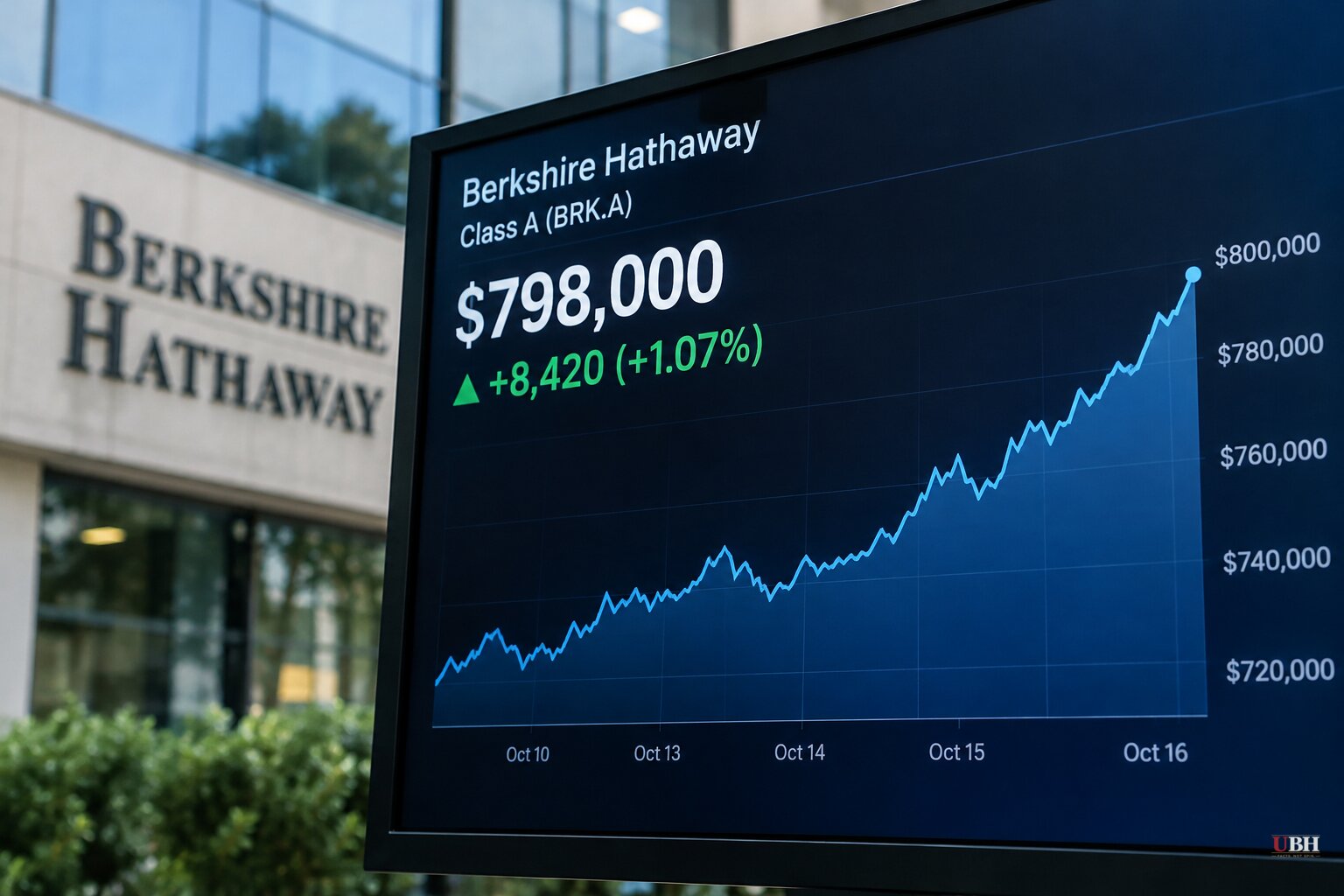
Berkshire Hathaway's Class A shares closed Friday, Oct. 16, at $798,000. That is the highest close since Warren Buffett told shareholders at the May 2025 annual meeting that he planned to step down as CEO at the end of that year.
The stock rose more than 1% on a day the broader market sold off. The Class B shares finished at $532.02.
Both share classes remain 1.4% short of their all-time closing highs: $809,350 for the A shares and $539.80 for the B shares. Both records were set the day before Buffett's announcement.
From the post-announcement slide to Friday
After Buffett's announcement, both classes lost more than 14% over three months. Investors worried that a "Buffett premium" built into the stock was dissolving. The low came in August 2025.
The recovery since then has not been smooth. The A shares dipped into the low $700,000s this summer after a peak on Aug. 10, according to 24/7 Wall St.
A 10-session winning streak that added 5% to Berkshire's share prices ended with a loss on Thursday. Friday's gain of more than 1% resumed the climb.
Berkshire is still behind the market. The B shares trail the S&P 500 by 6.0 percentage points for the year. That gap was 17.5 points on June 1, so it has shrunk by almost two-thirds.
What is lifting the stock
Keefe, Bruyette & Woods analyst Meyer Shields says higher short-term interest rates are helping. Berkshire holds roughly $360 billion in cash, and higher rates mean it earns more on that money, he said.
A quiet hurricane season so far has helped the insurance operations.
Higher oil prices help the stake in Chevron, valued at about $19 billion. Chevron closed Friday at an all-time high after gaining almost 36% since the start of July. Berkshire's energy-related subsidiaries are also getting a tailwind.
Coca-Cola also closed at a record, and is up 34% year to date. Berkshire's holding is now worth $37.6 billion, up $2.4 billion in a week. That passed Alphabet and made it the third-largest stake in the portfolio. The shares may have had a lift from KFC's switch from Pepsi to Coke.
Investors have also been rotating out of high-flying AI and tech names and into older-economy companies. Berkshire may be benefiting from that shift.
Abel is spending some of the cash
Under CEO Greg Abel, Berkshire bought back $4.5 billion of its own stock in the second quarter. It has also taken positions in Alphabet, Taylor Morrison Home, Lennar and Bending Spoons. It has not bought Lennar shares since Oct. 2.
CNBC Pro suggests investors may welcome the cash being put to work. The cash pile is still huge, which that analysis calls "a good symbol of continued patience under the new CEO."
The Bending Spoons bet
The most unusual purchase is Bending Spoons, an Italian company that began trading on Nasdaq in July. It buys internet businesses such as AOL, Evernote and Vimeo, uses AI to cut costs, and puts the savings into more acquisitions.
The stock trades at a high earnings multiple, which is not typical for a Berkshire value investment.
Bending Spoons said Berkshire invested $600 million in the IPO. In a release before Wednesday's open, it disclosed a further $330 million. Berkshire will buy 10 million newly issued shares at $33 each in a private placement.
Tuesday's close was $37.86. Bending Spoons shares reached $58.56 intraday Wednesday and closed at $53.46, up 41%. They gave back some of that in Friday's tech sell-off and ended at $47.07, which is 42.6% above Berkshire's latest purchase price.
CNBC estimates that if Berkshire bought its IPO shares at the $29 offering price, its roughly $930 million total outlay is worth more than $1.4 billion at Friday's close. That is a paper gain on a stock that has swung widely in four sessions.
The open question
The worry that followed Buffett's announcement was that the stock would lose a premium once he left. The share price has now recovered nearly all of that drop. Whether it reflects the premium surviving or simply a strong run in oil, rates, insurance and old-economy stocks is not settled by one Friday close.
The lag against the S&P 500 also shows the stock has not outrun the index this year.
When U.S. markets reopen Monday, Oct. 19, the Class A shares need a gain of about 1.4% to match their record close of $809,350.
Sources used for this briefing
7 links from 6 independent newsrooms (syndicated copies of the same report count once)
These are the sources it draws on, linked so you can verify.


