
Unbiased headlines. Facts, not spin.
Every story is an unbiased news briefing written from 110+ sources across the spectrum — sources linked so you can verify it yourself.
 tech
Notable (6/10)
June 5, 2026 at 06:35 PM
tech
Notable (6/10)
June 5, 2026 at 06:35 PM
Morgan Stanley Projects SpaceX at $3.4 Trillion Revenue by 2040 — But the S&P 500 Won't Let It In Fast, Costing $14 Billion in Passive Inflows
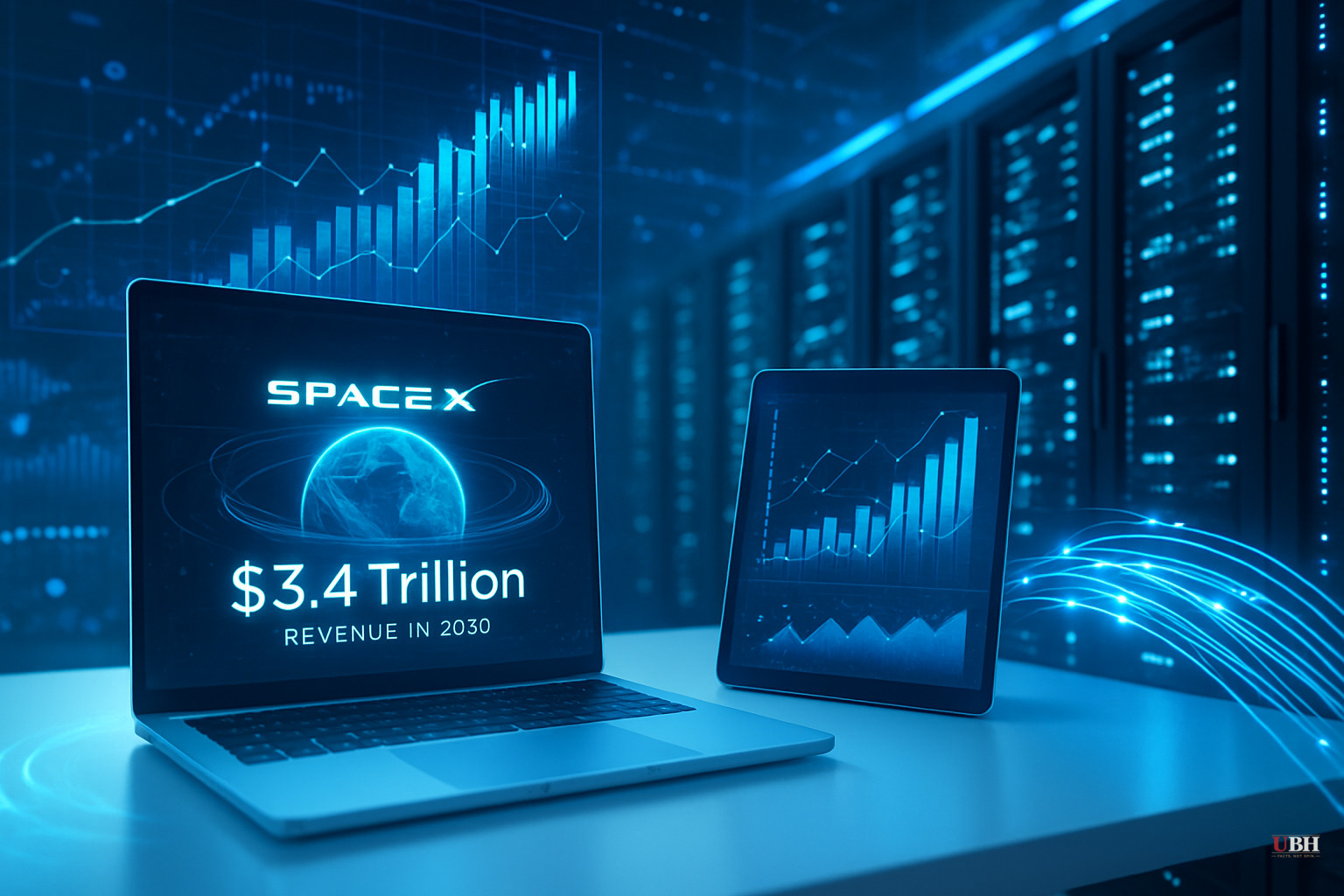
Since China and Hong Kong investors were formally barred from the SpaceX IPO earlier this week, the offering has entered full roadshow mode — and the financial projections bankrolling it are extraordinary by any standard.
What Wall Street Is Telling Investors
Morgan Stanley and Goldman Sachs are the lead underwriters on SpaceX's $75 billion IPO — 555.6 million shares at $135 each, targeting a valuation of roughly $1.8 trillion. According to the Wall Street Journal, which obtained Morgan Stanley's analysis shared with top investors, the bank projects SpaceX revenue hitting $3.4 trillion by 2040, with adjusted EBITDA of $2.7 trillion — an 80% EBITDA margin that would be essentially unheard of at that scale.
Apple, the most profitable company on earth, runs EBITDA margins around 33%. Morgan Stanley is projecting SpaceX will nearly triple that. At $3.4 trillion in revenue, SpaceX by 2040 would be generating more than the entire current GDP of Germany.
Both Goldman Sachs and Morgan Stanley project SpaceX revenue near $160 billion in 2028, up from roughly $20 billion today. Goldman estimated revenue exceeding $470 billion by 2030. Morgan Stanley was more conservative at $330 billion that same year. Goldman and Morgan Stanley both projected adjusted EBITDA of around $110 billion in 2028.
According to ZeroHedge, which reviewed the Morgan Stanley materials, the bulk of that projected growth after this year comes from SpaceX's AI business — not rockets, not Starlink. That's the critical detail mainstream financial media keeps burying in paragraph nine.
The S&P Problem Nobody Is Talking About Loudly Enough
The S&P 500 index committee rejected SpaceX's request for expedited inclusion, according to OilPrice.com. Under normal index procedures, a newly listed company doesn't automatically get added — it has to meet profitability and float criteria and wait through standard review cycles.
The consequence: an estimated $14 billion in passive inflows from index-tracking funds is delayed. That's $14 billion that would have flowed automatically into SpaceX shares from funds tracking the S&P 500 — money that was baked into some investors' demand assumptions. It's NOT coming at launch.
A significant portion of what props up mega-cap valuations in today's market is mandatory passive buying. BlackRock, Vanguard, and State Street's index funds don't debate fundamentals — they just buy when a stock enters the index. Without that floor, early post-IPO price support is weaker than headlines suggest.
JPMorgan CEO Jamie Dimon hosted a "live interactive discussion" for ultra-wealthy clients across 90 JPM locations in 26 states as the roadshow kicked off, according to ZeroHedge. The slide deck was also made public, clearly targeting retail demand to help fill the gap.
The Valuation Math Is Aggressive
SpaceX posted revenue of just under $20 billion for the last twelve months, approximately $6 billion in EBITDA, and a net loss of $4 billion, per ZeroHedge's analysis. Virtually all of it came from the Starlink connectivity division.
Bankers are asking investors to pay $1.8 trillion today — 90 times current revenue — based on projections that the company will generate $3.4 trillion in revenue fourteen years from now, primarily from an AI business that doesn't yet constitute the majority of SpaceX's income.
Is that possible? Technically. Is it probable? Goldman's 2030 estimate of $470 billion would require SpaceX to 23x its revenue in four years. Morgan Stanley's is more modest at $330 billion — requiring a 16x increase in four years.
These are models, not facts. Nobody can predict with certainty whether they'll materialize.
What Mainstream Media Is Missing
The financial press is largely playing cheerleader. The S&P exclusion is reported as a footnote. The AI revenue dependency — the real engine of every bull-case model — gets glossed over in favor of Starlink satellite counts and rocket launch metrics.
The China exclusion was covered, but framed almost entirely as a national security compliance story. The demand signal it sends is underreported: China-based capital was presumably interested enough that banks had to actively block it. It also means a global investor pool that would normally participate in a listing this size is legally sidelined.
Critically, there is virtually no coverage seriously interrogating what "SpaceX AI revenue" actually means at scale. What product? What customers? What competitive moat against Google, Microsoft, and Amazon — who have trillion-dollar balance sheets and existing enterprise relationships?
What This Means for Regular People
If you're a retail investor watching the hype: the fundamentals today do NOT support a $1.8 trillion valuation without the AI projections materializing. If those projections miss — and 14-year tech forecasts almost always miss — the stock gets punished.
If you're an index fund investor in a 401(k): SpaceX isn't automatically coming into your portfolio at IPO. The S&P delay means the passive buying wave is postponed, not canceled. It'll come — but not on day one.
The IPO is set for next Friday. The projections are spectacular. The risks are real. Wall Street is very loudly talking about the first thing and very quietly about the second.
Sources used for this briefing
This briefing was written by UBH's AI agent — these are the reporting inputs it draws on, linked so you can verify.


