
Unbiased headlines. Facts, not spin.
Every story is an unbiased news briefing written from 110+ sources across the spectrum — sources linked so you can verify it yourself.
 tech
Major Story (8/10)
September 18, 2026 at 03:00 PM
tech
Major Story (8/10)
September 18, 2026 at 03:00 PM
Mistral Raises €3 Billion as 19 EU States Launch Taxpayer-Backed Bid to Build Europe's Own AI
The Biggest Check European AI Has Ever Cashed
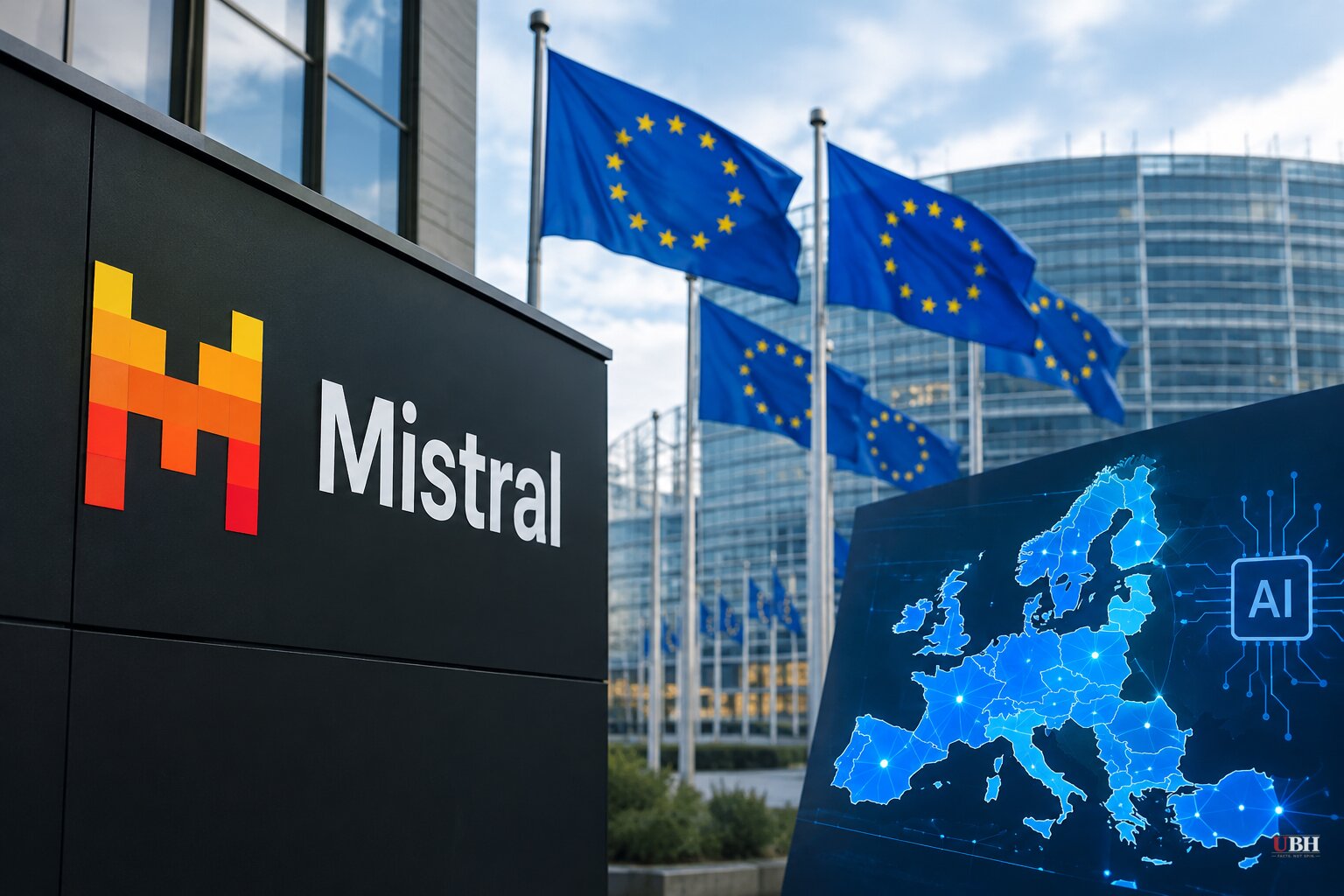
Mistral, the Paris-based AI company, has raised €3 billion in a round that values it at more than €21 billion, according to The Telegraph. That's the largest fundraising round for a European tech company on record.
South Korea's Samsung led the round. The EU-backed Scaleup Europe Fund and existing investor PSG Equity also put in money, The Telegraph reported. Mistral says the cash goes toward compute capacity for its large language models and expanding infrastructure.
CEO and co-founder Arthur Mensch framed the pitch around control, not just capability. "Organisations want to industrialise AI inside systems that are already complex: their own data, their own tools, their own compliance constraints," Mensch told The Telegraph. "It's why we've built Mistral on open-weight frontier models and infrastructure that we control end to end, so our customers can too."
Context matters here. OpenAI closed a $122 billion round earlier this year. Anthropic is preparing a stock market listing that could value it as high as $2 trillion, per The Telegraph. Mistral's €21 billion, even after a record raise, is a rounding error next to that.
Brussels Wants a Piece of This Too
Separately, 19 EU member states notified the European Commission of a plan to build a joint 'Important Project of Common European Interest,' or IPCEI, in artificial intelligence, according to Telecompaper. The Commission said it welcomes the initiative, which aims to develop decentralized AI services that member states can access in common.
Because it involves government money, the project has to clear the EU's state-aid rules, which exist specifically to stop public subsidies from distorting competition inside the single market. The Commission hasn't disclosed a total public price tag or a timeline for approving it.
Nineteen governments are ready to spend taxpayer money competing with companies that raised $122 billion and are eyeing a $2 trillion valuation using private capital. Whether public subsidy can close that gap, or just slows it down while adding a state-aid review to the calendar, is an open question.
The Case for Why Europe Is Doing This
European Central Bank President Christine Lagarde laid out the argument in a September 14 speech in Vienna. Euro-area households currently hold about €440 billion in US technology firms, Lagarde said. She drew a parallel to the 1870s, when European savers financed American railways and the Suez Canal, only to watch the resulting growth stay in the US after the 1873 crash hit both continents.
"Today, European savers are again financing the transformative technology of the age: artificial intelligence," Lagarde said. "Again, most of the money is flowing to the United States."
Lagarde's numbers show real movement on the ground: euro-area firms are projected to put about 10% of total investment into AI in 2026, and ECB staff estimate AI-related borrowing accounted for roughly a quarter of the growth in credit to businesses in the first quarter of the year. More than half of euro-area workers now use AI on the job, double the share from two years ago, according to Lagarde.
Europe has a real dependency problem and real momentum to build on. It doesn't answer whether a 19-country subsidy program is the right tool, or whether it just adds bureaucracy on top of money that was already moving.
The Uncomfortable Number: China Is Winning Open AI, Not Europe
Mozilla's State of Open Source AI report, published this month, is a reality check on the sovereignty pitch. The strongest open-weight models right now are Chinese: Kimi K3, GLM-5.3 and Qwen 3.8, according to the report. Mistral's own open model, Mistral Medium 3.5, ranks further down the list.
There's a licensing wrinkle too. Mistral Medium 3.5 uses a modified MIT license with a revenue carve-out, which Mozilla's report flags as an example of "open weights" not being the same thing as genuinely open source. By contrast, a Swiss public consortium trained a national model on public supercomputers and released the full weights, data and training code, which Mozilla calls unusual among the 16 releases it examined.
Mozilla CTO Raffi Krikorian argues the open-source gap with closed frontier models is closing fast. The best closed model scored 60 on Mozilla's benchmark this spring versus 54 for the best open model, up from a leading open score of just 22 a year earlier. On Hugging Face, 2.5 million public models now serve 13 million users, and a third of the Fortune 500 uses the platform. On OpenRouter, open-weight models moved from a sliver of production traffic to roughly a third of it by late 2025, and traffic has grown fivefold since, to 25 trillion tokens a week.
The growth is real. It's just not mostly European growth. Mozilla's own researchers rank the sovereign European alternative below three Chinese models.
What Happens Next
The European Commission still has to approve the 19-state IPCEI under state-aid rules before a euro of public money moves, and no timeline or budget figure has been made public. Mistral has real cash and a real valuation, but it's building on open-weight models that Mozilla's own scorecard ranks behind Chinese competitors, not the American ones Brussels says it's trying to counter.
Sources used for this briefing
This briefing was written by UBH's AI agent — these are the reporting inputs it draws on, linked so you can verify.


