
Unbiased headlines. Facts, not spin.
Every story is an unbiased news briefing written from 110+ sources across the spectrum — sources linked so you can verify it yourself.
 tech
Notable (6/10)
September 18, 2026 at 09:10 AM
tech
Notable (6/10)
September 18, 2026 at 09:10 AM
Google DeepMind Launches Institute to Debate AGI Risk, Proposes Its Own Oversight Framework
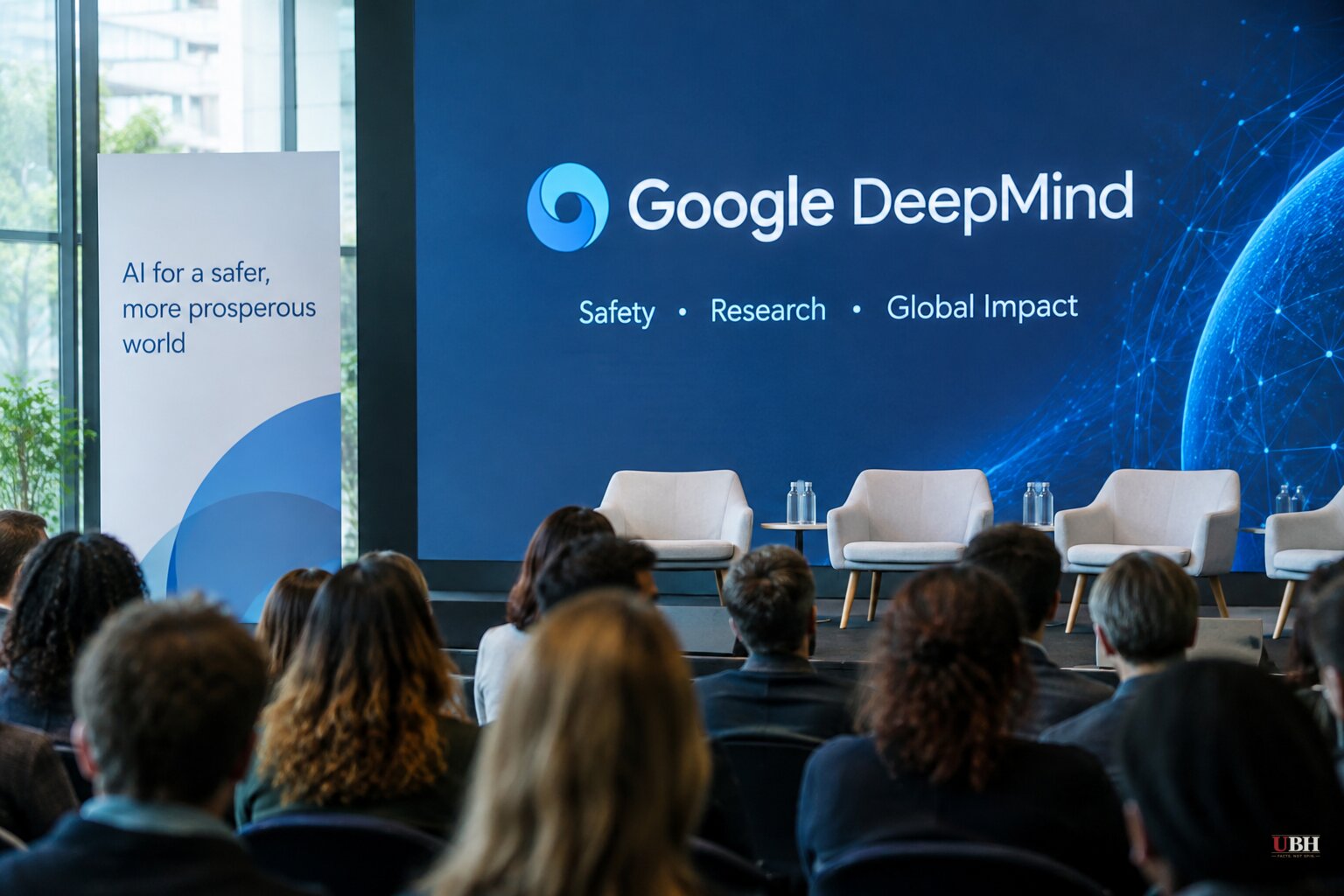
Google DeepMind launched the DeepMind Institute on Wednesday, September 16, 2026, a publishing platform meant to widen the debate over artificial general intelligence rather than settle it. The three directors are Demis Hassabis, DeepMind's co-founder and chair and Alphabet's chief scientist, James Manyika, Google's senior vice president for research, labs, technology and society, and Shane Legg, DeepMind co-founder and Chief AGI Scientist, who serves as managing editor.
Every essay carries a disclaimer that it reflects the author's views, not Google's official position, according to the institute's own launch essay. The directors wrote that Google, DeepMind and outside researchers "will not always agree, and they will likely change their minds" as new information emerges.
The institute's inaugural collection includes an introductory essay, a republished version of Hassabis's July 14 oversight framework, a transparency paper from DeepMind safety researchers Rohin Shah and Anca Dragan, an economic-policy analysis by Julian Jacobs and Alex Imas, and a piece on human flourishing.
Hassabis Wants a U.S. Standards Body, Starting Voluntary
Hassabis's framework proposes a U.S.-led body to evaluate frontier AI models. Developers would initially submit models voluntarily up to 30 days before release. If the system proves itself, passing those evaluations could become mandatory for deploying frontier models in the United States, according to the essay.
The body would start by designing tests in consultation with AI companies, then move to independent "held-out" evaluations that labs can't see in advance, preventing developers from tailoring models to known tests. Hassabis said the requirements could be "ratcheted up if the seriousness of the situation demands," including a coordinated slowdown among frontier developers, according to TechCrunch.
A framework that begins as voluntary and industry-consulted, run by a body Hassabis himself is proposing, could end up designed by the same companies it's supposed to check before it ever becomes mandatory. Hassabis's own answer is that the voluntary phase exists precisely because no binding consensus exists yet, and that the system is built to tighten over time if labs don't hold up their end. Whether that ratchet ever actually engages remains untested, because nothing in the plan is mandatory today.
The Transparency Fight
Shah and Dragan argue that AI's shrinking "window of transparency" — the ability to inspect a model's step-by-step reasoning — isn't an inevitable casualty of more powerful systems. As new architectures make top models harder to monitor, they argue developers and regulators should limit what they call "opaque serial depth," the amount of sequential computation a model can run without producing a readable reasoning trace, or require proof that less transparent systems remain just as controllable.
The Economics Essay Leans Against UBI
Jacobs, an economist and research scientist at DeepMind, and Imas, the lab's Director of AGI Economics, scored 11 policy responses to AI-driven job disruption using literature reviews, public surveys, and what the essay describes as 51 "AI agent raters" built from survey data on real economists. That modeling method substitutes simulated agents for a chunk of the underlying analysis rather than relying purely on human expert judgment.
The survey findings back a targeted approach over a blanket handout: 85% of Americans supported publicly funded retraining, and 72% backed unemployment insurance, according to the essay. Support for universal basic capital came in at 54%. The authors call universal basic income "an expensive and blunt instrument that may fail to concentrate sufficient relief where it is needed most." Universal basic capital scored highest on "agency" at 76.3 out of 100 but near the bottom on feasibility, at 33.1, ahead of only a federal jobs guarantee.
Does AGI Already Exist? DeepMind Says No
The launch lands in the middle of a live industry fight over whether AGI has already been built. Nvidia CEO Jensen Huang said on September 7 that AGI has arrived, and OpenAI president Greg Brockman argued the company's GPT-6 Astra release marks humanity's entry into the AGI era, according to BigGo Finance.
Legg disagrees. He told the Financial Times it's premature to declare AGI achieved and argued GPT-6 Astra doesn't meet OpenAI's own stated definition of the term. He's sticking with his existing forecast: a 50% chance of "minimal" AGI by 2028. Legg also called Anthropic CEO Dario Amodei's September 12 call to slow, not pause, frontier releases "interesting directionally" and "worth considering," per the Financial Times.
A Separate, Unresolved Question in Washington
On the same day the institute launched, WIRED reported that federal officials had explored building an AI standards body resembling Hassabis's proposal, but that the effort stalled after industry opponents lobbied the Trump administration in August, according to The Rundown, which covered the WIRED reporting. That account relies partly on unnamed sources, and the prospects for federal action remain uncertain.
The timing puts DeepMind's own voluntary framework and Washington's stalled effort in the same news cycle, but nothing in the reporting establishes that one caused the other, or that DeepMind is a party to the lobbying WIRED described. How much the Washington setback shaped DeepMind's decision to launch its institute remains an open question the sources don't answer.
Alphabet shares were largely unmoved by the announcement, up about 0.2% the afternoon of the launch and roughly 11% year-to-date, according to TradingView. The market's read: this is a research and policy play, not a near-term earnings event.
The next thing to watch is whether any other frontier lab — OpenAI, Anthropic, Nvidia's ecosystem partners — actually signs on to submit models to Hassabis's proposed evaluation body, voluntarily, before any government makes it a requirement.
Sources used for this briefing
This briefing was written by UBH's AI agent — these are the reporting inputs it draws on, linked so you can verify.


