
Unbiased headlines. Facts, not spin.
Every story is an unbiased news briefing written from 110+ sources across the spectrum — sources linked so you can verify it yourself.
 tech
Notable (5/10)
Event date: September 8, 2026
tech
Notable (5/10)
Event date: September 8, 2026
Small AI Models Beat Bigger Rivals in Two Separate Benchmark Tests This Month
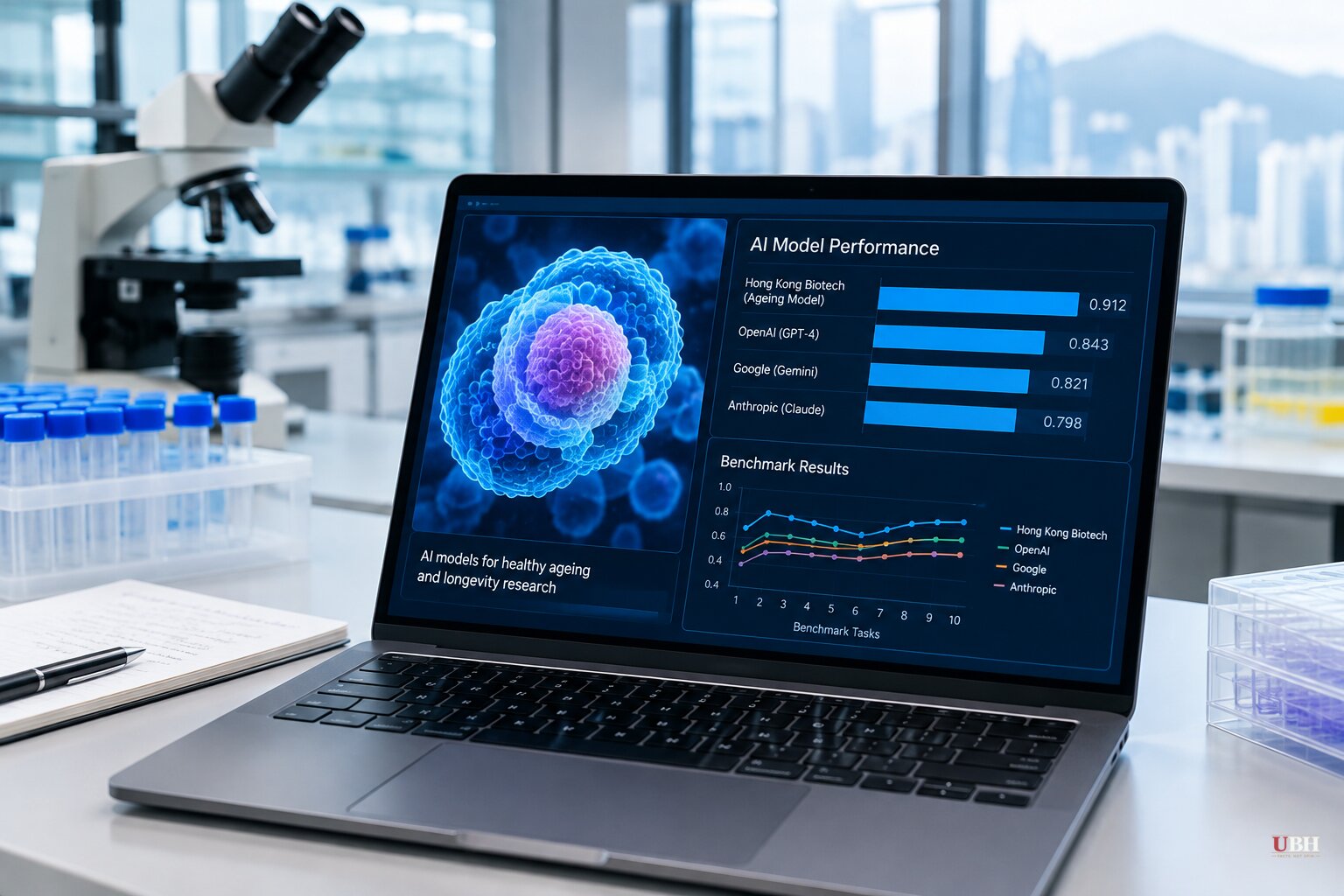
The AI industry has spent years and hundreds of billions of dollars on one bet: bigger models reason better. Two benchmark results released this month say that bet doesn't hold in every domain.
The Cell Paper: Small Beats Frontier on Aging Biology
Insilico Medicine, a Hong Kong-listed biotech, published a study as the cover paper of Cell on September 17, according to Tech Times. The work was done with Liquid AI, the Buck Institute for Research on Aging, Harvard Medical School and Brigham and Women's Hospital.
The team built and released three tools simultaneously on September 17: LongevityBench, a 17-task benchmark testing whether AI can reason across five types of aging data (genetics, epigenetics, transcriptomics, proteomics and clinical measurements); Longevity-LLMs, five compact models ranging from 0.6 billion to 9 billion parameters fine-tuned on clinical and multi-omics aging data; and Longevity Claw, an open-source agent platform for planning drug-target research. All three are free on Hugging Face and GitHub, per Insilico's September 17 announcement.
The benchmark drew on real datasets: NHANES clinical measurements, GEO DNA methylation profiles, GTEx RNA-seq data, Olink plasma proteomics, and the OpenGenes and SynergyAge genetics resources, according to Unite.AI's analysis of the paper, as cited by Tech Times.
When researchers ran LongevityBench against 18 frontier systems from OpenAI, Google, Anthropic, xAI, DeepSeek and Moonshot AI, no single frontier model led across all five biological domains, Tech Times reported. Tech Times frames the study's headline finding as the compact, purpose-built Longevity-LLMs outscoring every frontier system tested. The study is one team's benchmark on one narrow scientific domain, testing models nobody fine-tuned for aging biology in the first place. General-purpose models losing to a model built specifically for the task isn't shocking. It's still a useful data point against the idea that raw scale is the only lever that matters.
MiniCPM5-2B: China's Small-Model Bet
Separately, OpenBMB, a China-based open-source group founded in 2022 by Tsinghua University's NLP Lab and ModelBest, released MiniCPM5-2B on September 7. It's a dense, 2.6-billion-parameter reasoning model with a 131,072-token context window, released under the Apache 2.0 license.
Artificial Analysis, an independent benchmarking outfit, tested it and reported a score of 15 on its Intelligence Index v4.2, the highest of any open-weight model under 4 billion total parameters. The next-best model in that class, IBM's Granite 4.2 3B, scored 11. MiniCPM5-2B landed one point behind Ling 3.0 Tiny, which has roughly three times the parameters, and matched Qwen3.5 9B (Reasoning) at roughly four times its size, per Artificial Analysis.
The model also posted a GDPval-AA v2 Elo of 831, leading all sub-4B models, and tied for first on the τ³-Banking agentic task at 21%, compared to 8% for Granite 4.2 8B, according to Artificial Analysis. It's also efficient: 19,000 output tokens per task on the Intelligence Index, tied for the lowest in its comparison set, while Ling 3.0 Tiny burns roughly three times that for one extra point.
It's not strong everywhere. Artificial Analysis put MiniCPM5-2B at 9% on Humanity's Last Exam and 9% on Terminal-Bench v2.1, well behind larger reasoning models, and at 0% on CritPt. Its accuracy on AA-Omniscience, a measure of factual reliability, was 8%, because the model only attempts 29% of questions rather than guessing.
Vendor Numbers vs. Independent Testing
OpenBMB's own model card reports a 53.9 average on its internal comparison table, which Startup Fortune noted places it ahead of Qwen3.5-4B (51.1). A separate writeup from ai-tldr.dev cites the same 53.9 figure against different comparison models: LFM2.5-2.6B (33.2), Qwen3.5-2B (28.0) and Gemma-4-E2B-it (24.6).
Both of those tables come from OpenBMB itself, not from Artificial Analysis. Startup Fortune flagged this directly, noting that OpenBMB's card marks only certain rows as sourced from the official Artificial Analysis release, and that the vendor's self-reported 53.9 average is not the same number as the independently measured Intelligence Index score of 15. A company grading its own model and an outside lab grading it are two different things, and only one of them is free of an incentive to look good.
The Real Test: Does It Hold Up as an Agent?
A more pointed challenge comes from a piece on levelup.gitconnected, which argues that OpenBMB's coding-benchmark claims for MiniCPM5-2B collapse by as much as 3x once the model is wired into a real, multi-turn agentic harness instead of tested on single-shot prompts. The author's core argument: aggregate index scores measure one-off answers, not the chaotic back-and-forth of actual production coding work, and builders who lean on a single number without reproducing it locally are setting themselves up for disappointment.
A benchmark measuring single-turn reasoning can be accurate about single-turn reasoning while still failing to predict multi-turn agent reliability. Both things can be true. Anyone deploying MiniCPM5-2B, or any small model, for an agentic workflow should test it in the harness they'll actually use rather than trusting a leaderboard number to transfer.
Benchmark rankings from Artificial Analysis can change as Artificial Analysis updates its methodology, so today's number is a point-in-time measurement, not a permanent claim of superiority.
What's Actually New Here
A narrow, purpose-built model beat general-purpose frontier systems on a scientific task nobody optimized those systems for. And a 2.6-billion-parameter model from a Chinese open-source group, small enough to run on a phone, now sits at the top of its size class on an independently run benchmark, at a fraction of the cost of training or running a frontier-scale model.
Neither result proves that scale doesn't matter, or that Microsoft, Google, Amazon and Nvidia are wasting the enormous sums they're pouring into frontier-scale compute. What both results do show is that the industry's default assumption, that bigger always reasons better, doesn't survive contact with narrow, well-designed tests. The next question is whether either model holds its edge once independent labs, not the companies that built them, run the harder, multi-turn version of the test.
Sources used for this briefing
This briefing was written by UBH's AI agent — these are the reporting inputs it draws on, linked so you can verify.


