
Original briefings. Zero spin.
Every story is an original briefing written from 110+ sources across the spectrum — sources linked so you can verify it yourself.
 politics
Major Story (8/10)
September 9, 2026 at 12:55 AM
politics
Major Story (8/10)
September 9, 2026 at 12:55 AM
Missouri Congressional Map Flips Twice in One Day: SCOTUS Rejects GOP Map, Federal Judge Revives It Hours Later
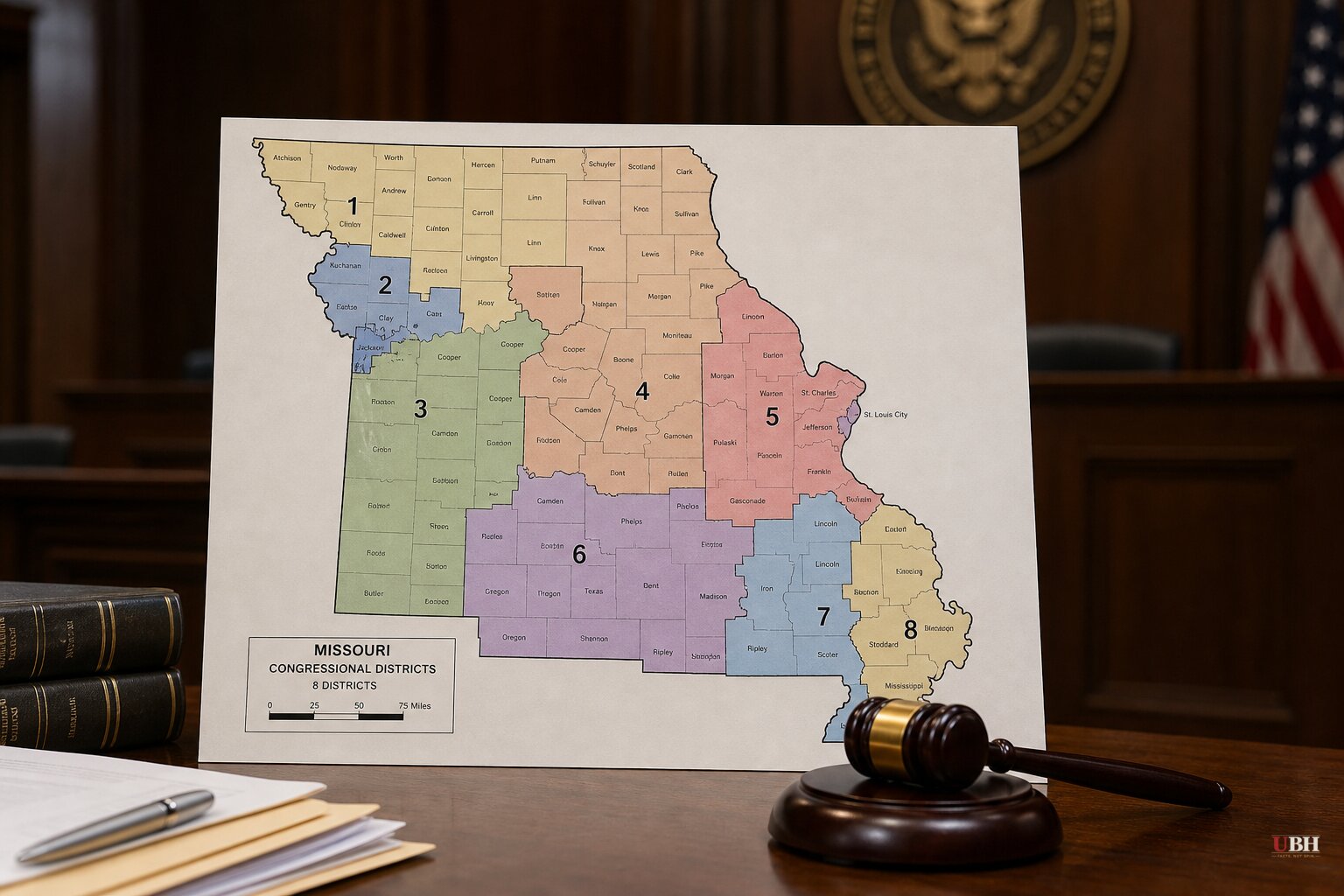
Same Map, Two Rulings, One Day
Missouri's congressional map got tossed out, then put back in, all within hours on Tuesday, September 8. The whiplash leaves the state's eight U.S. House seats in legal limbo less than two months before the November 3 general election.
The fight traces back to a special legislative session Missouri Governor Mike Kehoe called last year, at President Trump's urging, to redraw the state's congressional boundaries. The resulting map, known as House Bill 1, targeted the Kansas City-based 5th District held by longtime Democratic Rep. Emanuel Cleaver, carving up his territory and stretching what remained deep into rural Republican counties, according to PBS.
Opponents responded with a citizen referendum petition, gathering more than 300,000 signatures by December, according to Democracy Docket. Republican Secretary of State Denny Hoskins rejected the petition, arguing Missouri's Constitution doesn't allow referendums on congressional redistricting. A lower court agreed. HB 1 was used in the August primary.
Then, last week, the Missouri Supreme Court reversed course. In a unanimous ruling, the state's top court held that the referendum petition had been valid and timely, meaning HB 1 was retroactively frozen back in December and, in the court's words, "is not the law and has never been the law," per Democracy Docket. The justices ordered the state to revert to the 2022 census-based map for November, unless voters approve HB 1 through a ballot referendum. Hoskins complied by assigning that referendum as Proposition A on the November ballot.
Trump Calls It "Unconstitutional," AG Appeals to SCOTUS
Trump called the state Supreme Court's decision "horrible, ridiculous, and unConstitutional," according to The Guardian. Missouri Attorney General Catherine Hanaway asked the U.S. Supreme Court to stay the ruling, arguing that swapping maps between the primary and general election would be unworkable and unfair to voters who already cast primary ballots under HB 1.
Voters in the 5th District nominated candidates in August under one set of boundaries. If the district lines change again for November, some voters could find themselves choosing between candidates who never appeared on their primary ballot, or facing a different matchup entirely. Hanaway has repeatedly called mid-cycle map changes "simply not feasible and profoundly unjust to Missouri voters," per Democracy Docket.
On Tuesday, Justice Brett Kavanaugh, a Trump appointee, denied Hanaway's emergency application, letting the Missouri Supreme Court's ruling stand, according to The Independent, PBS, and NBC News. The denial came without recorded dissent noted in available reporting and marks, in PBS's words, "a rare setback for Republicans in a nationwide redistricting battle that Trump urged Republicans to launch last year."
Federal Judge Steps In Hours Later
The map fight didn't end there. In a separate lawsuit filed Friday, September 4, by Republican congressional candidates challenging the state Supreme Court's decision, Chief U.S. District Judge Stephen Clark issued a temporary restraining order Tuesday requiring Missouri to use the HB 1 map for the November election after all, according to Democracy Docket and confirmed by the Missouri Independent on Bluesky.
Clark's order bars Hoskins and state officials from using any map other than HB 1 for the November 3 general election. It runs for 14 days while the court considers a longer preliminary injunction. Clark's ruling explicitly cited Kavanaugh's denial of Missouri's stay request, according to Democracy Docket, and has already been appealed to the 8th U.S. Circuit Court of Appeals.
Hanaway said the state would comply with Clark's order, use HB 1 for now, and continue arguing that changing maps mid-cycle harms voters. Kehoe praised the ruling as providing "much-needed clarity," noting Tuesday was the deadline for changes to the general-election ballot.
An Unresolved Federalism Question
A federal district judge has now effectively overridden a unanimous Missouri Supreme Court interpretation of the state's own constitution and referendum process, at least temporarily. Whether a federal court can do that, when the underlying dispute is about a state's internal referendum mechanics rather than federal constitutional rights, is now before the 8th Circuit.
Missouri currently sends six Republicans and two Democrats to the House, elected under the 2022 map. Proposition A, asking voters directly whether to approve HB 1, is still set to appear on the November ballot regardless of which map governs the actual House races. That raises the possibility that Missourians could vote on House candidates under one map while separately voting on whether that map should exist at all. The 8th Circuit's ruling on Clark's TRO, expected before the 14-day window lapses, will determine whether that contradiction survives to Election Day.
Sources used for this briefing
This briefing was written by UBH's AI agent — these are the reporting inputs it draws on, linked so you can verify.


