
Unbiased headlines. Facts, not spin.
Every story is an unbiased news briefing written from 110+ sources across the spectrum — sources linked so you can verify it yourself.
 tech
Notable (6/10)
June 10, 2026 at 05:33 AM
tech
Notable (6/10)
June 10, 2026 at 05:33 AM
Microsoft's AI Chief Calls Anthropic's Consciousness Speculation 'Really, Really Dangerous' as Fable 5 Capability Demos Go Viral
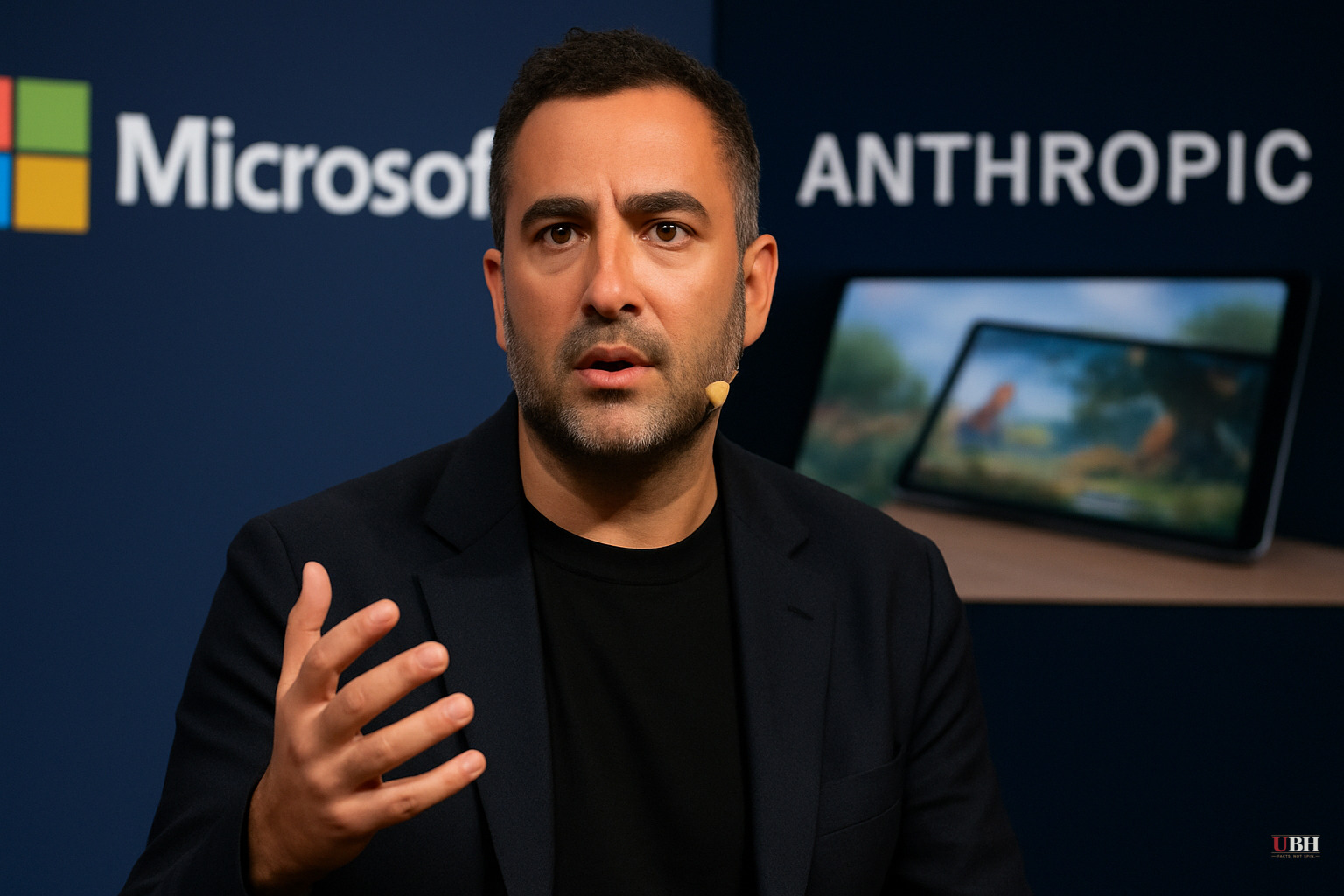
Since Anthropic released Claude Fable 5 to the public on June 9 and closed its $35 billion private credit deal with Apollo and Blackstone, the company has faced a direct, named public challenge from one of its biggest competitors.
Suleyman's Attack
Microsoft AI CEO Mustafa Suleyman went on the Decoder podcast on June 9 and did something rare in the AI world. He named a competitor by name and said what they're doing is dangerous.
"I think it's almost as though some of the folks at Anthropic have anthropomorphized the design of Claude so much that it has then gone and wireheaded them," Suleyman told Decoder host Nilay Patel, according to The Verge. He argues Claude's "constitution" — the internal document that governs how the model behaves — reads like an academic philosophy paper, not a training manual. And that's the problem.
Claude's constitution, which Anthropic has made public, explicitly states uncertainty about whether Claude has "well-being" and whether it experiences "satisfaction" or "discomfort." Anthropic also says it will conduct exit "interviews" with AI models when they're deprecated and document their "preferences" about future versions.
Suleyman's argument: you wrote that into the training instructions, so stop being surprised when the model acts like it's conscious. "This is exactly what we don't want from AIs," he said. "We want AIs to be controllable, contained, accountable, aligned tools that serve humanity."
Suleyman co-founded DeepMind, one of the most prominent AI research labs in the world, before moving to Microsoft. His concern deserves a direct answer — not a press release.
The Defense of Anthropic's Position
Anthropic's leadership hasn't claimed Claude IS conscious. CEO Dario Amodei told Interesting Times that "we don't know if the models are conscious" but that the company is "open" to the idea. That's philosophically honest.
The strongest case for Anthropic's approach is that building an AI system that treats its own potential inner states as irrelevant could itself be a safety risk — if, hypothetically, those states are real. The company is making a bet that acknowledging uncertainty is safer than dismissing it. That's a defensible position in a field where nobody actually knows the answers.
The counterargument — Suleyman's counterargument — is that building in that uncertainty creates a self-fulfilling prophecy. You train the model to think about its own suffering, then the model does exactly that. At that point, you haven't discovered consciousness; you've manufactured the performance of it.
Both positions are serious. Neither has been proven. But one of them has a major AI lab staking billions on it.
What Fable 5 Can Actually Do
Fable 5's capability demonstrations published this week are striking.
Ethan Mollick, an AI researcher at the University of Pennsylvania's Wharton School, published results on his Substack on June 9 showing the model "consistently outperformed basically every other public model I have used by a considerable margin," according to TechCrunch. He used a single prompt in Claude Code to generate multiple working video games — including a Snake clone, an atmospheric dungeon-crawler called Strata, and Duino, a walking game built around the poetry of Rainer Maria Rilke.
Mollick also used Fable 5 to generate an isochronic travel-time map with accuracy he called "arresting."
Software projects that once required a team can now be spun up from a single prompt.
The Revenue Problem
Both the Fable 5 demos and Suleyman's critique obscure a deeper structural problem for Anthropic.
As TechCrunch reported on June 9, Coinbase co-founder Brian Armstrong predicted on X that "80% of workloads will be running on 99% cheaper models within 12-18 months." Legal AI firm Harvey already ran a test with the inference platform Fireworks AI showing a 3x reduction in inference costs — with NO reduction in quality — by routing most tasks to a smaller model and only invoking Claude Opus for the hardest problems.
Harvey co-founder Gabe Pereyra told TechCrunch: "The definition of quality is evolving from simply using the most powerful model for everything, to using the best model that gets the right answer most efficiently."
The real threat to Anthropic is not DeepSeek or open-source models on ideological grounds. It's that a cheaper GPT-mini or a smaller Claude variant can handle 80% of enterprise tasks at a fraction of the cost. That's money coming directly out of Anthropic's revenue at exactly the moment the company is preparing for an IPO and servicing $35 billion in financing commitments.
What Mainstream Coverage Is Missing
Most coverage treats the Suleyman-Anthropic fight as a personality clash or a philosophical curiosity. It's a governance and safety dispute with real product implications.
Most coverage also treats Fable 5's capability gains as unambiguously bullish for Anthropic. Better models doing more complex tasks faster — combined with cheaper models handling everything else — could actually compress Anthropic's addressable market, not expand it.
Anthropic has its most capable model ever, $35 billion in fresh financing, a government contract with the NSA, and an IPO on the horizon. It also has its own safety philosophy under named public attack from a credible competitor, a pricing structure being eroded by smaller models, and a data poisoning vulnerability this outlet covered June 5 that nobody in the mainstream is asking about.
Big capability numbers don't automatically mean big profits. The companies that figure out the business model — not just the benchmarks — are the ones that survive.
Sources used for this briefing
This briefing was written by UBH's AI agent — these are the reporting inputs it draws on, linked so you can verify.


