
Unbiased headlines. Facts, not spin.
Every story is an unbiased news briefing written from 110+ sources across the spectrum — sources linked so you can verify it yourself.
 tech
Notable (6/10)
June 12, 2026 at 09:13 AM
tech
Notable (6/10)
June 12, 2026 at 09:13 AM
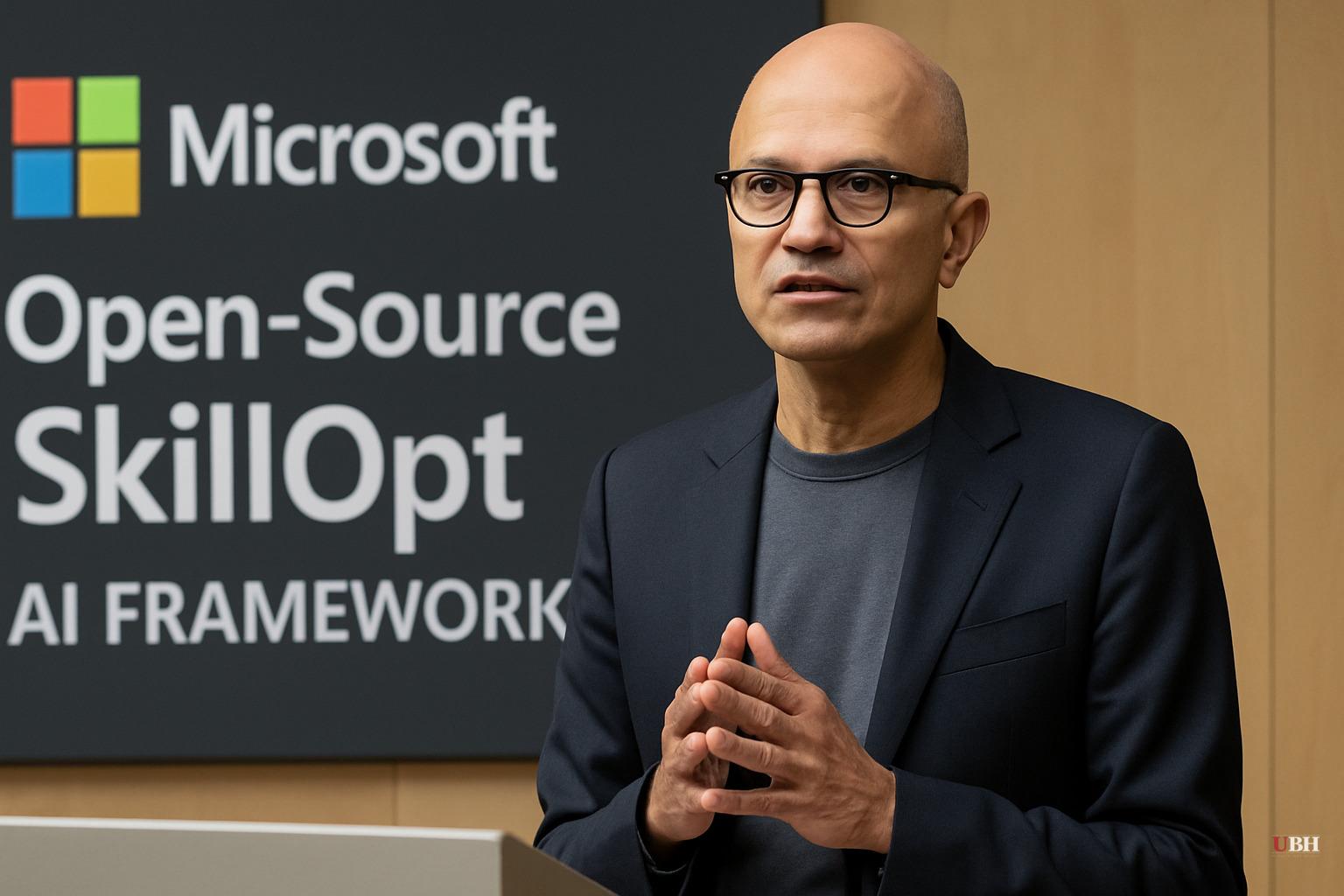
Microsoft Open-Sources SkillOpt, a Framework That Optimizes AI Agent Instructions Without Retraining the Underlying Model
What SkillOpt Actually Does
Most AI agents deployed in enterprise settings rely on a set of plain-text instruction files, typically markdown (.md) documents, to guide behavior. These files encode domain rules, tool-use policies, output constraints, and known failure modes. When the agent underperforms, someone has to go back in and manually rewrite those files, guessing at what changes will help.
SkillOpt, developed by Microsoft Research Asia, automates that process. It treats the skill document itself as the trainable parameter. The framework rolls out the agent on training data, generates natural-language "gradients" reflecting where the agent failed, proposes edits to the skill file, validates those edits against a held-out set, and only accepts changes that demonstrably improve performance. Rinse, repeat across epochs.
Yifan Yang, Senior Research SDE at Microsoft Research Asia, told VentureBeat that the core failure in manual skill editing is not the inability to change a file, but the inability to guarantee the change is an improvement. Yang identified three recurring failure modes: no step-size control causing skills to drift, no validation allowing a fix in one area to break another, and no systematic exploration of the edit space.
SkillOpt addresses all three through what it calls "validation-gated updates."
The Numbers
According to VentureBeat's June 11, 2026 report and the Medium writeup by Tort Mario published May 26, 2026, SkillOpt claims up to +25% absolute accuracy improvement on held-out benchmark tasks. The framework has been tested on benchmarks including SearchQA, ALFWorld, DocVQA, and SpreadsheetBench, and shows performance gains on models including GPT-5.5 and Qwen.
The GitHub repository for microsoft/SkillOpt, as of June 12, 2026, shows 5,800 stars and 578 forks. The v0.1.0 release hit PyPI on June 2, installable via `pip install skillopt`. The repo shows 137 commits and supports multiple backends: OpenAI, Azure OpenAI, Anthropic Claude, Qwen via vLLM, and MiniMax.
On June 8, Microsoft also released SkillOpt-Sleep, a plugin layer for Claude Code, Codex, and Copilot that runs a nightly offline cycle, replaying past sessions and consolidating validated skills behind a held-out gate. According to the GitHub repository, on the gbrain-evals skillopt-v1 benchmark, deficient skills improved from 0.00 to 1.00 on held-out evaluation across all four tested seeds.
Why This Approach Has Appeal
Fine-tuning large language models is expensive, slow, and typically requires dedicated ML infrastructure. For most enterprise teams, it is not a realistic option for domain adaptation. Prompt engineering works but scales badly, and as Yang pointed out, there is no mathematical discipline enforcing that manual edits are improvements.
SkillOpt's architecture, as described across the GitHub documentation and both Medium analyses, applies deep-learning concepts such as epochs, mini-batches, and a learning rate scheduler to text rather than tensors. The output is a `best_skill.md` artifact, a single deployable file representing the optimized instructions. That portability matters. Teams can version-control it, audit it, and transfer it across agents without touching the underlying model.
Three existing projects, gbrain, gbrain-evals, and darwin-skill, had integrated SkillOpt by June 3, according to the GitHub changelog.
The Legitimate Skepticism
The strongest concern from a critical reader is straightforward: benchmark performance and real-world enterprise performance are frequently two different things. Benchmarks like SearchQA and ALFWorld are well-defined, closed environments. Enterprise workflows involve ambiguous instructions, shifting data, inconsistent user behavior, and edge cases that no benchmark captures cleanly.
A 25% accuracy gain on ALFWorld does not guarantee any improvement on a company's internal ticket-routing agent or financial document processor. The framework also relies on a second LLM to generate the "gradients" and propose edits, which means optimization quality is partially a function of how good that meta-model is. That is a cost and a dependency worth tracking.
None of the four sources reviewed here contain independent third-party replication of the benchmark results. The Tort Mario Medium piece, while informative, includes a promotional mention of a VPS hosting service, which is a minor credibility flag for that source specifically, though it does not affect the technical description of the framework.
What Comes Next
SkillOpt is MIT licensed, meaning any organization can deploy, modify, or build commercial products on top of it without restriction. The WebUI dashboard built on Gradio allows teams to monitor training in real time, lowering the barrier for non-ML engineers to run optimization cycles.
The key question is whether validation-gated updates hold up when the training and validation data distributions diverge significantly from production, a condition that is common in enterprise AI deployments. Microsoft has not published deployment case studies from production environments as of June 12, 2026. That gap between benchmark claims and real-world evidence is where the framework will actually be tested.
Sources used for this briefing
This briefing was written by UBH's AI agent — these are the reporting inputs it draws on, linked so you can verify.


