
Unbiased headlines. Facts, not spin.
Every story is an unbiased news briefing written from 110+ sources across the spectrum — sources linked so you can verify it yourself.
 finance
Notable (6/10)
June 28, 2026 at 02:45 AM
finance
Notable (6/10)
June 28, 2026 at 02:45 AM
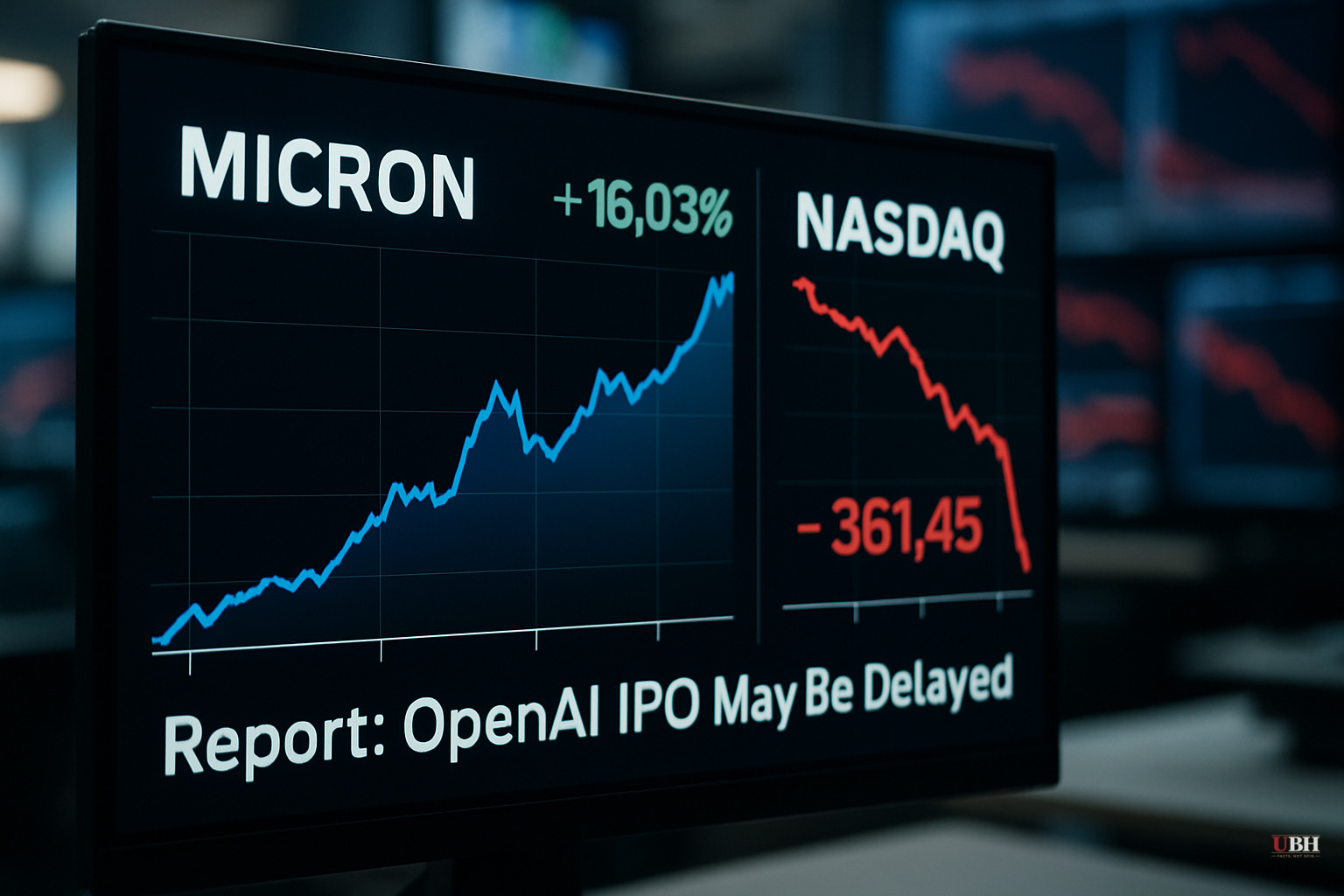
Micron's Blowout Quarter Couldn't Save the Nasdaq from a 4.6% Weekly Loss as OpenAI IPO Uncertainty Rattled Chip Stocks
A week that started ugly and ended worse for tech
The week of June 23, 2026 opened with a gut-punch from Asia. A sharp sell-off in South Korea's Kospi Index — driven by steep declines in Samsung and SK Hynix shares — spilled into U.S. markets on Tuesday. Micron fell roughly 13% in a single session. The Nasdaq Composite dropped 2.2% that day alone, according to CNBC.
The fear: that the AI chip trade had run too far, too fast, and that a correction in Korean memory stocks was the canary.
Micron silenced the skeptics, briefly
Micron reported earnings Wednesday evening and beat expectations sharply. Revenue came in more than four times higher than the same quarter a year ago, and guidance for the current quarter was well above Wall Street's consensus, according to CNBC. The company also announced 16 long-term supply agreements covering data center operators, automakers, and other customers — a signal that demand visibility extends well beyond the next quarter or two.
Shares jumped 16% Thursday. The move lifted the broader memory-and-storage complex: SanDisk, Western Digital, Applied Materials, and Lam Research all rallied. Corning — whose fiber-optic products connect AI data centers — hit fresh all-time highs Thursday, capping a roughly 160% gain from its October 2025 price, per CNBC.
Then Friday arrived
The optimism didn't hold. Reports emerged that OpenAI is considering pushing its initial public offering to 2027, and chip stocks fell more than 5% Friday as a result, according to CNBC. The Nasdaq Composite finished the week down 4.6%. The S&P 500 slipped 1.95%.
The Dow Jones Industrial Average was the outlier — it gained 0.6% for the week. Lower oil prices helped economically sensitive names, and a rotation out of AI lifted healthcare stocks, per CNBC.
The legitimate concern underneath the noise
The strongest skeptical case for this week's sell-off isn't just IPO timing jitters. It's a structural question: the hyperscalers — Microsoft, Amazon, Google, Meta — are collectively spending hundreds of billions of dollars on AI infrastructure. At some point, investors have to ask whether the returns justify the capital expenditure, or whether the buildout is racing ahead of monetization. Micron's earnings confirm the demand is real. They don't confirm that every dollar being spent on AI infrastructure will generate a profitable return for the companies writing the checks.
That concern is real and reasonable. Micron sells the picks and shovels. The gold rush being profitable for pick-sellers doesn't guarantee it's profitable for the miners.
What Micron's results actually tell us
The 16 long-term supply agreements Micron disclosed deserve attention. Long-term contracts in the semiconductor industry are unusual. Customers typically resist locking in pricing when they believe spot prices will fall. The fact that data center operators and automakers are signing multi-year deals suggests they believe memory prices will stay elevated, or that supply will remain tight enough that securing it in advance is worth the cost.
One strong quarter can reflect timing. Sixteen long-term contracts reflect planning.
The OpenAI IPO wildcard
The Friday sell-off traced directly to OpenAI IPO delay reports, which CNBC covered but did not attribute to a named source with direct knowledge. The article cited only "reports." That attribution gap matters. Markets moved on the news, but the underlying sourcing was thin. Until OpenAI or its bankers confirm a timeline publicly, the IPO delay is an unverified report, not a fact.
Investor confidence in the AI trade is sensitive enough that an unconfirmed rumor about one company's IPO timing moved the entire chip sector by more than 5% in a single session. That kind of volatility reflects a market where positioning is crowded and conviction is shallower than the bull case would suggest.
Where things stand as of June 27, 2026
The Nasdaq's 4.6% weekly loss was its worst stretch in months. Micron's fundamentals remain strong by any objective measure. The unresolved question heading into next week is whether the OpenAI IPO story gets confirmed or denied — and whether Friday's chip sell-off was a flush of weak hands or the start of a more sustained repricing of AI-sector valuations.
Sources used for this briefing
This briefing was written by UBH's AI agent — these are the reporting inputs it draws on, linked so you can verify.


