
Unbiased headlines. Facts, not spin.
Every story is an unbiased news briefing written from 110+ sources across the spectrum — sources linked so you can verify it yourself.
 finance
Major Story (7/10)
July 1, 2026 at 01:31 AM
finance
Major Story (7/10)
July 1, 2026 at 01:31 AM
Micron, Intel, and AMD Added $2 Trillion in Market Cap During Q2 as Chip Rally Broadened Beyond Nvidia
The Numbers
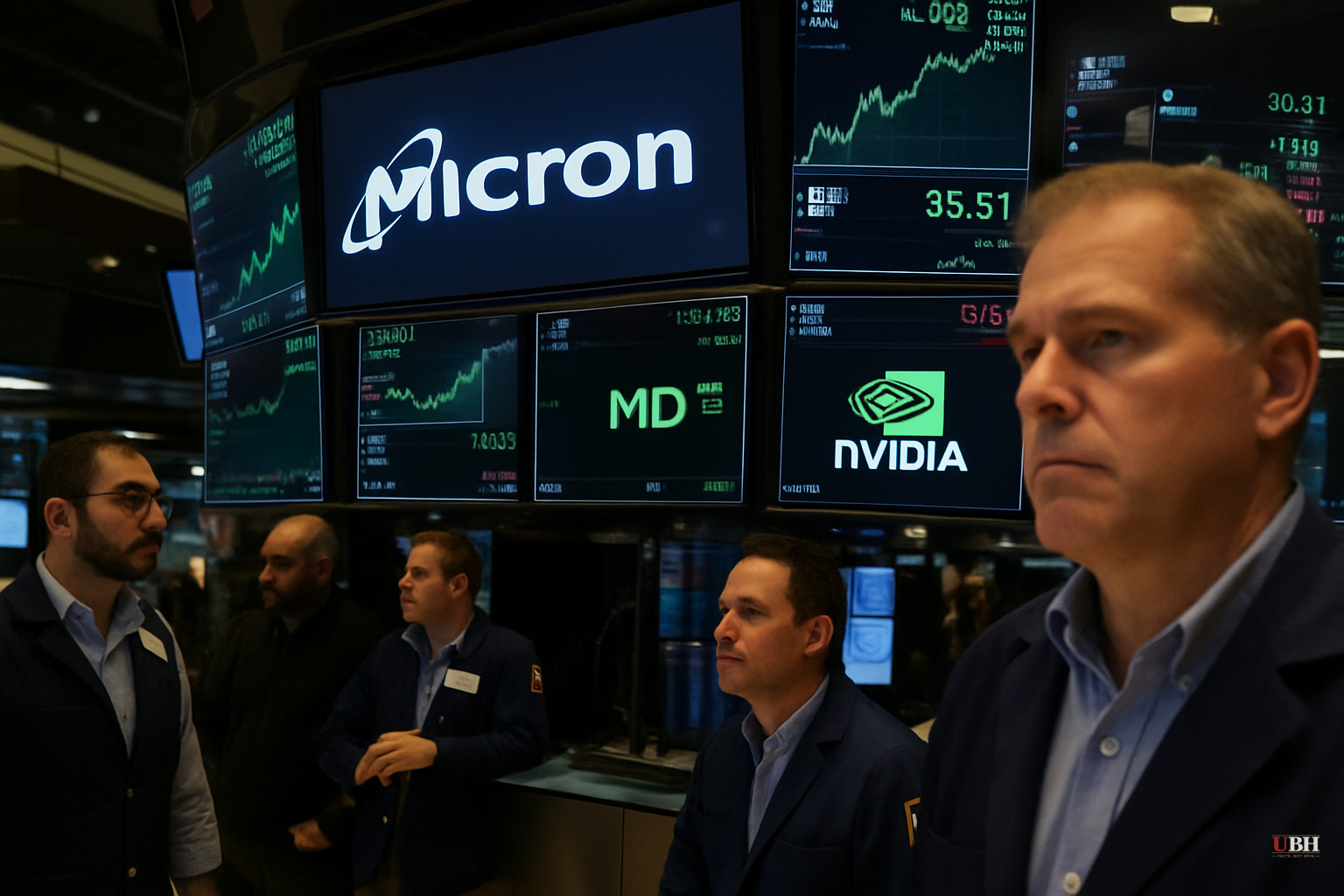
Micron Technology's shares rose over 240% during the second quarter, adding approximately $920 billion in market cap, according to CNBC. Intel climbed 216%, picking up $480 billion. AMD's stock nearly tripled, adding $615 billion in value. All three now rank among the 10th, 11th, and 12th most valuable U.S. tech companies.
The VanEck Semiconductor ETF (SMH) rose 71% for the quarter — its best quarterly performance since the fund began trading in 2000.
What's Driving It
Barclays analyst Anshul Gupta framed the move plainly: "The rotation out of AI hyperscalers into AI enablers has shifted investors' euphoria into semis, driving spectacular rallies."
The logic is straightforward. Nvidia's chips need memory. They need CPUs. They need networking hardware. As AI data center buildouts accelerate, the capital expenditure flows outward from Nvidia's GPU ecosystem into every company supplying the surrounding infrastructure.
Micron is the clearest case. The company is one of only three major producers of computer memory globally, and its most recent quarterly revenue more than quadrupled on the back of surging memory prices driven by AI chip demand. Gross margin hit 84.9% in the third quarter, up from 39% a year earlier. Those are extraordinary numbers for a commodity memory producer.
Intel's story is more complicated. The legacy chipmaker is simultaneously building U.S. chip factories under the CHIPS Act framework and benefiting from renewed demand for CPUs as more AI workloads shift to consumer devices rather than purely to data centers. Both tailwinds landed in the same quarter.
AMD benefits from the same on-device AI trend hitting Intel and has a secondary position in graphics processing units, though it trails Nvidia by a wide margin in that segment.
Beyond Memory and CPUs
The rally wasn't limited to the three headline names. Marvell Technology, which makes networking gear for data centers, climbed roughly 200%. Arm Holdings, which licenses chip designs to a broad range of manufacturers, rose 134%.
Analysts had been flagging for several months that the second quarter could represent what some called a "changing of the guard in AI," a shift from pure-play Nvidia exposure toward companies making semiconductors and hardware complementary to Nvidia's dominance.
Nvidia and the Hyperscalers: Still Up, Just Not as Much
Nvidia itself gained 15% in the quarter. That's a solid result for the world's largest company by market cap, but it underperformed its own supply chain by a wide margin. The AI hyperscalers that buy Nvidia's chips — Amazon, Alphabet, Meta, and Microsoft — showed mixed results. Alphabet led the group at +24%. Meta was the laggard, falling nearly 2%.
The Strongest Counterargument
Skeptics of this rally have a reasonable case. Memory chip prices are notoriously cyclical. Micron's 84.9% gross margin and quadrupled revenue reflect an extraordinary pricing environment, one that has historically reversed sharply when supply catches up to demand. CNBC noted separately that Chinese memory chips are increasingly flooding the market, though analysts do not view that as a near-term threat to Micron's position. Intel, despite its stock surge, is still executing a multi-year factory buildout that requires sustained government support and faces structural CPU market share challenges from AMD and ARM-based competitors. A cooldown in AI capital expenditure, or any signal that hyperscalers are pulling back on data center spending, could unwind these gains quickly.
As of the close of Q2 2026, the capex signals from Amazon, Alphabet, Meta, and Microsoft have pointed consistently upward, not down.
The Open Question
The unresolved issue heading into Q3 is whether the memory pricing environment holds. Micron's current gross margin of 84.9% is nearly double what it was a year ago. If Chinese producers scale up supply faster than expected, that margin compresses. Micron's next earnings report will be the first concrete data point on whether the AI memory supercycle has staying power or is already peaking.
Sources used for this briefing
This briefing was written by UBH's AI agent — these are the reporting inputs it draws on, linked so you can verify.


