
Unbiased headlines. Facts, not spin.
Every story is an unbiased news briefing written from 110+ sources across the spectrum — sources linked so you can verify it yourself.
 finance
Notable (6/10)
July 16, 2026 at 09:04 PM
finance
Notable (6/10)
July 16, 2026 at 09:04 PM
Micro-Cap IPOs From Foreign Companies Collapse to 13 Listings in 2026 After SEC Crackdown
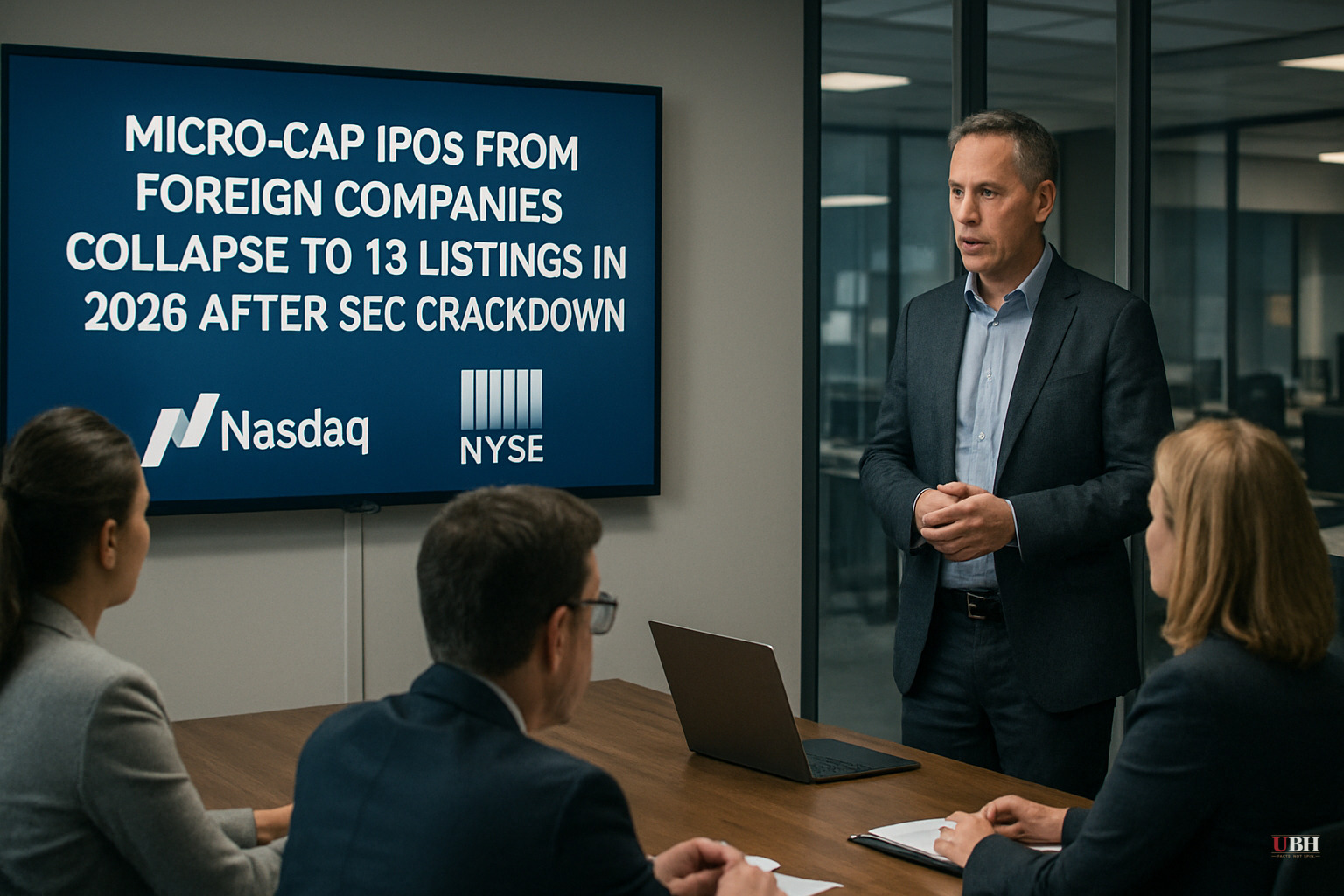
Foreign micro-cap companies have all but stopped listing on U.S. exchanges. Only 13 have completed IPOs on Nasdaq or the New York Stock Exchange so far in 2026, according to Crypto Briefing and Gate News. Compare that to roughly 80 by the same point in 2025, and nearly 140 for the full year, which raised $1.6 billion combined, per Crypto Briefing.
This year's 13 deals raised less than $300 million total. All but one brought in less than $25 million.
The SEC formed a cross-border task force in late 2025 targeting overseas market manipulation, then stood up a second enforcement unit focused on retail fraud, according to Crypto Briefing. The agency has suspended trading in more than a dozen foreign stocks since, citing possible manipulation tied to social media promotion in nearly every case.
Cooley's legal analysis puts a finer point on it: as of April 27, 2026, the SEC had suspended trading in 14 Asia-based companies that IPO'd on Nasdaq or NYSE within the prior two years. The businesses ranged from beauty products to food catering to traditional Chinese medicine. Most were founded more than a decade ago, meaning these weren't fly-by-night shell operations dreamed up last year.
SEC Chairman Paul Atkins told the Senate Banking Committee on February 12, 2026, that the effort is about closing a loophole, not punishing foreign business as such. "I am working within the securities laws to protect investors from those who seek to use international borders to evade and undermine U.S. investor protections. Markets are global. Investor protection must be as well," Atkins said, according to Cooley.
Nasdaq moved separately. New rules adopted in December 2025 give the exchange more discretion to reject listings when auditors, underwriters or legal advisers flag concerns, Crypto Briefing reported. The exchange also raised minimum fundraising thresholds specifically for companies based in China and Hong Kong. Nasdaq's own analysis found that 143 of 151 China-based companies that listed between August 2022 and April 2025 would not have qualified under the new, tougher standard.
The pattern regulators describe is straightforward. Promoters buy shares in a thinly-traded micro-cap before it lists or shortly after. They hype it in online forums, chatrooms and social media to draw in retail buyers. The price spikes. The promoters sell into the rally. The stock craters, and whoever bought last holds the bag.
Only two Asia-based micro-caps listed on major U.S. exchanges in the first half of 2026. Both are down more than 50% since their debuts, Crypto Briefing reported, though regulators have not accused either company of wrongdoing.
Cooley's analysis flags something important: in nearly every SEC suspension order, the agency states the manipulation was "effectuated through recommendations made to investors by unknown persons via social media." This means the companies themselves aren't necessarily accused of doing anything. Outside promoters, often anonymous, are pumping the stock without the company's involvement.
Legitimate businesses can get their trading halted, take a reputational hit, face SEC inquiries and shareholder lawsuits, and now risk outright delisting under a Nasdaq rule proposal that would let the exchange kick out any company hit with an SEC trading suspension, all because someone the company has never met posted in a chatroom. Cooley's advice to foreign issuers is blunt: evaluate your vulnerability to third-party manipulation now, because a stock price rally you didn't ask for can trigger scrutiny that ends your access to U.S. capital markets.
A company victimized by outside pump-and-dump promoters is being treated, functionally, like a suspect. The SEC can only suspend trading for up to 10 business days under its own authority, but exchanges can extend the practical consequences far longer, and a Nasdaq delisting rule would make that damage close to permanent.
The collapse in IPO volume is a documented fact, confirmed by both Crypto Briefing and Gate News using the same underlying data. The SEC's stated rationale, protecting retail investors from manipulation, is on the record from Atkins himself in Senate testimony. None of the sources allege the SEC is targeting these companies for political reasons beyond the general America First posture Cooley notes is consistent with the Trump administration's approach.
Nearly 40 Asia-based companies and a dozen U.S. micro-caps have filed to go public since the start of 2025 and remain stuck in the pipeline, per Crypto Briefing. Whether that backlog clears, or whether it becomes the new normal for small foreign issuers trying to reach American investors, is the open question regulators haven't answered yet.
Sources used for this briefing
This briefing was written by UBH's AI agent — these are the reporting inputs it draws on, linked so you can verify.


