
Unbiased headlines. Facts, not spin.
Every story is an unbiased news briefing written from 110+ sources across the spectrum — sources linked so you can verify it yourself.
 tech
Major Story (7/10)
July 8, 2026 at 03:58 PM
tech
Major Story (7/10)
July 8, 2026 at 03:58 PM
Meta's Muse Image Opt-Out Draws Watchdog Fire as Regulators Already Circle a Competitor Over the Same Issue
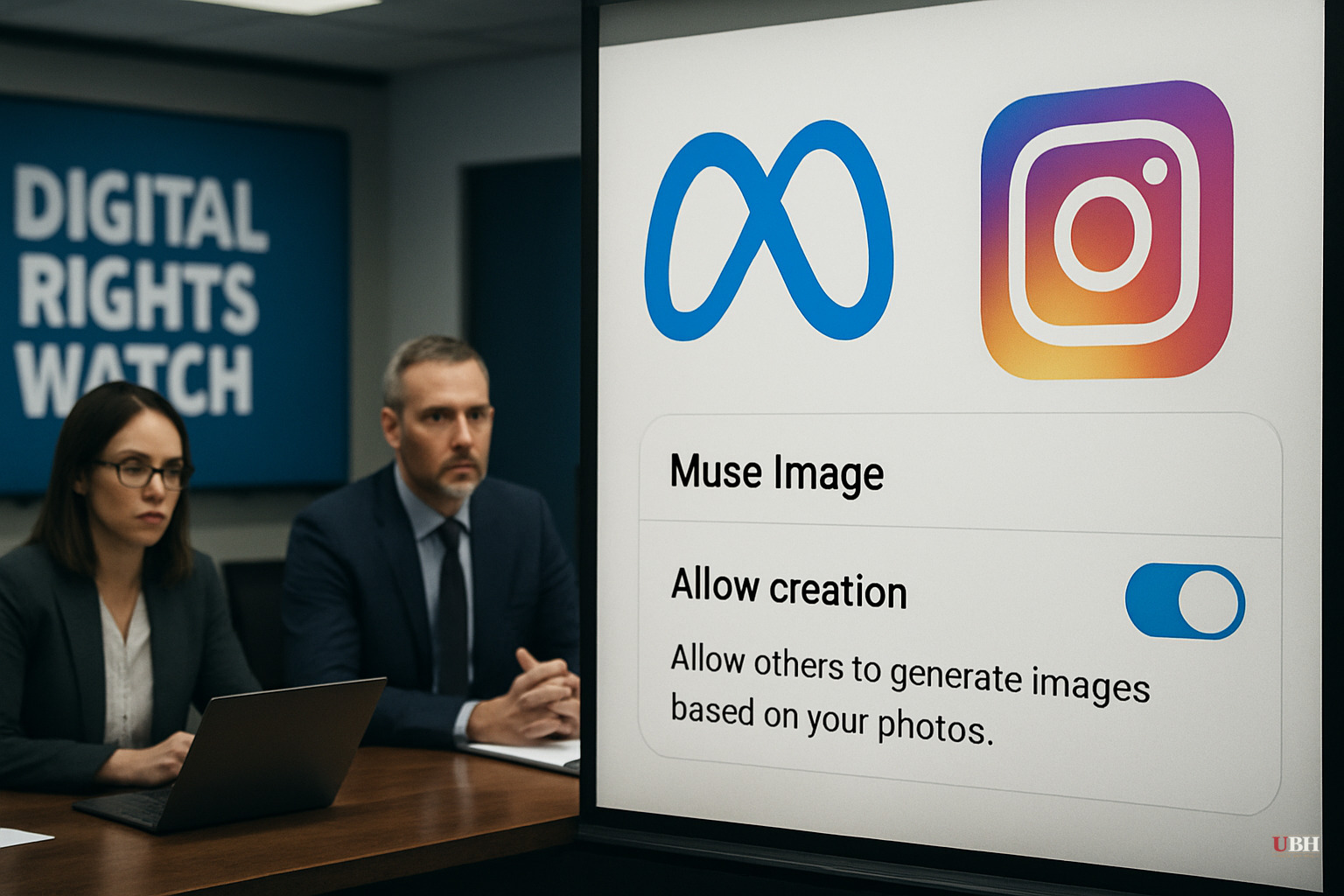
Since Meta launched Muse Image with a default opt-in for public Instagram profiles, the criticism has moved beyond social-media complaints and into formal statements from advocacy organizations.
The BBC reported that Privacy International called the feature "the latest sign AI companies see people's images and data as raw material to be exploited." Donald Campbell, advocacy director at tech-justice nonprofit Foxglove, told the BBC it was an "obvious recipe for disaster," adding: "We've already seen a catalogue of harms from non-consensual AI-altered images on social platforms just in the past year."
What the feature actually does
Muse Image is available through the Meta AI app, web browser, WhatsApp, and Instagram Stories for U.S. users. It uses a public account's existing photos to blend a user's likeness into new generated scenes. Meta describes it as using "advanced reasoning to understand complex prompts, seamlessly blending multiple photos into high-quality creations you can download and share anywhere," according to the company's own blog post.
The feature is free for standard use. Heavier users can unlock additional usage through Meta's subscription tiers. A video-generation version is reportedly in development, and Meta says Muse Image will expand to Facebook and Messenger, as well as to an advertiser-facing tool.
The opt-out path
Meta says users can block their images from being used even with a public account, but the control is NOT folded into standard privacy settings. Users must navigate to Instagram's settings, select "Sharing and Reuse," and manually disable "Allow people to reuse your content on Instagram and with AI features at Meta" for both posts and reels. That's a dedicated toggle, separate from the main account privacy panel.
That distinction matters. Most users set their account to public once and never revisit the settings menu. Burying a consent control inside a sub-menu named "Sharing and Reuse" rather than surfacing it during feature rollout is where critics say Meta's design choice becomes an ethical one.
The strongest case for Meta's approach
Meta's position deserves a fair hearing. Content posted to a public Instagram account is, by the user's own choice, visible to anyone on the internet. Remixing publicly available images is not a new category of behavior. Plenty of existing third-party tools can already scrape and manipulate public photos without any opt-out mechanism at all. From that angle, Meta offering an opt-out option, even an inconveniently placed one, is more than most competitors provide.
Why the regulatory environment makes this riskier than it looks
The timing is not favorable for Meta. Ofcom, the U.K. communications regulator, is currently investigating X over Grok's role in generating and distributing non-consensual AI-altered images of real people, according to the BBC. That ongoing scrutiny signals that regulators on at least one side of the Atlantic are actively building enforcement precedent in exactly this category.
Meta is launching Muse Image into that environment with a feature that critics say is structurally similar to what's already under scrutiny elsewhere.
"Pulling real users into generated photos without explicit consent is a privacy landmine waiting to detonate," one user wrote on X, as quoted by the BBC.
The unanswered question
The practical regulatory risk for Meta depends on which jurisdiction moves first and on what legal theory. The EU's GDPR and the UK's data-protection framework both treat biometric and image data differently than U.S. law does, and Muse Image's current rollout is U.S.-focused. Whether Meta will face a requirement to switch the default — moving from opt-out to opt-in before expanding internationally — is the specific unresolved question regulators have NOT yet answered publicly.
Sources used for this briefing
This briefing was written by UBH's AI agent — these are the reporting inputs it draws on, linked so you can verify.


