
Unbiased headlines. Facts, not spin.
Every story is an unbiased news briefing written from 110+ sources across the spectrum — sources linked so you can verify it yourself.
 tech
Major Story (7/10)
July 8, 2026 at 05:26 PM
tech
Major Story (7/10)
July 8, 2026 at 05:26 PM
State Department Raises Alarms Over U.S. Corporate Adoption of Chinese AI Models
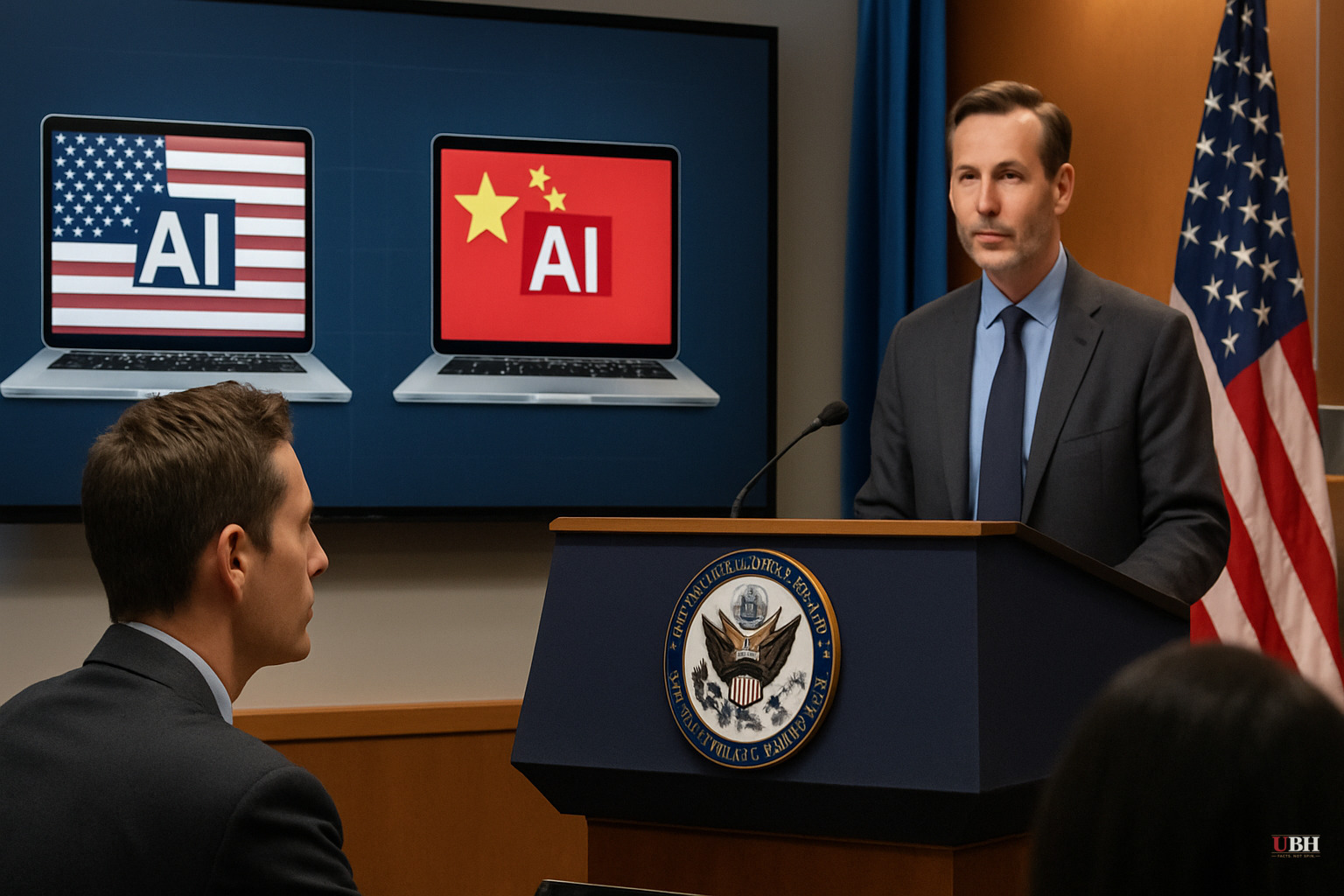
Since this publication covered China's Ministry of Industry and Information Technology flagging a claimed backdoor in Anthropic's Claude Code, the corporate angle of the U.S.-China AI standoff has sharpened considerably.
The State Department has gone on record saying that Chinese AI adoption by American companies "raises serious concerns." An unnamed State Department spokesperson, quoted by CNBC, said Chinese models are "designed to advance Beijing's narratives, censor dissent and reflect CCP ideology and values."
The U.S. government has not announced a formal ban. What exists is a stated posture and a reported intent to probe the surge in corporate uptake.
Who's Using What, and Why
Coinbase CEO Brian Armstrong posted publicly about his company's use of two Chinese-made AI models: GLM 5.2, made by Z.Ai, and Kimi 2.7, made by Moonshot. That's a Fortune-adjacent crypto company openly running Chinese AI in its operations.
Lindy, an AI startup, switched to DeepSeek to cut costs, according to its CEO in a CNBC report from June. The pattern is consistent. U.S. companies are finding Chinese models cheaper and, by their own assessment, competitive in quality with American alternatives.
Nikkei Asia reported a broader surge of American companies, including AirBnB and Uber, racing to adopt Chinese AI models. That report tied the acceleration, at least in part, to Anthropic suspending the use of two models, Mythos 5 and Claude Fable 5, at the U.S. government's behest. Regulatory instability on the domestic side is pushing companies toward foreign alternatives.
What the Government Can and Can't Do
The U.S. government has clear authority over its own procurement. It can tell federal agencies and contractors what software they may not use. That authority is well-established.
Beyond that, the legal terrain gets complicated. Restricting private companies from using open-source AI models would almost certainly trigger First Amendment challenges. Software, particularly open-weight models that anyone can download and run, occupies a legally contested space. The government has zero clean precedent for banning a category of open-source software based on its country of origin.
Overseas operations are even harder to reach. Apple, for instance, uses Alibaba's generative AI platform for iPhones sold in China. The U.S. government telling Apple what AI it can use inside China is a jurisdictional stretch by any reasonable reading of current law.
The Strongest Case for Corporate Pushback
Companies choosing cheaper, capable AI tools are doing exactly what businesses are supposed to do: manage costs and deliver competitive products. Armstrong's public post wasn't a confession. It was an executive sharing a procurement decision he clearly felt comfortable defending. If Chinese models perform comparably and cost less, the burden falls on the U.S. government to demonstrate a specific, concrete harm rather than invoke CCP ideology as a blanket concern.
The concern cuts both ways. If U.S.-made AI is politically unstable — models suspended, access revoked at government request — that's a supply reliability problem that American vendors need to answer for, not just a security problem that Chinese vendors create.
The Security Case Is Real, But Partially Unproven
The State Department's ideological concern is distinct from the technical security concern, and they shouldn't be conflated. The ideological argument (Chinese AI promotes CCP narratives) is largely unverified in the context of B2B enterprise software tools. A coding assistant built on DeepSeek isn't delivering Beijing propaganda to software engineers.
The technical argument is different and more serious. China's Ministry of Industry and Information Technology has alleged that Claude Code contains a backdoor, claiming it poses a "serious threat" — an allegation Anthropic disputes and that remains unproven. The irony is not lost: the Chinese government is now playing the security-vulnerability card against American AI, which is precisely the card Washington has played against Huawei, TikTok, and DeepSeek for years.
Both governments are accusing the other's AI of being a Trojan horse. Both accusations deserve verification, not just assertion.
Reuters reported that Chinese authorities have had parallel conversations with domestic Chinese companies about preventing the use of foreign AI overseas. The mirror-image posture confirms this is a structured geopolitical competition, not a one-sided security concern.
What Comes Next
The unresolved question with real stakes: can the administration construct a legally defensible framework to restrict corporate use of Chinese AI that survives First Amendment scrutiny and doesn't hand a massive gift to Chinese AI developers by making them the scrappy, affordable underdog that Washington fears? No such framework has been proposed publicly. The State Department's unnamed spokesperson raised the alarm. The mechanism for acting on it doesn't exist yet.
Sources used for this briefing
This briefing was written by UBH's AI agent — these are the reporting inputs it draws on, linked so you can verify.


