
Unbiased headlines. Facts, not spin.
Every story is an unbiased news briefing written from 110+ sources across the spectrum — sources linked so you can verify it yourself.
 tech
Notable (6/10)
July 13, 2026 at 11:09 AM
tech
Notable (6/10)
July 13, 2026 at 11:09 AM
Meta Nearly Doubles Louisiana Data Center Price Tag to $50 Billion, Backed by 20-Year Tax Exemption
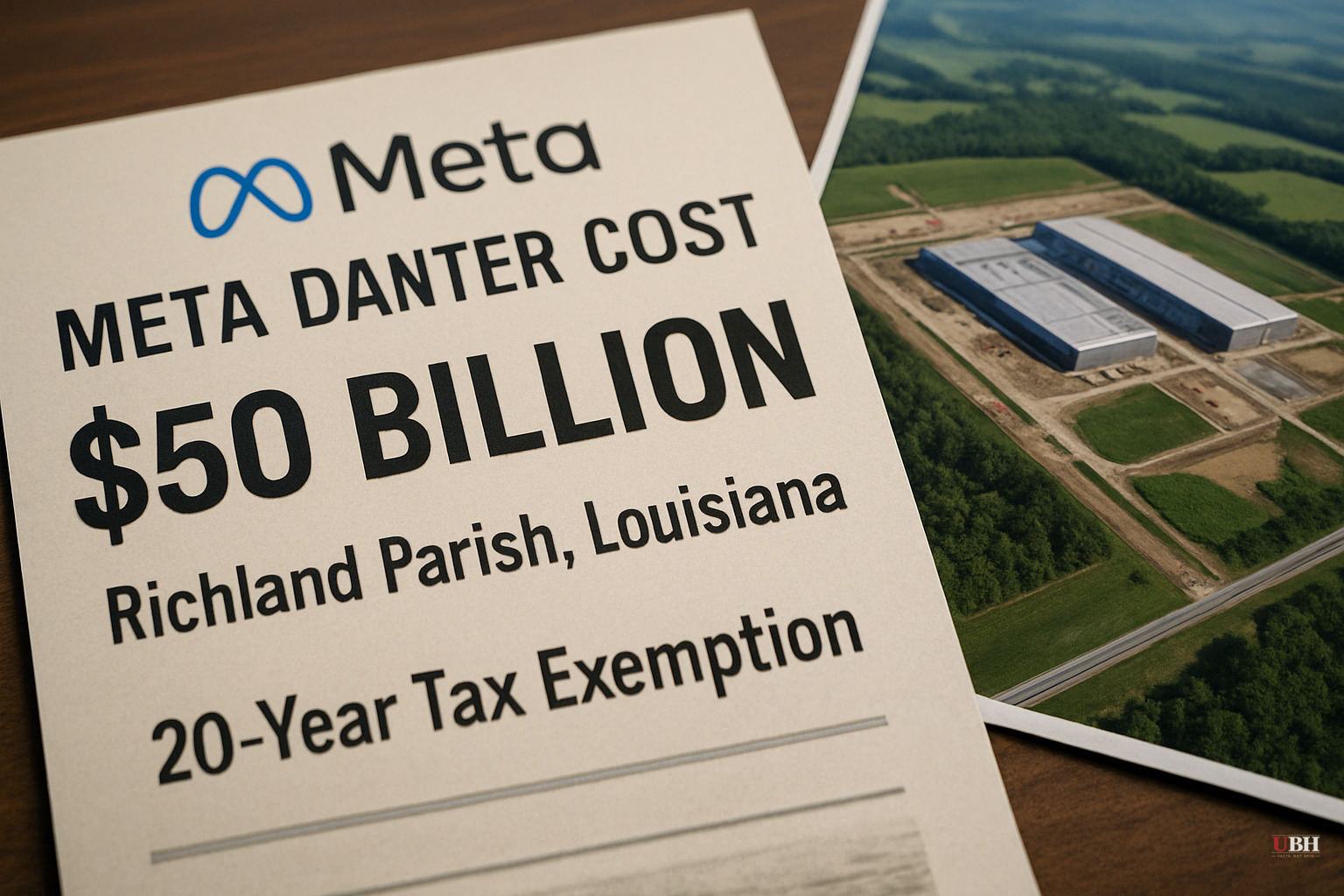
Meta's data center project in Richland Parish, Louisiana just got a lot bigger and a lot more expensive.
The company said in a blog post Monday, July 13, that the site, dubbed Hyperion, will now be a 5-gigawatt facility costing more than $50 billion. That's nearly double the $27 billion figure Meta disclosed in October 2025, when it formed a joint venture with Blue Owl Capital to help finance and manage the buildout, according to CNBC. The project started even smaller than that: an estimated $10 billion when construction began in December 2024.
Governor Jeff Landry, a Republican, was scheduled to host a press event in Baton Rouge on Monday to mark the expansion.
The Tax Deal That Made It Happen
Landry signed a law in late 2024 giving data centers built before 2029 a 20-year sales tax exemption, a move CNBC reported was specifically designed to court Meta. That's two decades of foregone state sales tax revenue on a facility that will eventually be one of the largest industrial developments in Louisiana history.
"I'm a business guy," Landry told CNBC in an interview last year. "What we know is when you look at the overall comprehensive package here, it's in the black. For local government, and the state, and how you get to the bottom line is irrespective to me."
Landry and his administration are betting that construction jobs, over $1.6 billion in local contracts already awarded since December 2024, and long-term infrastructure spending will outweigh the tax revenue the state gives up. Meta says it's pouring more than $1 billion into local roads, water, and wastewater systems as part of this expansion alone. For a rural parish that wasn't exactly a hotbed of industrial investment, that's real money hitting the ground.
Meta also says it's covering its own energy and water infrastructure costs directly so residential consumers don't get stuck subsidizing the plant's utility footprint. That's a meaningful commitment if it holds, since data centers of this scale can strain local power grids and water supplies enough to raise rates for everyone else nearby.
The Risk of Long-Term Tax Bets
When a state hands out a 20-year tax exemption to lock in a single company's investment, taxpayers are making a two-decade bet with very little ability to walk away if the numbers don't pan out. If electricity demand from a 5GW facility pushes up regional power costs, or if promised jobs don't materialize at the scale advertised, the state has already signed away its tax leverage for a generation. Landry's statement that the math is "irrespective" to him of whether local government or the state carries the immediate cost deserves scrutiny.
Nobody outside Meta and the Landry administration has produced an independent, audited cost-benefit breakdown of the exemption's total value over 20 years versus the jobs and infrastructure spending it's supposed to generate. CNBC's reporting doesn't include one either.
Part of a Bigger Race
Meta isn't alone in chasing state incentives for AI infrastructure. Microsoft, Alphabet, and Amazon are all competing for tax rebates and energy deals from states eager for a piece of the AI buildout, according to CNBC. Louisiana just moved first and biggest with Meta.
The expansion comes right after Meta had its best stock market week since early 2024, following the release of two major AI models under Alexandr Wang, who leads Meta Superintelligence Labs. Investors have been pushing Meta to show concrete returns on its enormous AI spending, and CEO Mark Zuckerberg has said Hyperion will give Meta Superintelligence Labs "industry-leading levels of compute" and the highest compute-per-researcher ratio in the industry.
Meta didn't announce a new financial partner for the expanded $50 billion price tag, meaning the exact mix of Meta's own capital, the Blue Owl joint venture, and any additional financing remains unclear. What's also unresolved: whether Louisiana's legislature or an independent state auditor will ever publish a formal accounting of what the 20-year exemption actually costs the state treasury against what Richland Parish gains in jobs and infrastructure. As of now, that math is coming from Meta and the governor's office, not from anyone independently checking it.
Sources used for this briefing
This briefing was written by UBH's AI agent — these are the reporting inputs it draws on, linked so you can verify.


