
Unbiased headlines. Facts, not spin.
Unbiased Headlines is an independently owned news organization. We bring you the facts, not opinions, written fresh from 110+ named sources. Sources linked so you can verify it yourself.
 tech
Major Story (8/10)
Event date: October 19, 2026 ·
Meta Faces About $42 Billion in Penalties and Settlements as It Appeals New Mexico's $25 Billion Order
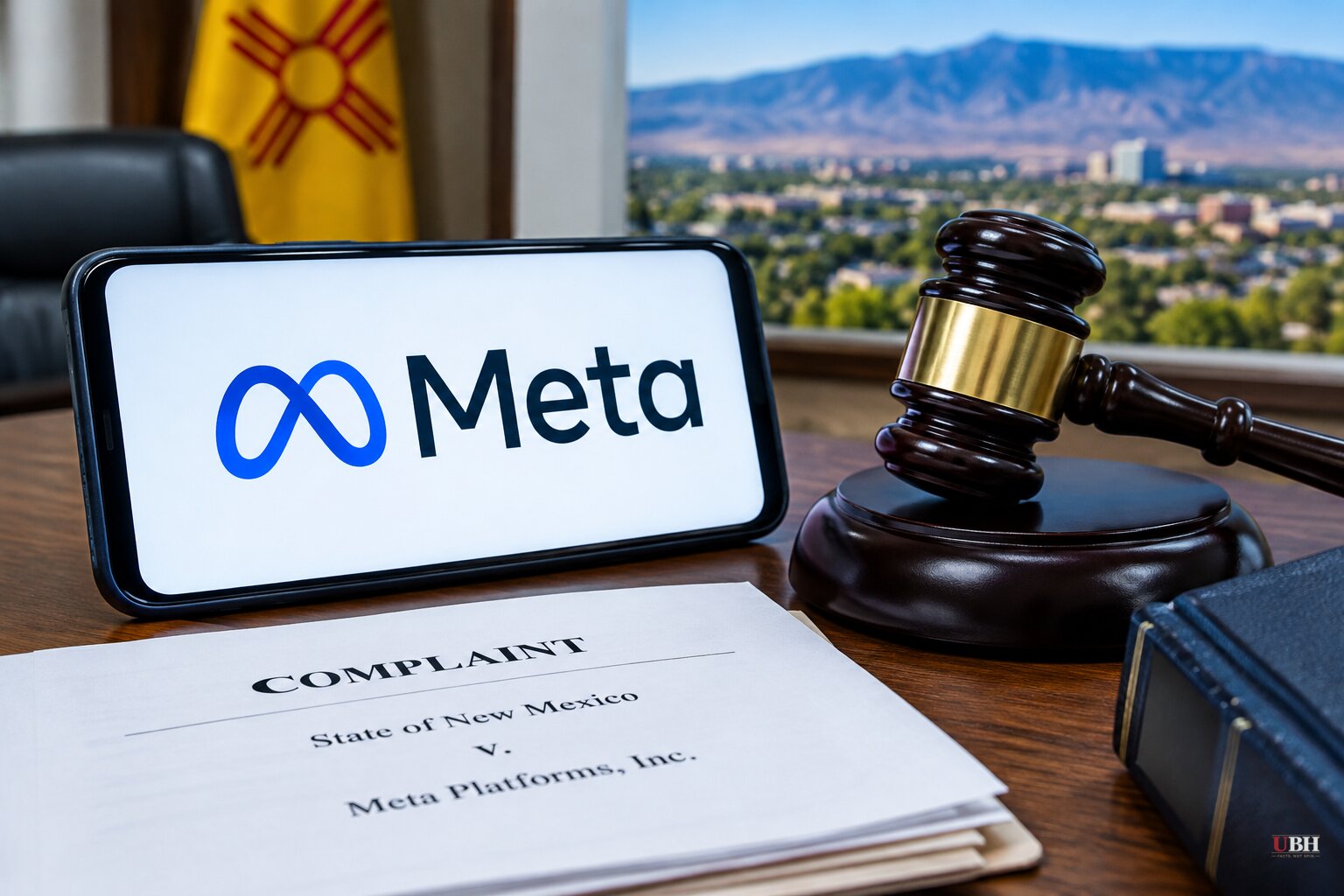
After a New Mexico jury found on Sept. 25 that Meta misled users about privacy, the company's recent legal bill has reached roughly $42 billion. That figure combines a $25 billion state penalty ordered last Wednesday, Oct. 21, with a multistate settlement of about $17 billion reached in August.
The new part is the appeal, and the argument that AI companies should read the numbers closely.
The New Mexico order
Judge Francis Mathew of New Mexico state court set the $25 billion penalty under the state's Unfair Practices Act. The jury had found more than 43 million violations. At the statutory maximum of $5,000 each, the total came to $219.5 billion. Mathew cut that to $25 billion.
His findings were blunt. He wrote that the "extraordinary number of willful violations," the duration of the conduct and "the involvement of senior Facebook leadership" supported the highest per-violation penalty the law allows. He called Facebook's misrepresentations about user control of data "a systematic pattern of deception at the core of Facebook's business model."
The penalty grows by 15% a year until paid in full. On $25 billion, that is about $3.75 billion in the first year.
The case began with a 2021 lawsuit over the Cambridge Analytica episode, in which data on as many as 87 million Facebook users was improperly obtained. New Mexico Attorney General Raúl Torrez said the result "makes clear that no corporation is too powerful to be held accountable."
Meta's response
Meta Chief Legal Officer C.J. Mahoney said the ruling and Torrez's approach "makes it all but impossible to do business in the state of New Mexico." He added that "at its core, this lawsuit seeks to impose a tax on speech to enforce new rules for what people can say online." Meta says it is confident it will prevail on appeal.
That is the company's position, and it is a serious one. Axios reports that legal experts expect the penalty to be reduced on appeal. A ruling that limits how violations are counted would shrink the number sharply.
The jury's findings are also at issue. LA Times columnist Michael Hiltzik notes that the post-2019 statements jurors flagged as deceptive mostly concerned Meta's efforts to police hate speech, misinformation and incitement, not privacy protections. That detail is likely to feature in Meta's argument about speech.
The other $17 billion
In August, Meta agreed to a settlement of about $17 billion with 47 states and territories over claims that Instagram and Facebook were designed to be addictive and harmful to young people. It also resolved those states' outstanding Cambridge Analytica claims. Meta has described the deal as worth up to $18 billion.
New Mexico stayed out and pursued its own case.
Meta took a $9.9 billion charge for the settlement in the quarter ended in September. Operating income came in near $13 billion, against nearly $23 billion without the charge. Profit missed Wall Street expectations. Revenue still rose 26% to $64.6 billion.
The penalties are large but remain small next to Meta's earnings. This is also not its first privacy bill. The Federal Trade Commission fined the company $5 billion in 2019. Mathew cited that history, writing that "penalties, consent agreements and decrees have not deterred Meta from using deceptive trade practices."
Why AI companies are watching
Axios argues the cases show courts can impose enormous costs well before any AI-specific regulation exists. Neither the New Mexico case nor the multistate claims relied on a new technology law. They rested on a long-standing consumer protection statute and on theories of product design and harm to minors.
Axios also reports that legal experts say Section 230, the 1996 provision shielding platforms from suits over user-created content, likely does not cover AI models, because the models generate their own output. That would open AI developers to traditional product-liability and negligence claims.
The per-violation arithmetic is the obvious worry. AI products reach millions of users, and each interaction could in theory be framed as a separate deceptive act. Meta's 43 million counted violations show how fast that math scales.
Axios reports that liability is likely to feature prominently in the risk disclosures of AI companies such as Anthropic and OpenAI as they prepare for possible public listings. Anthropic's IPO is expected before Thanksgiving, according to Axios.
The Muse question
The timing is awkward for Meta's own AI push. On the Oct. 21 earnings call, Zuckerberg touted the "state-of-the-art privacy and security" built into Muse, Meta's new AI-powered bot. Hiltzik argues in a commentary that some of Meta's past privacy promises resemble those it is now making about Muse. That is his view. Meta has not responded to it in the sources available, and the judge did not mention Muse.
What comes next
Meta had already recorded loss accruals before the ruling. It has also flagged possible collateral obligations that could arise while appeals run.
The open question is whether New Mexico's appellate courts uphold counting each misleading statement to each user as a separate violation. If they do, the $25 billion figure stands as a template. If they trim it, Meta's "tax on speech" argument and the 15% annual interest clock both change in the meantime.
Sources used for this briefing
6 links from 5 independent newsrooms (syndicated copies of the same report count once)
These are the sources it draws on, linked so you can verify.


