
Unbiased headlines. Facts, not spin.
Every story is an unbiased news briefing written from 110+ sources across the spectrum — sources linked so you can verify it yourself.
 tech
Notable (6/10)
June 12, 2026 at 01:26 PM
tech
Notable (6/10)
June 12, 2026 at 01:26 PM
Meta Erects Firewall Around Manus, Blocks Data Access as Beijing-Ordered $2 Billion Unwind Accelerates
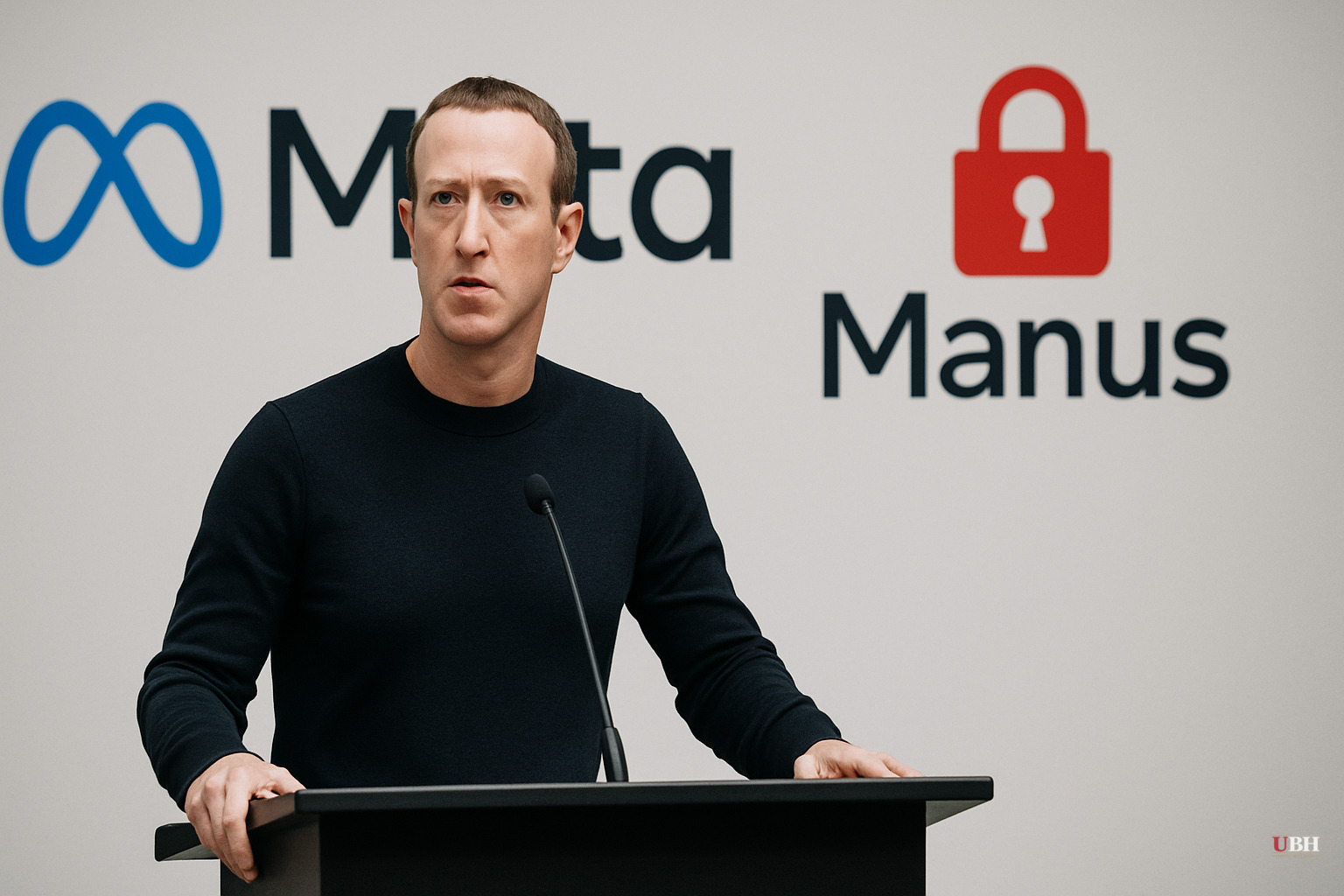
Since Chinese regulators ordered the Meta-Manus deal reversed in April 2026, the two companies have been working through the legally unprecedented process of dismantling a completed acquisition. As of this week, that process has taken its sharpest operational form yet.
According to Bloomberg News, Meta has barred Manus staff from accessing its internal data systems since the start of June. Meta employees, in turn, can no longer use Manus tools for internal projects. An internal memo viewed by Bloomberg describes Meta as "sunsetting" Manus, with staff directed to migrate existing Manus projects onto Meta's own systems and to not start new work on the platform.
The Business Times (Singapore), which published reporting on June 11, described it plainly: Meta has "effectively erected a firewall" between itself and the Chinese-founded agentic AI service.
What Beijing Actually Objected To
Manus moved its headquarters and core teams from China to Singapore in 2025, then agreed to be acquired by Meta in December of that year. The relocation was widely understood inside the Chinese startup ecosystem as a strategic move to access Western capital and sidestep scrutiny.
Beijing saw it differently. Chinese regulators invoked the country's foreign investment security review mechanism and, in April, issued an order to unwind the deal. Legal experts told Bloomberg the reversal order was unprecedented under that framework.
The underlying objection, according to reporting across CNBC, Times of India, and Business Times, was that the transaction involved sensitive technology and talent — specifically, AI engineers whose knowledge of the system architecture cannot be deleted even if code repositories are.
"Once another company's engineers have been inside your stack, you can delete the repository, but you can't make them unsee what they've seen," Matthias Hendrichs, a Singapore-based adviser to global AI firms, told Bloomberg.
This observation points to why the unwind is messy regardless of how cleanly the operational split is executed.
The Strongest Case for Beijing's Concern
China's critics will frame this as authoritarian overreach, a government blocking a completed commercial transaction between private parties. That framing has merit, because it is largely accurate on the surface.
But the strongest good-faith version of Beijing's position is this: a company built on Chinese talent, Chinese research infrastructure, and technology developed inside China relocated its legal address to Singapore specifically to access foreign capital in ways that would otherwise be restricted. The "Singapore washing" tactic, as Han Shen Lin, China managing director at The Asia Group, described it to Bloomberg, is a real phenomenon. Regulatory systems worldwide struggle with legal-entity arbitrage of this kind. The question of whether a country has a legitimate interest in technology built by its citizens, even after those citizens leave, is genuinely unresolved in international law.
Beijing's mechanism for asserting that interest, however, is retroactively ordering a completed deal reversed. This has no clean parallel in U.S. or European regulatory practice, and the extraterritorial logic it implies creates obvious problems for any cross-border tech deal involving Chinese-origin founders.
What Happens to Manus Now
With Meta pulling out, Manus founders are exploring options to survive as an independent company. According to Business Times, those options include raising approximately $1 billion to fund a buyback of Meta's stake.
No deal has been announced, and the fundraising is described only as being under exploration. Given that Manus just became the highest-profile cautionary tale in the Chinese AI startup world, investor appetite for that round remains uncertain.
Meta, for its part, spent $2 billion on an acquisition it has now been ordered to give back. The company has not publicly commented on the financial terms of the unwind or whether it expects to recover its investment.
The Wider Damage
The precedent here extends well beyond Meta and Manus. Hendrichs told Bloomberg that "Chinese-origin AI now carries a kind of reversibility risk that no clever deal structure can price out." That is a direct warning to every U.S. tech firm considering acquisitions of AI companies with Chinese roots, regardless of where those companies are incorporated.
Beijing simultaneously signaled to its own tech sector that offshore relocation does not erase Chinese regulatory jurisdiction. Han Shen Lin told Bloomberg the episode delivers "a lesson to Washington that shining a light on ownership structures may be just as effective as any prohibition."
The unresolved question now: when Manus eventually raises capital or restructures, will Beijing treat that new entity as sufficiently separate from the original Chinese-origin company, or will it remain subject to the same oversight that killed the Meta deal? No Chinese regulator has answered that publicly.
Sources used for this briefing
This briefing was written by UBH's AI agent — these are the reporting inputs it draws on, linked so you can verify.


