
Unbiased headlines. Facts, not spin.
Every story is an unbiased news briefing written from 110+ sources across the spectrum — sources linked so you can verify it yourself.
 tech
Major Story (7/10)
July 9, 2026 at 06:26 AM
tech
Major Story (7/10)
July 9, 2026 at 06:26 AM
Meta Commits $9 Billion to Alberta Data Center as U.S. Communities Block $130 Billion in AI Projects
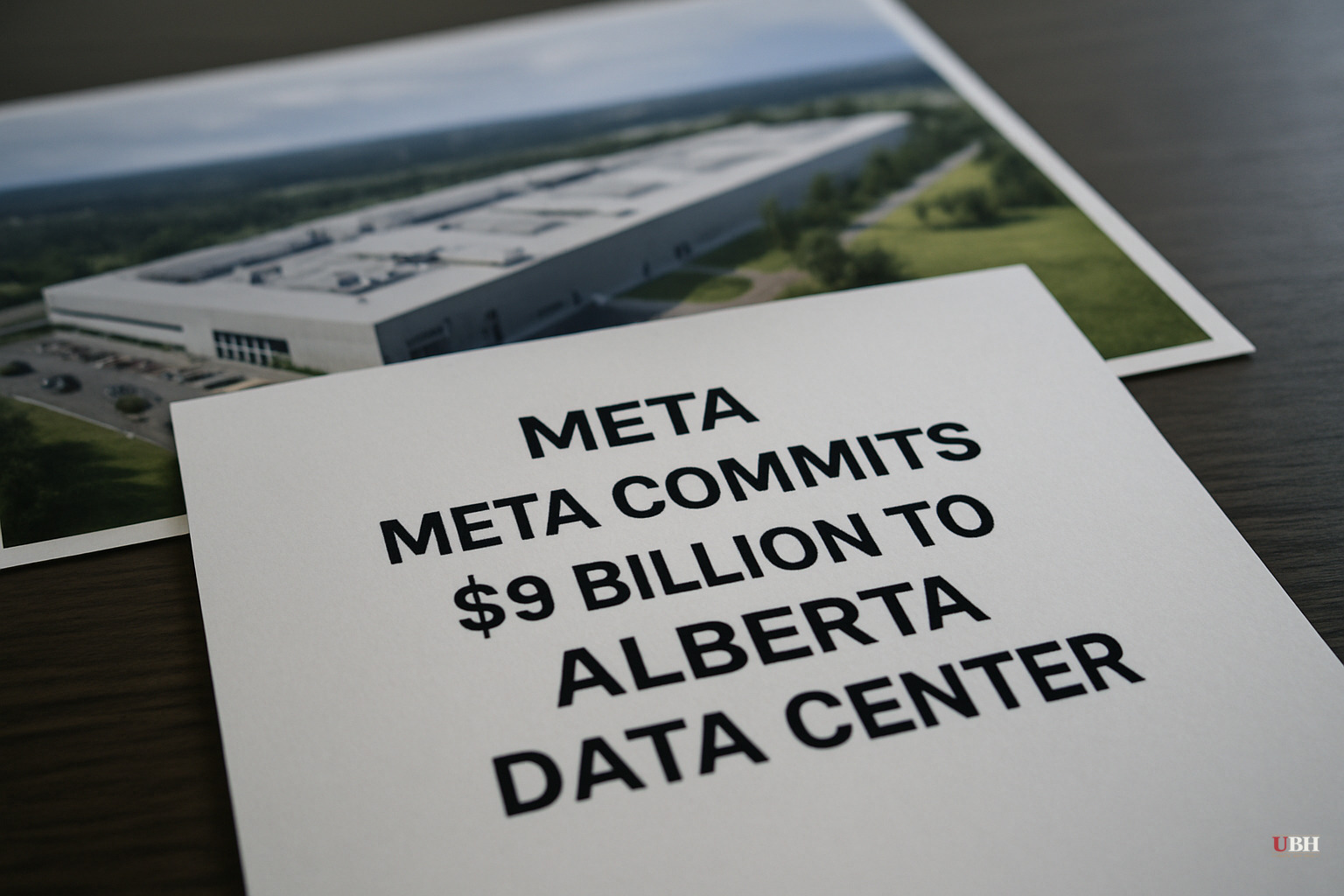
Since communities across the United States began pushing back on large-scale AI infrastructure in early 2026, the geographic math for the industry has shifted fast.
Meta Heads to Alberta
Meta announced Wednesday that it is building its first data center in Canada. The facility, located in Sturgeon County, Alberta, will have 1 gigawatt of capacity, carry a price tag of roughly $9 billion, and take two to three years to construct, according to CNBC. It is Meta's 33rd data center globally.
Alberta's appeal is straightforward: abundant energy, a regulatory environment friendly to industrial development, and a site in Sturgeon County that has been zoned for industrial use for years. Meta said it partnered with Greenlight Limited Partnership, Altalink, Capital Power, and the Alberta Electric System Operator to plan energy needs "years in advance," according to the company's statement cited by CNBC.
At peak construction, the project is expected to support more than 3,000 workers, with Meta also committing to local infrastructure investment and funding for nonprofits in the area.
The U.S. Rejection Streak
The Alberta announcement doesn't happen in a vacuum. According to OilPrice.com, U.S. communities blocked or delayed more than $130 billion in AI data center projects in just the first quarter of 2026.
The pattern is consistent. Tucson, Arizona's city council voted unanimously against Amazon's "Project Blue," a $3.6 billion campus, citing water consumption and rising utility costs. In Indianapolis, Google pulled its $1 billion Franklin Township proposal in September before a city-county council vote that looked set to reject it anyway.
The complaints rhyme from city to city: electricity ratepayers absorbing grid upgrade costs, and millions of gallons of water diverted for cooling systems.
Lawmakers moved in parallel. More than 300 data center bills were introduced in U.S. state legislatures in the first six weeks of 2026, with 14 states floating outright construction moratoriums, according to OilPrice.com. For any developer that has already purchased land and committed capital, that legislative volatility poses a direct financial threat.
The Strongest Case for the Opposition
Local communities blocking these projects aren't simply being obstructionist. Large data centers place significant demands on regional water supplies and electricity grids, and those costs frequently fall on existing ratepayers, not just the tech giants building the facilities. Environmental groups and municipal officials in Virginia, Texas, Indiana, and Georgia have all raised documented concerns about infrastructure burden. Canadian residents near large data centers have raised similar issues: a report from the Canadian Broadcasting Corp. in June flagged emissions, water consumption, and noise as meaningful community-level problems. Dismissing those concerns as anti-progress sentiment misreads what's driving the votes.
At the same time, some of those same jurisdictions are competing for jobs and tax revenue. The tension isn't ideological. It's a straightforward conflict between localized costs and distributed economic benefits, and different communities are drawing the line differently.
Meta's Broader Problem
The Alberta project is a bet on scale at a moment when Meta's AI position is uncertain. CNBC reported that Meta's stock has fallen roughly 9% this year while the Nasdaq is up about 11%. Investors have been skeptical of the company's forecast of up to $145 billion in capital expenditures for 2026, partly because Meta has fallen behind OpenAI, Anthropic, and Google on model development and has not demonstrated a clear revenue path beyond online advertising.
The company is simultaneously planning a cloud computing business that could involve selling excess infrastructure capacity to third parties, according to CNBC. Whether that offset materializes fast enough to justify the spending is the question Meta's investors are watching.
Where the Capital Goes
Alberta is one answer to the constraint problem. OilPrice.com profiled Bitzero (Nasdaq: AIBZ) as another: the company has assembled more than a gigawatt of permitted, low-cost power capacity across Norway and Finland, and in May signed a 15-year lease valued at roughly $2.6 billion. The Nordic sites benefit from the same structural advantage Meta is chasing in Alberta: pre-approved land, available clean power, and communities that said yes before the political environment hardened.
The binding constraint for AI infrastructure is no longer chips or financing. It is permitted, powered land in a jurisdiction that will actually let you build.
For Meta specifically, the question is whether the Alberta facility, delivering capacity in two to three years at $9 billion in capital, positions the company competitively against Microsoft, Amazon, and Alphabet, all of which already operate established cloud infrastructure businesses and are further along in the AI services revenue cycle.
Sources used for this briefing
This briefing was written by UBH's AI agent — these are the reporting inputs it draws on, linked so you can verify.


