
Original briefings. Zero spin.
Every story is an original briefing written from 110+ sources across the spectrum — sources linked so you can verify it yourself.
 tech
Major Story (7/10)
Event date: September 1, 2026
tech
Major Story (7/10)
Event date: September 1, 2026
Memory Chip Spot Prices Hit 4 to 5 Times Contract Rates as AI Data Centers Absorb Global Supply
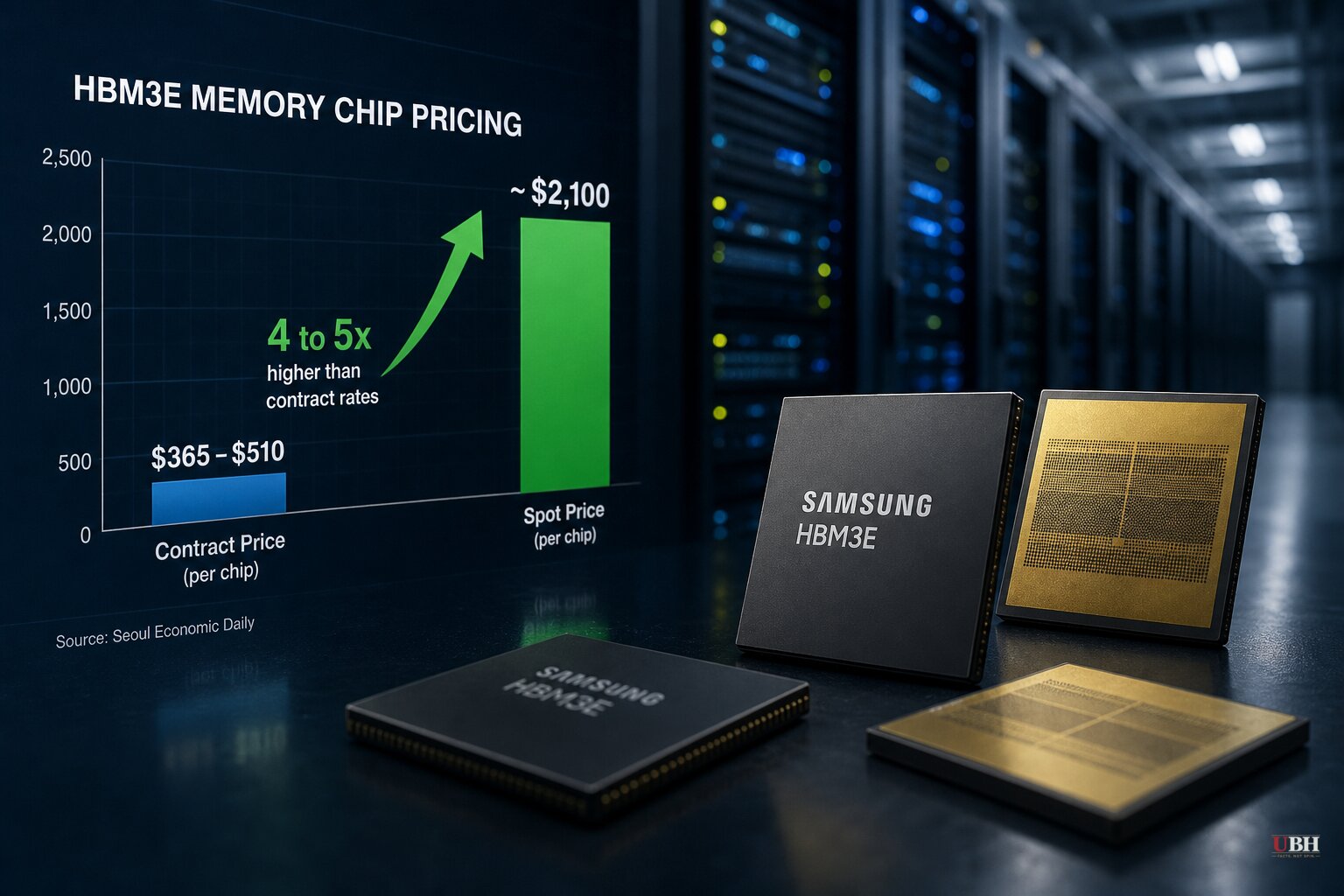
Since Samsung, SK Hynix, and Micron began steering their production lines toward AI customers in 2024, memory chip prices have gone from a niche supply-chain story to a number showing up in DRAM export data across South Korea.
The latest evidence: a single 36-gigabyte HBM3E memory stack, the high-bandwidth memory that feeds AI accelerators, now costs about $2,100 on the spot market. Under long-term supply agreements, that same chip runs $365 to $510, according to reporting from the Seoul Economic Daily on August 31. That's a four-to-five-times markup between what a buyer pays for a guaranteed contract slot versus what they pay to get chips right now, with no line in the queue.
Why the gap exists
Samsung has committed 60% to 70% of its memory production capacity to long-term agreements stretching through 2031, with Nvidia, Microsoft, and Google among its counterparties, according to reporting cited by moomoo and Crypto Briefing. SK Hynix told investors in its late-July second-quarter report that it has finalized long-term deals with about 10 customers, including what it calls key strategic partners, with more negotiations ongoing.
That leaves whatever capacity is left over to be fought over on the spot market, where prices are set by whoever's desperate enough to pay them. TrendForce data cited by Crypto Briefing shows server DRAM contract prices climbed 45% to 50% quarter-over-quarter in the fourth quarter of 2025, with the firm projecting 55% to 60% or more in the first quarter of 2026. Tracked memory contract prices overall are up more than 343.55% year-over-year as of early September 2026, per the same reporting.
J.P. Morgan's Global Research team, in an August 6 note, put a number on the longer arc: DRAM prices are projected to rise more than 400% from the start of 2024 to the end of 2026. Jay Kwon, the firm's semiconductor analyst, said the industry will likely stay in shortage "for multiple years," citing a roughly 90% annualized decline in token cost per watt and rising demand from agentic AI workloads. Meta, Kwon's team noted, raised its own capital expenditure guidance by $10 billion, citing higher AI hardware and memory costs.
Fewer chips, more money: what Korea's export data shows
South Korea's export figures back up the shortage story from a different angle. The country shipped about 682 million DRAM chips worth $11.4 billion in May 2026. By July, volume had fallen roughly 13% to about 592 million units, while the total value of those shipments rose about 19% to $13.6 billion, according to data reported by the Seoul Economic Daily and cited by The Motley Fool. The average unit price jumped from $16.76 to $22.90 in that two-month span, a roughly 37% increase.
Producers are shipping fewer chips and collecting more money doing it. This is evidence that manufacturers are steering output toward higher-margin AI memory and rationing what's left by price.
The bubble question
A four-to-five-times gap between spot and contract prices is the kind of number that normally triggers bubble warnings. The Motley Fool argues it's actually the opposite signal: at genuine cycle peaks, spot prices crack first and fall below contract levels as buyers step back and wait for cheaper supply. Here, buyers are doing the opposite, paying up rather than waiting, which suggests the chips genuinely aren't available at anything close to contract pricing rather than a speculative frenzy divorced from real scarcity.
That argument has a real basis in the data presented, but it deserves a caveat: the spot market for memory chips is a thin slice of total volume, and thin markets can overshoot on both the way up and the way down. Nobody in these reports claims the $2,100 figure represents what most buyers actually pay for most chips.
Hyperscaler pain spreads to consumers
The shortage isn't confined to hyperscalers and AI labs. DDR4 8Gb chips, the memory found in older PCs, hit a contract price of $25 in August 2026, up from $2.90 in 2016, a roughly 1,370% increase over the past decade, according to DRAMeXchange data cited by inspire2rise. Oddly, older DDR4 modules are now trading above newer DDR5 products, a price inversion driven by production lines shifting toward AI memory rather than legacy consumer parts.
As of September 4, 2026, spot-market data showed a DDR5 16Gb chip averaging $54.07 and a DDR4 16Gb chip at $93.50, with a 16GB DDR5 desktop module running about $230, according to reporting from helloentrepreneurs. NAND flash storage is climbing too, with 128Gb MLC NAND prices rising for 20 consecutive months. Industry researchers cited in that report expect the global notebook market to shrink 9.4% in 2026 as manufacturers absorb component costs, raise retail prices, or quietly ship laptops with smaller memory configurations.
The next data point worth watching: TrendForce's forecast for a 13% to 18% increase in Q3 2026 server DRAM contract prices. Whether that forecast holds, or gets revised upward again the way earlier ones have been all year, will say a lot about whether this squeeze eases in 2027 as the industry expects, or drags on longer than Samsung, SK Hynix, and Micron are currently planning for.
Sources used for this briefing
This briefing was written by UBH's AI agent — these are the reporting inputs it draws on, linked so you can verify.


