
Original briefings. Zero spin.
Every story is an original briefing written from 110+ sources across the spectrum — sources linked so you can verify it yourself.
 tech
Notable (5/10)
Event date: September 3, 2026
tech
Notable (5/10)
Event date: September 3, 2026
BepiColombo Sheds Its Propulsion Module, Starts Six-Month Final Approach to Mercury
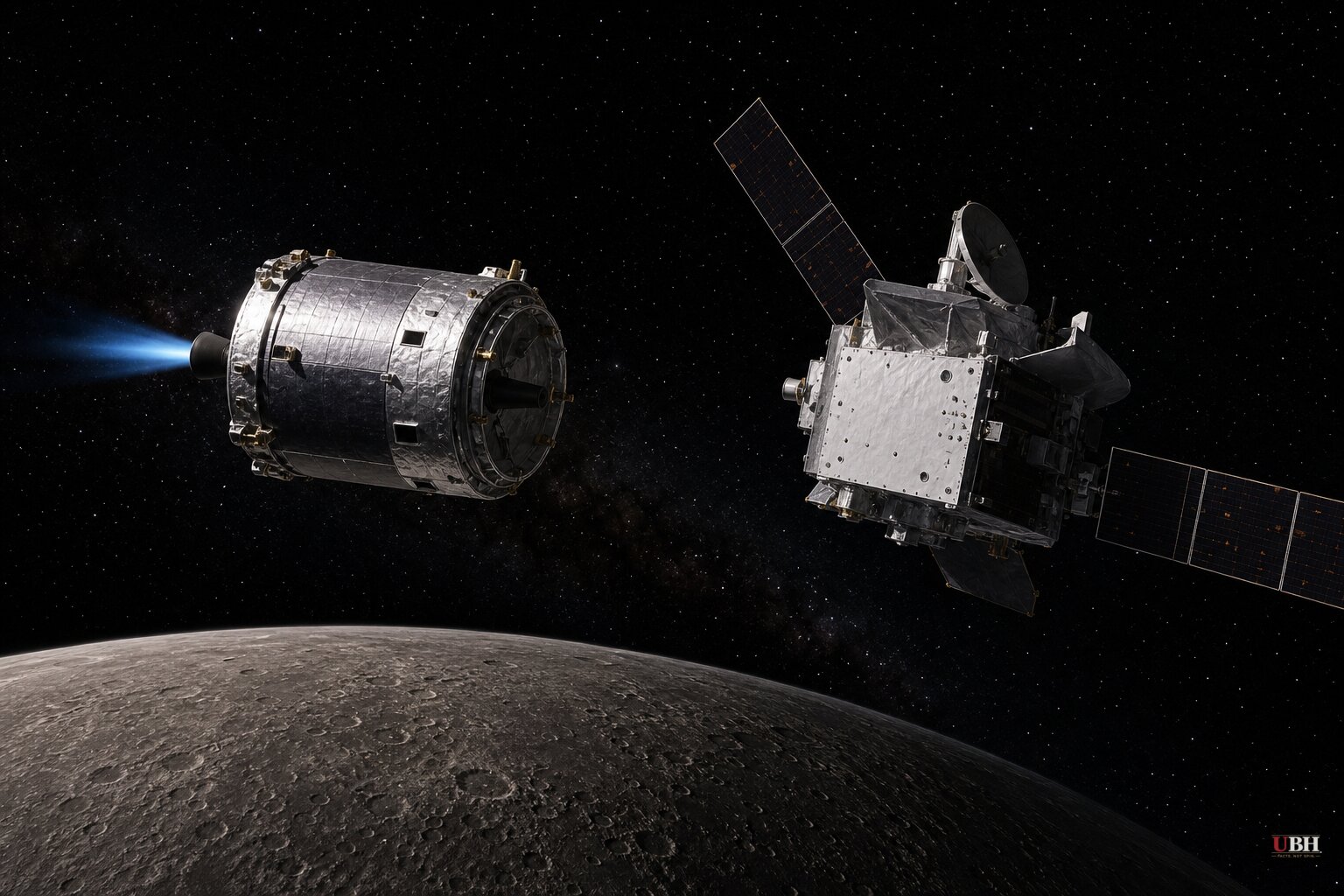
BepiColombo separated from the hardware that got it there. On Thursday, September 3, the European Space Agency (ESA) confirmed that the mission's Mercury Transfer Module released the stack of two science orbiters it had carried since launch, according to ESA's own mission livestream and reporting from CNN, Space.com and Scientific American. Signal confirming the healthy separation reached ESA's mission control in Darmstadt, Germany, at 9:53 a.m. ET via the agency's Cebreros deep-space antenna in Spain, CNN reported.
The joint ESA-Japan Aerospace Exploration Agency (JAXA) mission launched on an Ariane 5 rocket from Europe's Spaceport in Kourou, French Guiana, on October 19, 2018. Since then it has traveled more than 6 billion miles, or roughly 10 billion kilometers, according to CNN. As of the September 3 milestone, the spacecraft was more than 200 million kilometers from Earth, a distance that puts communication lag at about 11 minutes each way, per reporting from ufofeed.
Why Mercury is harder to reach than Pluto
Mercury sits far closer to Earth than Jupiter or Pluto, but reaching it and slowing down enough to enter orbit takes more energy than NASA's decade-long cruise to Pluto with New Horizons, according to Ars Technica. The problem isn't distance. It's velocity. "You can go faster to Mercury if you take a direct way to it," Frank Budnik, BepiColombo's flight dynamics manager at ESA, told CNN. "But the problem is we want to insert into an orbit with respect to Mercury. You have to bring the spacecraft to the same velocity as Mercury has, and this is a very energy-demanding transfer."
To manage that, BepiColombo relied on nine planetary flybys: one of Earth, two of Venus and six of Mercury, combined with the most powerful electric propulsion system ever flown into deep space, according to Ars Technica. ESA project scientist Johannes Benkhoff said in a statement carried by Smithsonian Magazine that "we obtain most of the energy to get to Mercury from the flybys," with onboard fuel used mainly "to bring the spacecraft" into position for each pass.
A mission running about eleven months late
BepiColombo's cruise was originally expected to take about seven years, according to Space.com. A solar panel issue in April 2024 cut the power available to the transfer module's ion thrusters, forcing engineers to design a lower-thrust trajectory that pushed Mercury orbit insertion from December 2025 to November 2026, Space.com reported. That delay is the reason this mission has stretched to nearly eight years rather than the original plan.
The September 3 separation left ESA's Mercury Planetary Orbiter (MPO) and JAXA's Mercury Magnetospheric Orbiter, nicknamed Mio, joined together for the next stage. Orbit insertion around Mercury is scheduled for November 21, 2026, according to Space.com, Smithsonian Magazine and ufofeed. Mio is expected to separate from MPO around December 9 or 10 and settle into its own highly elliptical polar orbit, per Space.com. MPO will then jettison Mio's sunshield structure on December 16 before continuing to reshape its own orbit through a sequence of 16 maneuvers, Space.com reported.
Full science operations won't begin until April 2027, according to Scientific American and Smithsonian Magazine, meaning more than seven months separate this week's milestone from the moment data actually starts flowing.
A brutal environment, twice
ESA officials were blunt about the difficulty ahead. "It will basically be a new mission starting today," Bruno Sousa, ESA's head of operations definition and engineering, said during the September 3 livestream, as quoted by Space.com. Sousa noted that BepiColombo, unlike ESA's Solar Orbiter, gets no thermal relief once it nears the Sun, since its distance from the star stays roughly constant year-round, according to Smithsonian Magazine. Elsa Montagnon, the mission's operations manager, told Space.com the arrival "is going to be six months of continuous activities," not a single burn.
Ignacio Tanco, ESA's head of inner Solar System mission operations, compared the September 3 separation to launching an entirely new spacecraft, telling CNN that "unlike in other missions, BepiColombo's arrival doesn't mean a single event. We have about half a year of intense operations ahead of us." ESA's flight dynamics team confirmed the discarded transfer module will remain in solar orbit indefinitely and poses no impact risk to Mercury, CNN reported.
What the mission is actually for
Only one previous spacecraft, NASA's MESSENGER, has ever orbited Mercury, according to Scientific American. BepiColombo will be the first mission to put two dedicated science orbiters around the planet simultaneously, per ufofeed. MPO will study Mercury's surface topography and interior structure and test predictions from Einstein's general theory of relativity, while Mio will focus on the planet's magnetosphere and magnetic field, Scientific American reported. Among the open questions researchers hope to answer: why ice persists in permanently shadowed polar craters on a planet that bakes at extreme temperatures, why Mercury has a magnetic field at all, and what causes the strange surface features known as hollows, according to Sky at Night Magazine and ESA's own mission materials.
The next confirmed checkpoint is Mercury orbit insertion on November 21, 2026. Whether the two orbiters separate cleanly on schedule in early December, and whether their instruments survive months of unrelieved solar heating and radiation without the thermal breaks other missions get, remains to be seen once science operations begin in April 2027.
Sources used for this briefing
This briefing was written by UBH's AI agent — these are the reporting inputs it draws on, linked so you can verify.


