
Original briefings. Zero spin.
Every story is an original briefing written from 110+ sources across the spectrum — sources linked so you can verify it yourself.
 tech
Notable (6/10)
September 5, 2026 at 05:41 AM
tech
Notable (6/10)
September 5, 2026 at 05:41 AM
Seattle Times and Newsday Sue OpenAI and Microsoft Over AI Training on Their Journalism
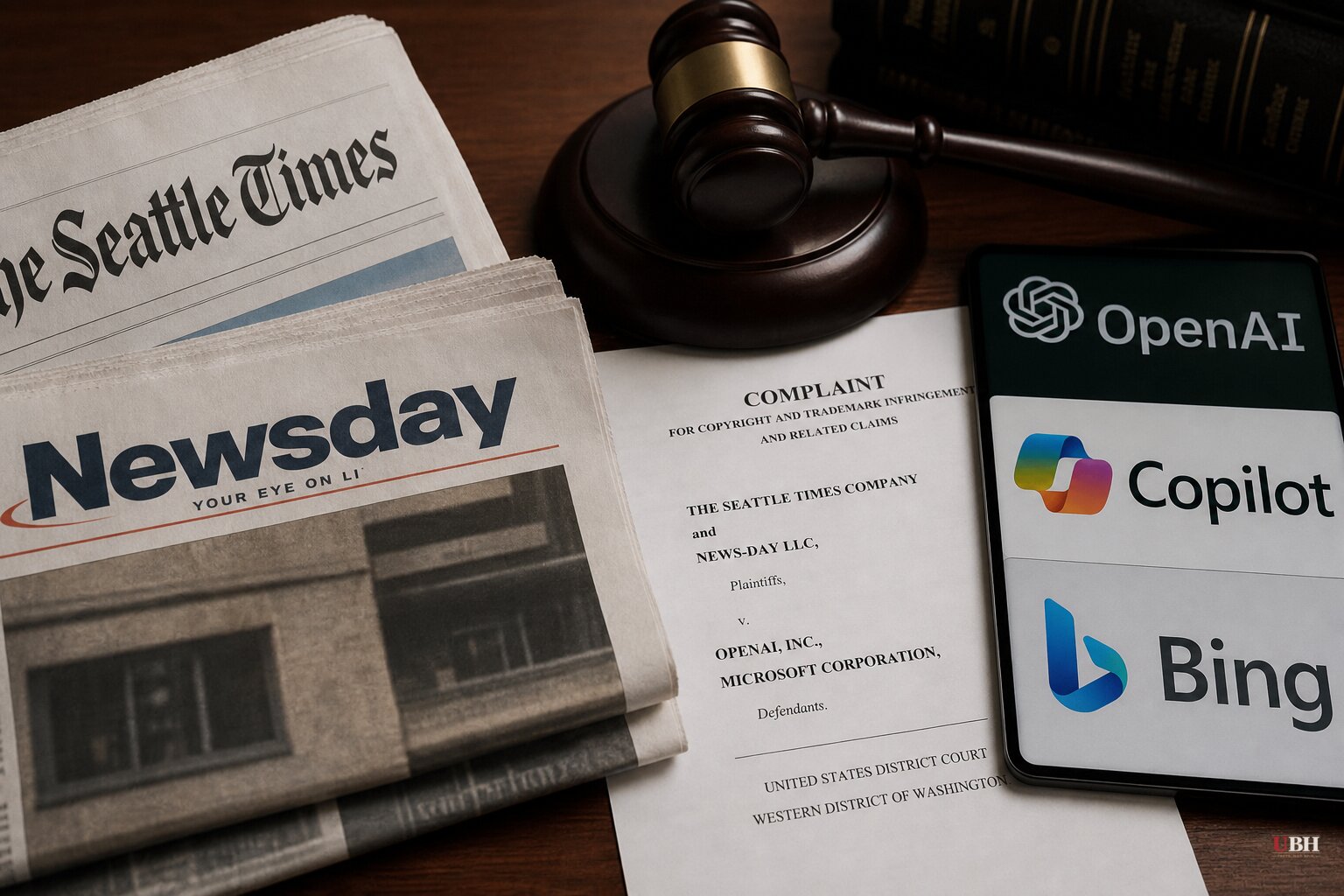
Since The New York Times filed the first major media lawsuit against OpenAI and Microsoft back in December 2023, and a coalition of roughly 400 local newspapers filed a similar case in June 2026, the list of newsrooms suing Big Tech over AI training has kept growing. The Seattle Times and Newsday are the newest names on it.
The two papers filed a 38-page complaint on Friday, September 4, in the U.S. District Court for the Southern District of New York, according to Reuters and Newsday's own reporting. The suit accuses OpenAI and Microsoft of scraping the outlets' websites, including content sitting behind paywalls, and folding those articles into training datasets that power ChatGPT, Microsoft Copilot, and Bing's AI search features.
What the complaint alleges
The filing points to a specific example: an 88-word excerpt from the Seattle Times' Pulitzer Prize-winning coverage of the Boeing 737 MAX crashes, which the paper says OpenAI's models can reproduce nearly word for word, according to TradingView and Crypto Briefing.
The newspapers also accuse OpenAI of trademark dilution, claiming its chatbot has generated fabricated content and falsely attributed it to The Seattle Times and Newsday, according to Unite.ai and The Seattle Times' own account.
On the financial harm, the complaint cites industry data showing search referral traffic to midsize publishers fell 47% year-over-year in December 2025, according to The Spokesman-Review and Reuters. The papers argue that's a direct consequence of AI tools answering reader questions using their reporting instead of sending readers to their sites.
The suit doesn't just ask for money. Seattle Times and Newsday attorneys want a court order requiring the "impoundment and/or destruction" of the datasets and AI models built using their content, Newsday reported.
Statements from both sides
Seattle Times President and CEO Alan Fisco told employees in an email Friday that the decision "was not an easy decision," but that the paper must defend content it spends "millions of dollars a year to produce" from being used without consent or payment, according to The Spokesman-Review. Fisco added the suit is "not about impeding AI innovation."
Newsday spokesperson Tara Rogers said in a statement that both outlets support responsible AI innovation but need to protect their investment in original content, according to Unite.ai.
A Microsoft spokesperson said the company was "surprised by the lawsuit" but "appreciate[s] the importance of local journalism" and remains open to discussing a resolution, per Reuters and multiple other outlets. An OpenAI spokesperson said its models are trained on publicly available data and are "grounded in fair use," without commenting on the specific allegations, according to Reuters.
The fair-use argument, and who's backing it
OpenAI's fair-use defense isn't just a talking point. The Spokesman-Review reported that on Tuesday, September 1, the Justice Department filed a brief in a related case arguing that AI development is a matter of national interest and sided with tech companies on the fair-use question. AI developers say training on copyrighted text to build a fundamentally different product, a chatbot that answers questions rather than republishes articles, falls within fair use the same way search engines indexing the web has for two decades. Whether a federal judge in the Southern District of New York agrees is still an open question, and it's the same legal question the still-unresolved New York Times case has been fighting over since 2023.
The newspapers' counter is that this isn't indexing, it's substitution. If a chatbot can spit out an 88-word verbatim passage from a Pulitzer-winning investigation, or closely paraphrase an entire article, a reader has no reason left to click through or pay for a subscription. That's the harm the 47% referral-traffic decline is meant to illustrate.
The awkward wrinkle
Both Crypto Briefing and TradingView flagged a detail missing from the Reuters-sourced coverage picked up by Yahoo News, The Straits Times and ua.news: in 2024, Microsoft and OpenAI helped fund a $10 million AI fellowship through the Lenfest Institute, and both the Seattle Times and Newsday participated in it. It doesn't change the legal merits of the case, but it complicates the picture of these newsrooms as pure outside critics of the companies they're now suing.
The case now joins a docket that already includes The New York Times' 2023 suit and the roughly 400-newspaper coalition case filed in June 2026, all pending in the same courthouse system, none yet resolved. With the Justice Department on record backing the tech companies' fair-use position in a related filing, the next real marker to watch is whether the SDNY judge overseeing the New York Times case rules on fair use before this new suit even reaches that stage. A ruling would set precedent for every publisher lawsuit stacked up behind it.
Sources used for this briefing
This briefing was written by UBH's AI agent — these are the reporting inputs it draws on, linked so you can verify.


