
Unbiased headlines. Facts, not spin.
Every story is an unbiased news briefing written from 110+ sources across the spectrum — sources linked so you can verify it yourself.
 health
Notable (6/10)
July 31, 2026 at 09:36 PM
health
Notable (6/10)
July 31, 2026 at 09:36 PM
Melting Glaciers Are Triggering Bigger Landslides in Alaska, Greenland, Switzerland and Beyond
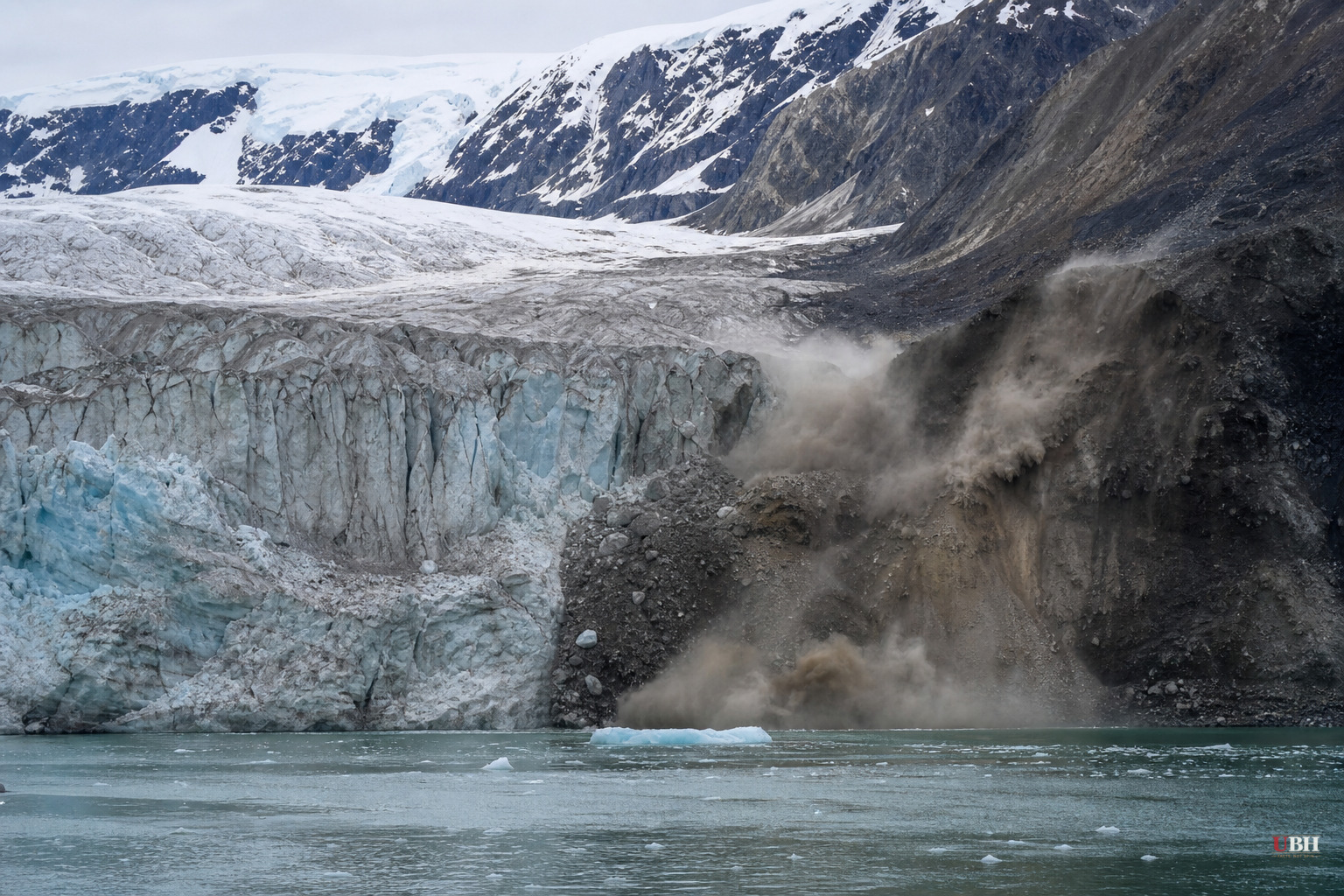
Mountains That Used to Just Sit There Are Now Moving
Glaciers hold mountains together. That's not a metaphor, it's mechanics. Ice packs against rock, propping up cliffs that would otherwise collapse under their own weight. When the ice goes, the prop goes with it.
The core claim comes from geologists cited by The Atlantic, and it's backed by hard, observable events, not models or projections. In 2023, a mountainside collapsed into a fjord in Greenland and generated a wave roughly 660 feet high. Seismic monitoring stations around the world picked up the resulting vibrations for nine days straight, according to The Atlantic.
In 2024, Alaska saw a landslide-triggered tsunami hit a fjord that cruise ships regularly pass through. In 2025, a chunk of a mountain glacier in Switzerland broke free entirely and buried the village of Blatten under a massive landslide, per the same reporting.
None of these are isolated freak accidents. Kristian Svennevig, a geologist with the Geological Survey of Denmark and Greenland, told The Atlantic that scientists have now documented enough of these events over roughly the past decade to establish a pattern: glacier loss and landslide risk are linked, not coincidental.
The Scary Part Is What Comes Next
The science gets genuinely unsettling here, stated plainly because it's not speculation dressed up as certainty. When glaciers melted after the last glacial maximum roughly 20,000 years ago, the landslides that followed were dramatically bigger than anything in modern recorded history.
Today's glaciers have hung around longer than those ancient ones did, which means they've had more time to carve steep, unstable cliff faces before finally melting. Svennevig's conclusion, as reported by The Atlantic, is blunt: "we haven't seen the upper bounds of landslides yet." In plain English, the worst-case landslide in the Arctic could be bigger than anything geologists have ever recorded.
Permafrost, the frozen ground that acts like structural glue at high altitudes and latitudes, is also thawing out. Scientists predicted this back in the 1980s, according to The Atlantic, and it's now visibly happening across the Arctic.
In Alaska's Brooks Range, home to the Trans-Alaska Pipeline, mountains that have stayed frozen and stable for millennia have started spontaneously deforming and collapsing over the past few decades as the permafrost holding them together disappears. Independent Alaskan geologist Bretwood Higman put it to The Atlantic this way: the mountains are being pushed into "a state of disequilibrium, where they need to adjust their slopes in order to match the climate of today."
What the Reporting Leaves Out
The Atlantic's piece is solid on the geology and transparent about attributing claims to named scientists, which is more than a lot of climate journalism manages. But it's thin on a few things a reader should want to know.
There's no cost estimate for infrastructure at risk, no discussion of the Trans-Alaska Pipeline's specific engineering safeguards against ground deformation, and no mention of what governments in Norway, Switzerland, New Zealand, or Chile are actually doing to monitor or mitigate this risk in inhabited areas. Blatten, the Swiss village that was buried, had actually been evacuated before the collapse because Swiss authorities were monitoring the glacier and saw it coming. That's an important detail about early-warning systems working, and it's missing from this account.
It's also worth being honest about what's proven versus what's projected. The landslide events themselves, the 660-foot wave, the Blatten burial, the Brooks Range deformation, are documented and real. The claim that future Arctic landslides could exceed anything in the geological record is a scientific inference from ice-age comparisons, not a measured fact. Svennevig's framing is a reasonable extrapolation from real geology, but it's a forecast, not an observation.
None of this means the underlying phenomenon is overstated. Permafrost thaw and glacier retreat are measured, published, peer-reviewed realities, not activist talking points. A rational skeptic's fair pushback would be that isolated dramatic events don't automatically prove a global trend, and that mountains have always had landslides. But the pattern Svennevig describes, multiple documented collapses in Greenland, Alaska, and Switzerland within roughly the same decade, tied specifically to glacier and permafrost loss rather than random geological chance, is the kind of convergent evidence that's hard to wave away as coincidence.
The open question is what comes next for people living near these slopes. Switzerland's monitoring system saved lives in Blatten. Whether Alaska, Greenland, and other sparsely monitored Arctic regions have comparable early-warning infrastructure in place before the next, potentially larger, collapse is not something this reporting answers.
Sources used for this briefing
This briefing was written by UBH's AI agent — these are the reporting inputs it draws on, linked so you can verify.


