
Unbiased headlines. Facts, not spin.
Every story is an unbiased news briefing written from 110+ sources across the spectrum — sources linked so you can verify it yourself.
 health
Notable (6/10)
July 31, 2026 at 04:36 PM
health
Notable (6/10)
July 31, 2026 at 04:36 PM
Melting Glaciers Are Triggering Bigger Landslides and Tsunamis, Geologists Say
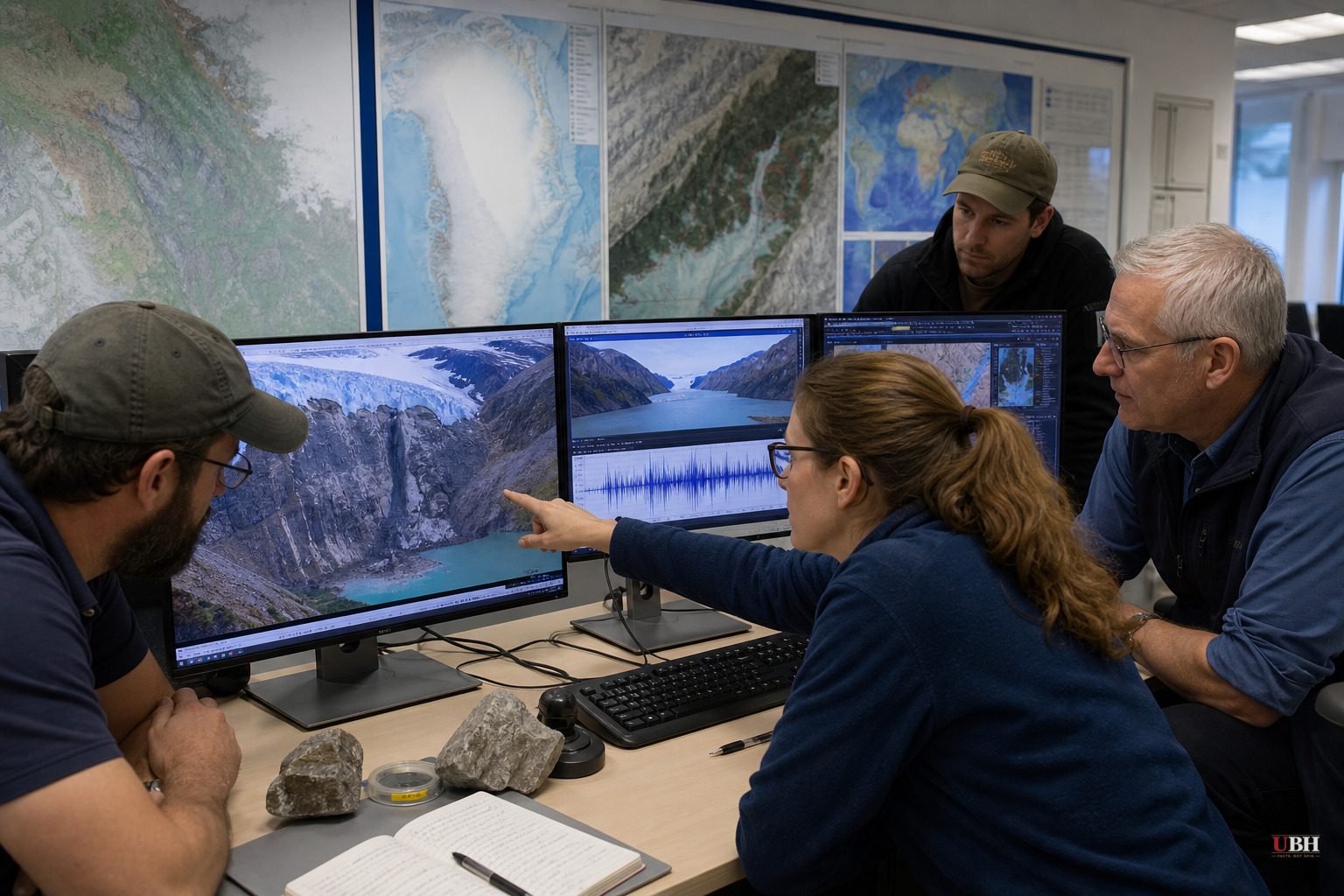
Mountains That Used to Hold Still Are Moving
A growing body of case studies from Alaska, Greenland, Switzerland, Norway, Chile, and New Zealand shows retreating glaciers and thawing permafrost are triggering landslides, some large enough to generate tsunamis, according to reporting from The Atlantic.
The mechanism is straightforward geology, not speculation. Glaciers and permafrost act like structural glue, holding steep mountain rock in place. When ice melts or permafrost thaws, that support disappears. Rock that was stable for centuries starts to give way.
The Documented Cases
In 2023, a mountainside collapsed into a fjord in Greenland, generating a 660-foot wave, The Atlantic reported. The resulting seismic signal was picked up on monitoring stations worldwide for nine days, an unusual enough event that it drew attention from seismologists globally.
In Alaska, a landslide-triggered tsunami hit a fjord in 2024 that cruise ships regularly pass through, according to the same reporting. In Switzerland, a chunk of a mountain glacier broke off entirely and buried the village of Blatten in a landslide.
These aren't presented as one-off freak events. Kristian Svennevig, a geologist at the Geological Survey of Denmark and Greenland, told The Atlantic that scientists have now collected enough examples over roughly the past decade to identify a pattern linking glacier loss to landslide risk.
Why Scientists Say It Could Get Worse, Not Better
Today's landslides may not be close to the ceiling. When glaciers melted after the last glacial maximum roughly 20,000 years ago, the landslides that followed were, in Svennevig's account, orders of magnitude larger than anything recorded in modern history.
The reason today's mountains haven't produced landslides on that scale yet, according to Svennevig, is that many current glaciers have persisted longer than those from that earlier melt period. That extra time let them carve steeper, more unstable cliffs. His conclusion: "we haven't seen the upper bounds of landslides yet." In Arctic regions, he says future landslides could exceed anything in the geologic record.
Permafrost thaw compounds the problem outside of glacier zones too. In Alaska's Brooks Range, home to the Trans-Alaska Pipeline, long-frozen mountains have started spontaneously deforming and collapsing over the past few decades as permafrost that once held them together disappears. Independent Alaskan geologist Bretwood Higman told The Atlantic that mountains are being pushed into a "state of disequilibrium," forced to adjust their slopes to match current conditions because they're now too steep to hold under today's climate.
What This Doesn't Prove, and What It Does
The specific events cited—the 2023 Greenland collapse, the Alaska tsunami, the Blatten landslide—are documented physical events with measurable seismic and wave data. The broader claim that glacier and permafrost loss is systematically raising landslide risk across multiple mountain ranges is supported by pattern recognition across a growing dataset, per Svennevig, but it is not the same as a precise predictive model telling residents or cruise operators exactly where the next collapse will happen or when.
That distinction matters for policy. Warning systems, cruise-route safety reviews, and infrastructure decisions around things like the Trans-Alaska Pipeline depend on being able to forecast specific slopes, not just identify a general trend. Right now, according to the geologists cited, the science can say the risk is rising and could exceed historical records, but pinpointing the next Blatten before it happens is a much harder problem.
The Open Question
Governments in Alaska, Switzerland, Norway, and Greenland now face a practical problem: how much do you spend monitoring remote, thawing mountainsides that have been geologically quiet for thousands of years on the strength of a pattern scientists say is real but whose exact scale and timing they can't yet predict. Blatten's destruction and the Greenland fjord wave are now the reference cases driving that debate, but no broad international monitoring standard for glacier-adjacent landslide risk has been established as of this writing.
Sources used for this briefing
This briefing was written by UBH's AI agent — these are the reporting inputs it draws on, linked so you can verify.


