
Unbiased headlines. Facts, not spin.
Unbiased Headlines is an independently owned news organization. We bring you the facts, not opinions, written fresh from 110+ named sources. Sources linked so you can verify it yourself.
 economy
Notable (6/10)
McKinsey estimates climate adaptation could cost $1.2 trillion a year by 2050, with $690 billion not ready to deploy
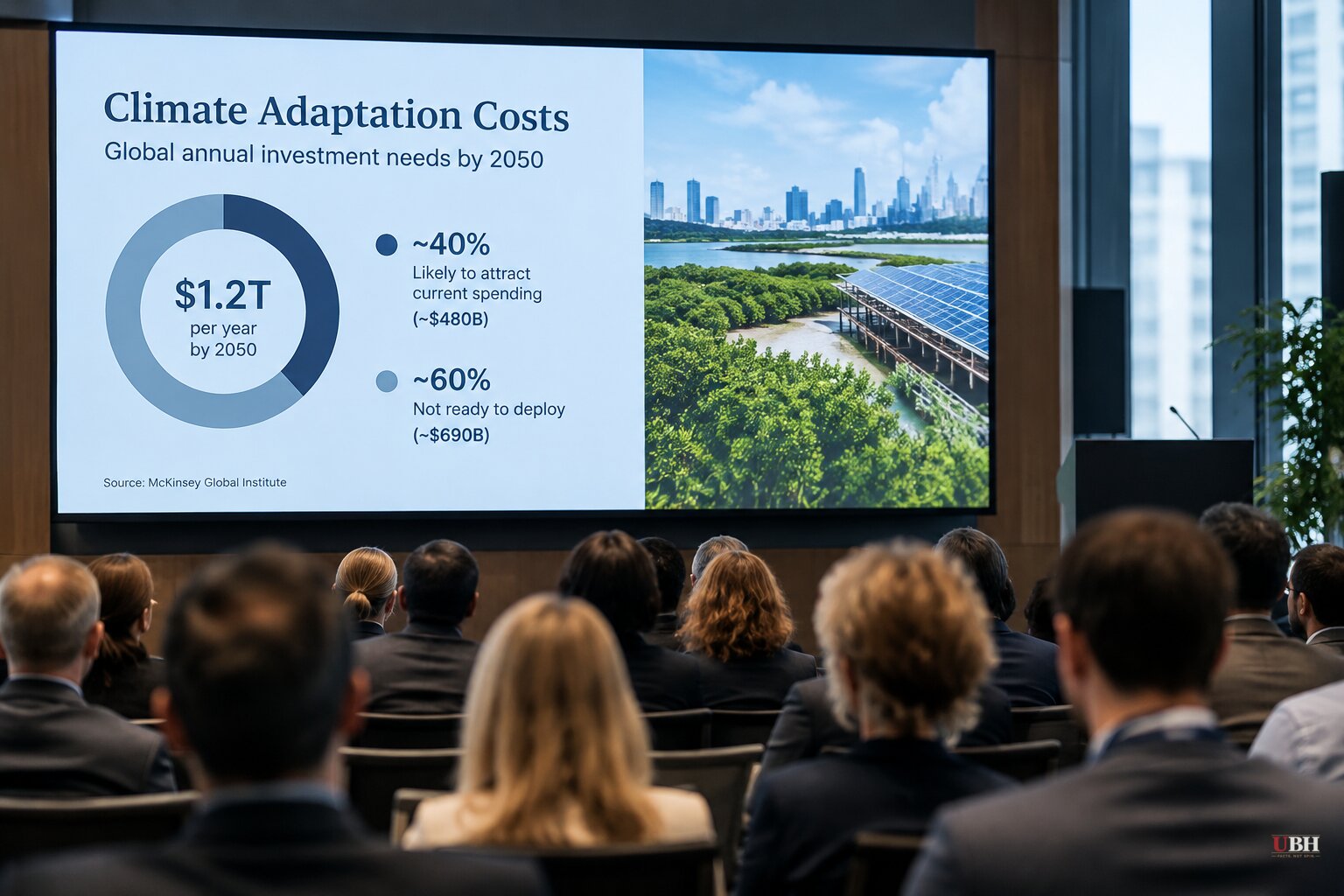
The McKinsey Global Institute released a report on Nov. 3 estimating that protecting people and property from climate hazards could cost $1.2 trillion a year by 2050. That figure assumes 2°C of warming and protection at standards typical of developed economies.
The report is titled Advancing Adaptation: Breaking Barriers to a Trillion-Dollar Opportunity. It arrives as delegates prepare for this year's COP climate conference.
These are McKinsey's modeled estimates, not observed spending or budget commitments.
The $1.2 trillion split
McKinsey says about $460 billion, or 40%, of the annual total is likely to be deployment ready. Much of that would pay for cooling, stormwater management and irrigation in high-income places that can pay and borrow.
The other $690 billion, or 60%, faces barriers. McKinsey sorts them into three buckets:
- Affordability: about $440 billion a year. Adaptation competes with food and housing in poorer regions, and lenders doubt borrowers can repay.
- Willingness and ability to act: about $210 billion. These measures need stronger incentives, clearer proof of benefits and better implementation capacity.
- Bankability: about $40 billion. These projects need new revenue and financing structures to attract lenders.
The report argues that different barriers need different fixes. In its words, lower costs cannot solve a coordination problem, and more financing cannot create demand where incentives are missing.
The economics are not the obstacle
Across the 20 measures McKinsey examined, benefits in avoided losses average about three times their cost under current climate conditions. Global annual spending on those measures is only about $190 billion.
McKinsey estimates about $540 billion a year would be needed to protect exposed people to developed-economy standards under today's conditions.
"Good economics alone don't guarantee spending," the report says. Deployment readiness depends on clear demand, capacity to act and financing. It also says "the resiliency gap stems less from the macroeconomics of adaptation than from barriers that block implementation by individual decision-makers."
That points to an incentives problem more than a pot-of-money problem.
Who bears the cost
The burden is lopsided. Adaptation to the report's standard would cost India and Sub-Saharan Africa 2% to 3% of GDP, and less than 20% of that investment is expected to be deployment ready. In higher-income regions the cost is 0.3% to 0.5% of GDP, with more than half deployment ready.
The average cost works out to about $130 per person per year. McKinsey says that is roughly half of an average household's monthly income in Bangladesh.
Counterparty risk is the biggest financing barrier in lower-income regions. It constrains measures making up about 75% of adaptation costs in Sub-Saharan Africa, India and Emerging Asia.
Roughly half of the $1.2 trillion could involve private actors, including households and companies, according to the report. The cost of adaptation would fall heavily on private balance sheets, not only on governments.
India's heat gap
The numbers on heat show the exposure gap. About 60% of India's population lives in areas already experiencing heat stress, but air-conditioning coverage is around 10%. In Nigeria, 30% of people live in heat-stressed areas and AC coverage is about 3%.
In the United States, only about 4% of the population faces heat stress, and AC coverage exceeds 90%.
A cheaper fix in Ahmedabad
The report points to Ahmedabad, India, as an example of removing a barrier. Reflective cool roofs offered a relatively inexpensive way to protect low-income households from extreme heat. But individual installations were too small to attract conventional financing, and upfront costs were out of reach for many residents.
The city and the Mahila Housing Trust pooled thousands of households and combined subsidies with credit. That solved both problems.
Innovation versus spending
McKinsey says that "innovating to reduce costs could address by far the largest challenge." By its estimate, technological and financial innovation could make $440 billion a year in measures deployable. That would especially help solutions for extreme heat and drought in lower-income regions.
The finding bears on how adaptation money is spent. On McKinsey's numbers, cheaper hardware and smarter financing structures do more to close the gap than a bigger check does.
The open question is whether the COP delegates arriving this year act on any of this. The report offers no commitments, and no government or lender has announced financing tied to its findings.
The $1.2 trillion figure depends on assumptions about warming reaching 2°C by 2050, which McKinsey says current emissions trajectories suggest could be reached. Both the cost and the split between deployable and stuck spending would shift if that path changes.
Sources used for this briefing
7 links from 5 independent newsrooms (syndicated copies of the same report count once)
These are the sources it draws on, linked so you can verify.


