
Unbiased headlines. Facts, not spin.
Unbiased Headlines is an independently owned news organization. We bring you the facts, not opinions, written fresh from 110+ named sources. Sources linked so you can verify it yourself.
 economy
Major Story (7/10)
Event date: November 2, 2026 ·
Floods and a Tornado Force Polling Site Moves in Florida and Oklahoma on Election Day
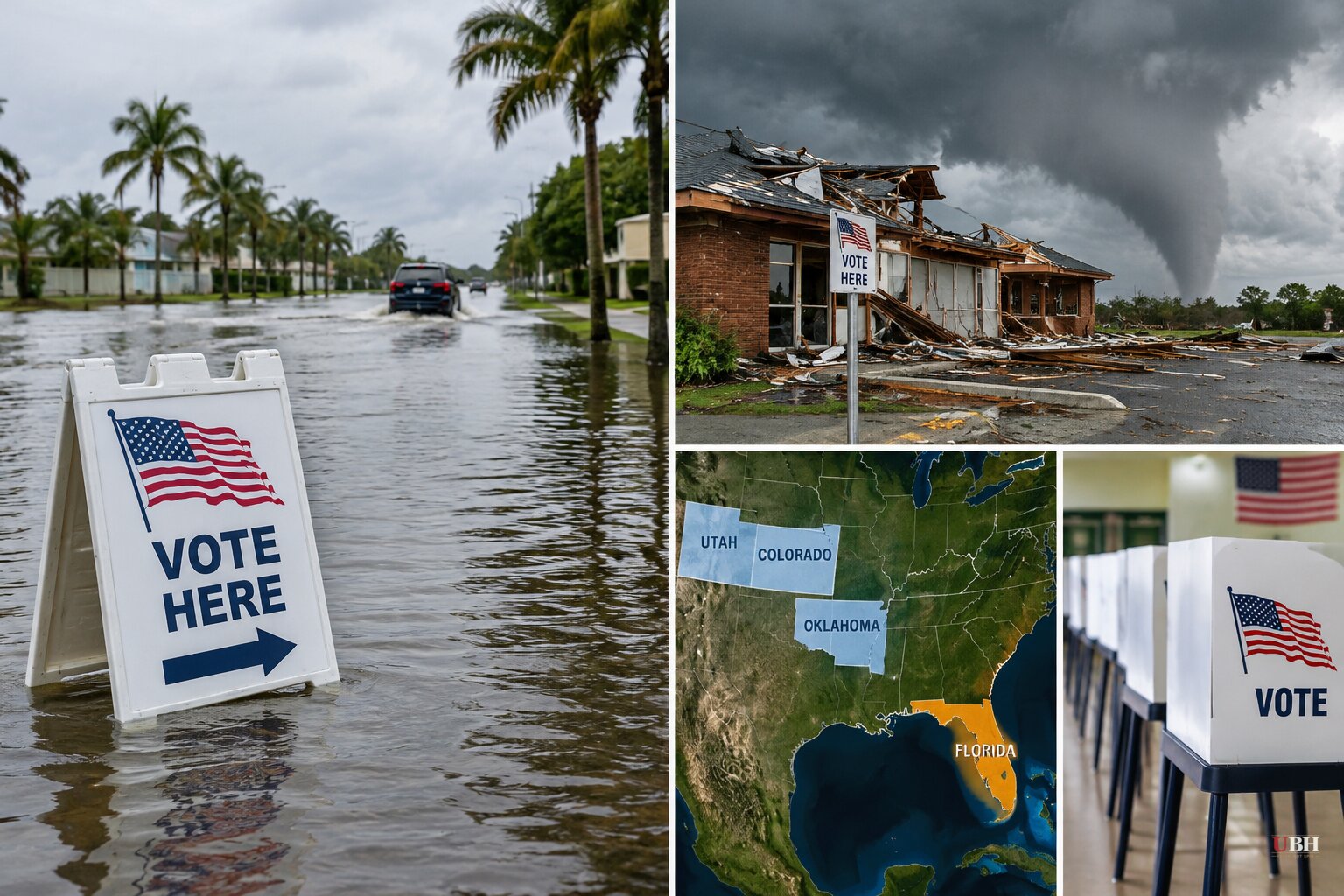
Weather has already forced election officials in three regions to move polling places on Tuesday, Nov. 3, with a storm system still crossing the central U.S.
Florida: 18 sites moved
At least 18 polling locations were relocated across seven Florida counties: Brevard, Highlands, Indian River, Martin, Okeechobee, Palm Beach and St. Lucie. Flash flooding began Monday and carried into Tuesday morning.
A storm dumped as much as 22 inches of rain in 24 hours on the state's Atlantic coast. Palm Bay saw nearly 20 inches in a single day. Roads in several areas were impassable. One forecaster said the storm "exceeded everyone's expectations."
The National Weather Service said flooding was already occurring Monday in parts of Indian River, Martin and St. Lucie counties after 6 to 12 inches of rain. A flood watch remained in effect in parts of Florida Tuesday morning, though rainfall rates were slowing. Forecasters warned that "areas affected by catastrophic flooding remain extremely sensitive to any additional rainfall."
Florida polls generally opened at 7 a.m. More storms are forecast for South Florida Tuesday afternoon, though meteorologist Lissette Gonzalez of CBS News Miami told the Miami Herald, "Thankfully, it is not looking quite as wet."
Oklahoma: tornado hits a polling place
A tornado struck Cimarron County, Oklahoma, on Sunday. The National Weather Service's damage survey put peak winds at about 100 mph. It damaged the roof of the Keyes Community Center and collapsed a wall.
In an emergency request, county election officials said the tornado caused "considerable structural damage," leaving the polling location "unsafe." The county moved the site.
Severe storms also moved across Oklahoma, Texas and Arkansas overnight. A tornado watch for the region ran until about 2:45 a.m. local time Tuesday.
Utah and Colorado: ballots by electronic return
Historic flooding in the Four Corners region has cut off some voters entirely. Utah Lt. Gov. Deidre Henderson declared a state of emergency. She also issued a special accommodation that lets San Juan County voters isolated by floodwaters request and return ballots electronically.
Colorado's secretary of state is allowing a similar option in La Plata and Archuleta counties, according to 9News.
Electronic ballot return is a departure from standard in-person and mail voting. Both states are treating it as an emergency measure for voters who cannot physically reach a polling place.
In New Mexico, a flood warning for part of Rio Arriba County ran until 6 a.m. MST Tuesday, with road closures reported around Chama.
What the storm does next
The system is moving east. The Storm Prediction Center's outlook calls for scattered thunderstorms Tuesday from the Sabine and lower Mississippi valleys north into the mid-Mississippi Valley. A few could produce damaging gusts and a couple of tornadoes. The center rates the risk of severe thunderstorms as marginal, covering East Texas and central Louisiana into southeastern Missouri and southwestern Illinois.
Forecasters see the greatest tornado concern in the Ark-La-Miss region. The severe threat could continue into Tuesday night across northern Mississippi.
The Weather Prediction Center has raised its slight risk of excessive rainfall to include northwestern Missouri and southern Iowa, where 1.5 to 2 inches are forecast on average and some spots could top that. Flash flooding is possible in the Plains and Midwest where storms repeatedly cross the same ground. Flash flooding is also possible Tuesday in parts of Alabama, Tennessee, Arkansas and Mississippi.
The Northeast and mid-Atlantic are forecast to stay largely dry and mild.
Battleground states in the path
Several closely watched Senate races sit under the storm. In Iowa, Republican Rep. Ashley Hinson faces Democrat Josh Turek. In Kansas, Republican Sen. Roger Marshall faces Democrat Adam Hamilton, with wind gusts forecast between 30 and 40 mph. In Michigan, Democrat Abdul El-Sayed faces Republican Mike Rogers, and heavy rain is possible on the west side of the state. In Texas, Democrat James Talarico faces Republican Attorney General Ken Paxton. Skies are expected to clear in north and central Texas, while Houston and the Ark-La-Tex region could see thunderstorms.
Past research suggests weather can matter. Studies of elections from 1948 to 2000 found a modest drop in turnout during unusually intense rainstorms.
The effect may be blunted this year. More than 49 million Americans had already voted early heading into Tuesday, and early ballots in Texas had passed 70% of the state's total 2022 turnout. Most polling places stay open in the rain, though severe weather can force last-minute site changes.
Louisiana: timing against the 8 p.m. close
In Louisiana, polls open at 6 a.m. and close at 8 p.m. The National Weather Service timing puts the worst weather in Lake Charles and southwest Louisiana between 5 p.m. and 9 p.m. Lafayette and surrounding parishes should see the strongest storms and heaviest downpours between 6 p.m. and 11 p.m.
That overlaps the final two hours of voting, and the first hours after the time change leave the evening commute in darkness. Louisiana voters who go early face the least weather risk, and anyone still in line at 8 p.m. will be voting as the storms arrive.
Sources used for this briefing
8 links from 8 independent newsrooms (syndicated copies of the same report count once)
These are the sources it draws on, linked so you can verify.


