
Unbiased headlines. Facts, not spin.
Unbiased Headlines is an independently owned news organization. We bring you the facts, not opinions, written fresh from 110+ named sources. Sources linked so you can verify it yourself.
 tech
Notable (6/10)
Market Estimates Put SK Hynix Ahead of Intel in 2025 Chip Revenue, and Quarterly Gap Passed 3 to 1 by Mid-2026
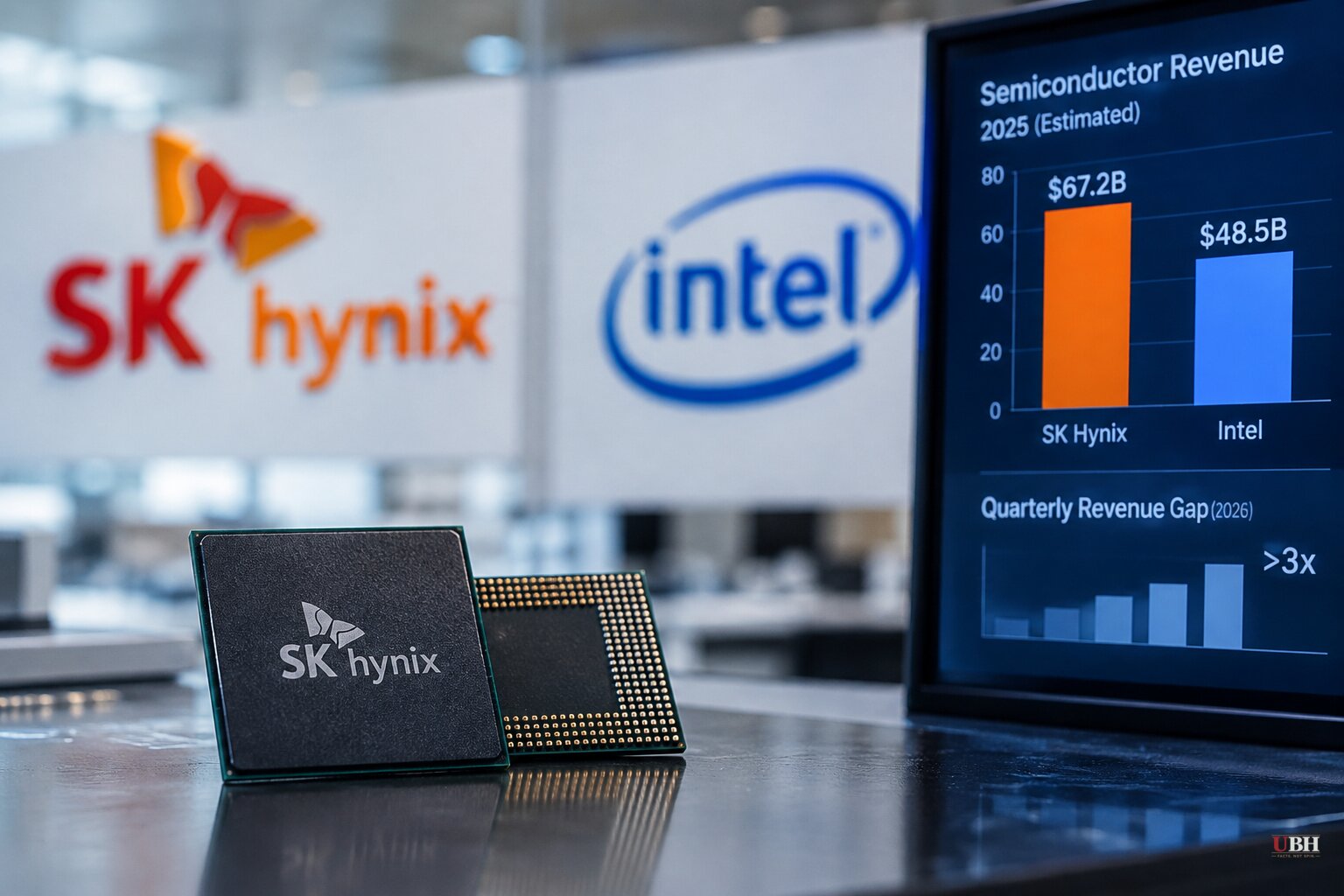
Since AI data-center spending began pulling money toward memory chips, the semiconductor league table has been rearranged. The latest version has SK Hynix in third place and Intel in fourth.
A market-research ranking estimates SK Hynix's 2025 chip revenue at $67.2 billion, up 42.3% from $47.2 billion in 2024. It puts Intel at $48.5 billion, down 3.7% from $50.4 billion. Intel was the only top-10 supplier to shrink in a year when the overall market topped $830 billion.
These are estimates, not filed results. A second preliminary ranking also lists SK Hynix third and Intel fourth, but at $60.640 billion and $47.883 billion. The order matches. The dollar figures do not.
What the companies actually reported
SK Hynix's own FY2025 revenue was 97,146.7 billion won, up 47%, with high-bandwidth memory (HBM) revenue more than doubling. Intel's consolidated 2025 revenue was $52.9 billion, against $53.1 billion in 2024.
On Intel's filed numbers, the company was essentially flat. The research firms' $48.5 billion and $47.883 billion figures are lower than that, so Intel's decline looks smaller on its own books than in the rankings.
The quarterly data still shows a large swing. In Q3 2024, Intel's $13.3 billion beat SK Hynix's $12.9 billion. By Q2 2026, SK Hynix reported $52.6 billion to Intel's $16.1 billion, more than three times as much. SK Hynix's figures are converted from won, so exchange rates affect the comparison.
Why memory is winning
HBM is the memory stacked next to AI accelerators so they are not left waiting on data. SK Hynix holds roughly 50% of that market and remains Nvidia's leading HBM supplier, though Samsung is taking some share.
SK Hynix posted an operating margin of around 76% in the second quarter of 2026, driven by HBM and DRAM, up from 41% in the prior year. Intel has been reporting net losses.
Omdia senior principal analyst Lino Jeng said the demand goes beyond HBM: "AI servers require not only more HBM but also significantly more system memory, particularly DDR5." DRAM revenue nearly tripled from just over $50 billion in 2023 to more than $150 billion in 2025.
Global semiconductor revenue topped $425 billion in the second quarter of 2026, up 31.4% from the first quarter. Memory chips made up more than half of it. First-half revenue reached $752 billion.
Nvidia, Samsung, SK Hynix and Micron grew their combined market share from 24% to 42% over two years. The top 10 companies grew 90% in that period, versus 8% for everyone else.
Intel's response
Intel is spending to catch up. In August it completed an upsized $20 billion common stock offering, selling 210.5 million shares at $95 each, with proceeds earmarked for general corporate purposes including capital expenditures.
On October 6 it announced a technical collaboration with Applied Materials, working at Applied's EPIC Center and Intel's Oregon R&D site. The target is next-generation transistors, interconnect scaling and advanced packaging for AI workloads.
SK Hynix is also building in America. It broke ground in August on an advanced packaging facility in Indiana and has signed a preliminary memorandum to receive federal government grants. The amount has not been specified in the material we reviewed, so the taxpayer exposure is unknown.
China is closing in on memory
The bigger strategic risk sits in China. Reuters, citing four people familiar with the plans, reported that Samsung aims to switch its Xian plant to 286-layer NAND flash by the end of the year. SK Hynix is targeting 240 or more layers at its Dalian plant, which it took over in 2021. No timetable for the Dalian upgrade is clear. Dalian currently makes 192-layer chips, and Xian accounts for about 40% of Samsung's global NAND output.
Both companies need U.S. licenses to install American-made equipment in Chinese factories under export controls imposed in 2022. Samsung and SK Hynix say they are working in consultation with U.S. authorities.
The controls are meant to slow China's progress. Reuters' sources point to them as one reason Chinese firms like Yangtze Memory Technologies (YMTC) have grown. YMTC told investors at a recent IPO preparation meeting that it aims to become the world's largest NAND producer by the end of 2027. A September 2026 report said CXMT, China's largest DRAM maker, is eyeing 3D NAND for SSDs. CXMT posted $22.41 billion in revenue and $11.57 billion in net profit in the first half of 2026 after years of losing money, though it remains much smaller than Samsung, SK Hynix and Micron.
Whether Seoul's two giants can upgrade fast enough under licensing delays is the open question. YMTC's 2027 target and the Dalian and Xian timelines will show who is right.
Sources used for this briefing
4 links from 4 independent newsrooms (syndicated copies of the same report count once)
These are the sources it draws on, linked so you can verify.


