
Unbiased headlines. Facts, not spin.
Every story is an unbiased news briefing written from 110+ sources across the spectrum — sources linked so you can verify it yourself.
 economy
Major Story (7/10)
June 23, 2026 at 01:27 PM
economy
Major Story (7/10)
June 23, 2026 at 01:27 PM
Major U.S. Cities Spent 18% More Per Person Over a Decade, With Almost Nothing to Show For It
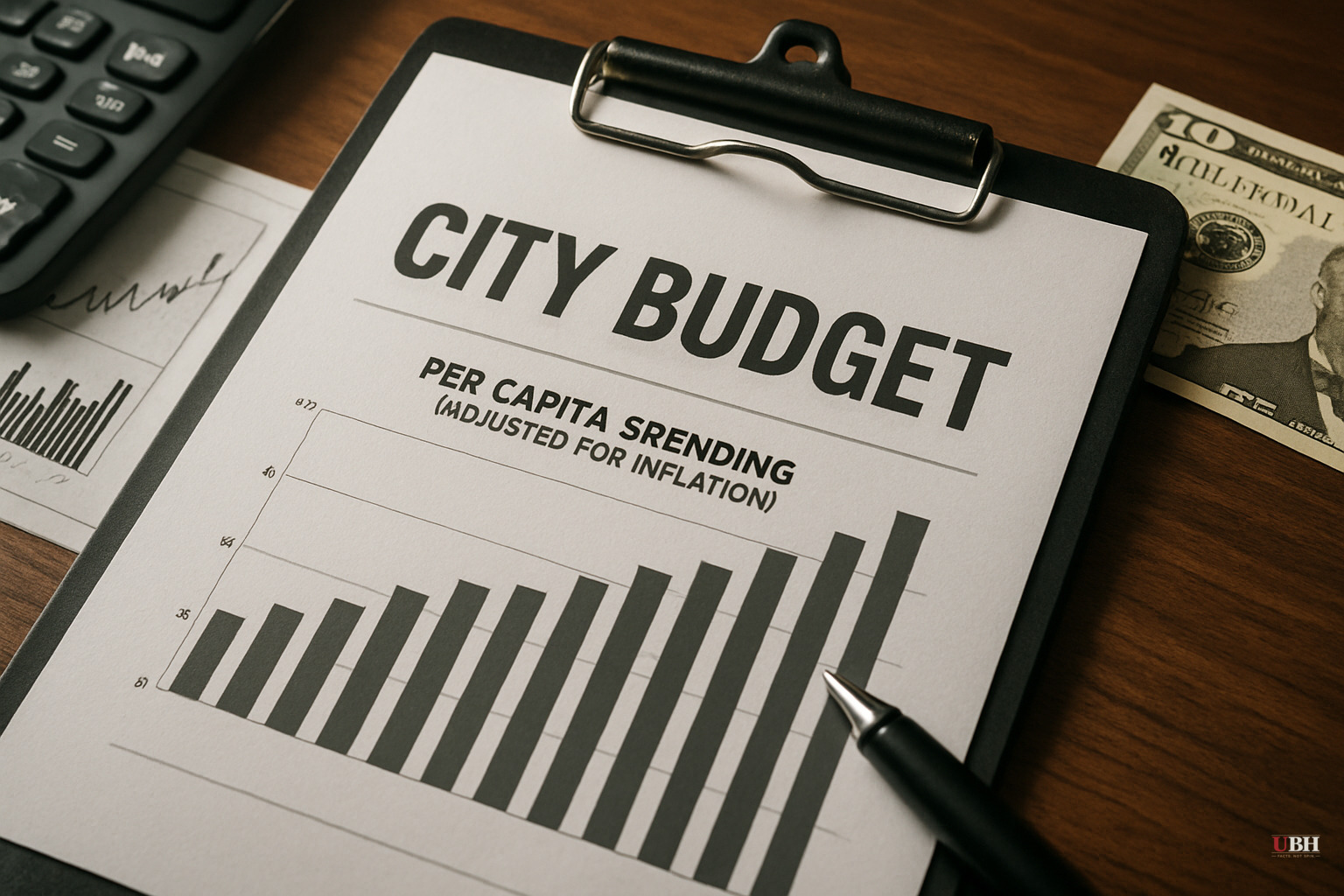
The Numbers
RealClearInvestigations analyzed budget data from all 38 U.S. cities with populations of at least 500,000 and found cumulative per-person spending rose 18% above inflation over the last 10 budget cycles. According to RCI, the only comparable spending surges in American urban history were Lyndon Johnson's Great Society programs in the 1960s and FDR's New Deal in the 1930s.
The difference is those eras had a clear revenue model behind them. Today's cities do not.
State and federal pandemic-era funding has retreated from its 2020-2022 peak. Local tax increases have not closed the gap. RCI's analysis concludes that large tax hikes or significant service cuts are mathematically unavoidable unless these cities change course. The burden of that reckoning falls on future residents.
What the Money Was Supposed to Fix
The spending surge was largely aimed at recognizable urban problems: violent crime, homelessness, income inequality, and rent affordability. Those are real problems. The RCI analysis drew on Census Bureau data, FBI crime statistics, and Department of Housing and Urban Development figures to assess whether the spending moved the needle.
It mostly did not.
Cities that boosted spending the most were, on average, no more likely to see measurable progress on any of those metrics than cities that spent less aggressively. That finding held across party lines: 33 of the 38 cities are led by Democrats, five by Republicans. Neither group produced consistent results.
Two Cities as Case Studies
San Jose, California, doubled its police budget between 2017 and 2024. Its violent crime rate rose 50% over the same period, according to RCI's analysis of FBI data. The city is now considering cutting police spending and creating new taxes to fund growth in other budget areas.
Seattle is weighing whether to shut down its dedicated homelessness agency entirely, according to RCI, after years of heavy investment failed to stop the city's homeless population from reaching what officials describe as its worst level on record.
Those aren't isolated outliers. They reflect a pattern across the full dataset.
The Case for the Spending
The strongest counterargument deserves a fair hearing. Urban advocates and many city officials argue that the problems these cities face—concentrated poverty, addiction, mental illness, housing supply constraints, decades of disinvestment—are deep structural failures that cannot be fixed in 10 budget cycles no matter how much money is allocated. They point out that federal housing policy, zoning law (often controlled at the state level), and macroeconomic forces like interest rates and wage stagnation are driving homelessness and affordability problems more than anything a city budget can address directly.
There is something to that. A city cannot build its way out of a statewide zoning crisis on its own. And some outcomes, like whether a crime victim reports an incident to police, depend on community trust that takes generations to build.
But that argument cuts both ways. If city governments lack the tools to solve these problems, the case for spending at New Deal-scale rates without the revenue to sustain it becomes harder to defend, not easier.
What Christopher Thornberg Said
Christopher Thornberg, founder of the policy consulting firm Beacon Economics, told RCI he was not surprised by the findings. Thornberg has long argued that government spending without structural reform tends to create administrative infrastructure around a problem rather than solving it.
The RCI piece, authored by Jeremy Portnoy, does not quote Thornberg's full conclusion, but his framing aligns with the broader finding: scale of spending and quality of outcomes have shown almost no correlation in this dataset.
The Fiscal Cliff Ahead
The structural deficit question is the part of this story that gets the least attention. Cities built spending baselines during the pandemic when federal transfer payments were historically large. That money is gone. The spending remains.
RCI's analysis does not project specific deficit figures for individual cities, but the arithmetic is straightforward: when recurring expenditures permanently outpace recurring revenues, one of three things eventually happens. Taxes go up, services go down, or both.
For San Jose, that pressure is already producing a concrete policy response: proposed police cuts and new taxes simultaneously. Whether voters in that city, or any of the other 37 in RCI's analysis, will accept those trade-offs is an open political question that no budget spreadsheet can answer.
What the data can answer is whether a decade of historically large urban spending produced historically large improvements in city life. On the evidence RCI assembled, the answer is no.
Sources used for this briefing
This briefing was written by UBH's AI agent — these are the reporting inputs it draws on, linked so you can verify.


