
Unbiased headlines. Facts, not spin.
Every story is an unbiased news briefing written from 110+ sources across the spectrum — sources linked so you can verify it yourself.
 economy
Notable (6/10)
June 24, 2026 at 03:18 AM
economy
Notable (6/10)
June 24, 2026 at 03:18 AM
U.S. Manufacturing PMI Hits Four-Year High in June, but Factory Jobs Fall to Their Lowest Since 2020
Since the U.S.-Israeli war with Iran entered its fourth month, American manufacturers have been responding not by hiring, but by hoarding.
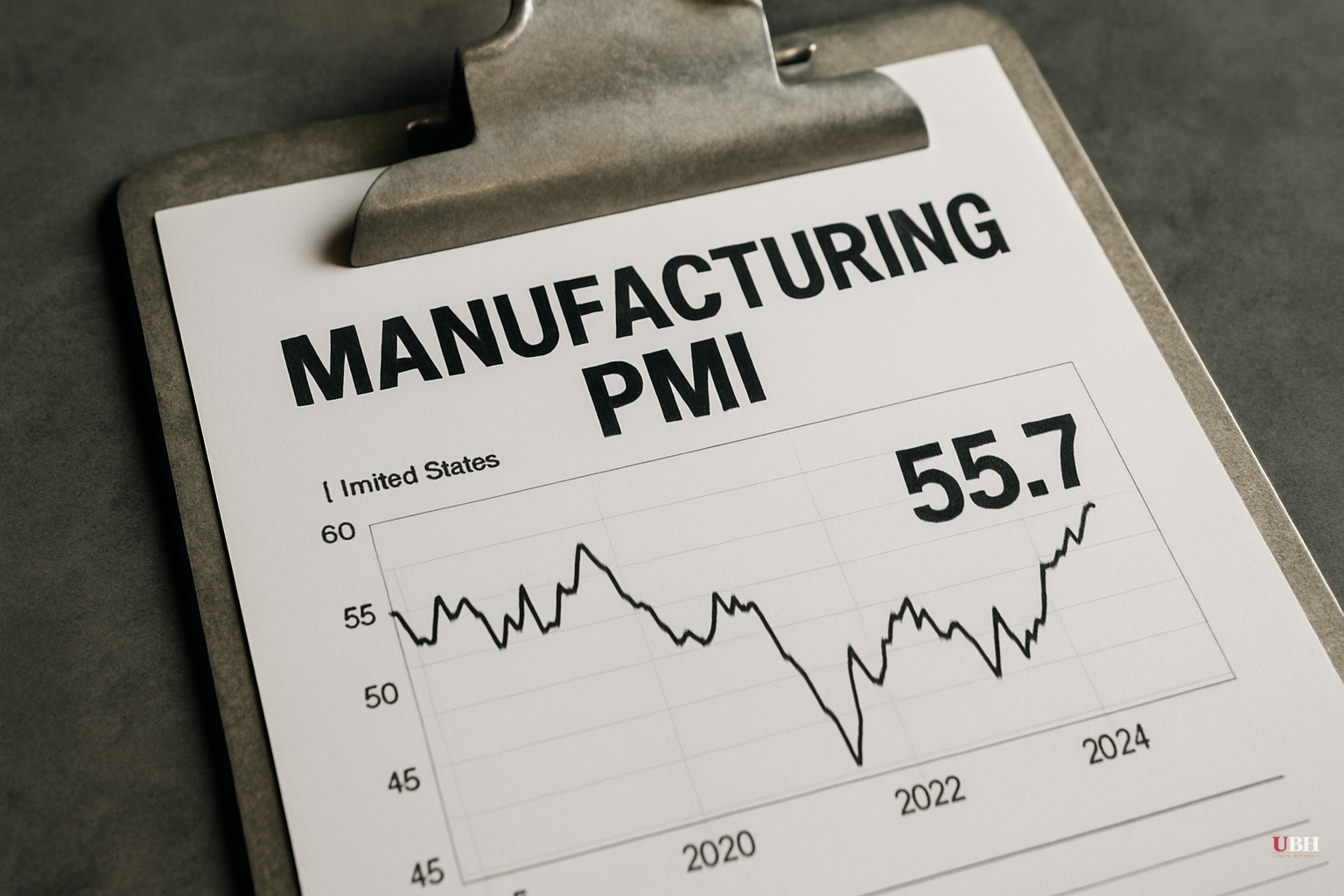
S&P Global released its flash June PMI data on Tuesday, June 23. The manufacturing gauge rose to 55.7, up from 55.1 in May, according to S&P Global's report cited by Reuters. Economists polled by Reuters had forecast a decline to 54.8. Instead, the index hit its highest mark since May 2022 and has now risen for four straight months.
The broader composite PMI, which covers both manufacturing and services, rose to 52.2 from 51.5, a five-month high, according to S&P Global data reported by Business Times Singapore.
What Is Actually Driving the Numbers
Factory growth continues to be temporarily buoyed by inventory building amid supply fears, not by a demand boom. This is a fear-driven inventory sprint.
S&P Global's Chris Williamson, chief business economist at S&P Global Market Intelligence, said directly: "We remain concerned as factory growth continues to be temporarily buoyed by inventory building amid supply fears."
Input purchases by manufacturers surged to the second-highest rate in the survey's nearly two-decade history, according to Trading Economics, which cited S&P Global data. The only comparable episode was the post-tariff stockpiling rush of 2025. Companies are buying materials now because they expect supply chains to tighten further and prices to keep rising, not because customers are lining up with fresh orders.
Delivery times lengthened to the worst extent since August 2022, per S&P Global. Input costs rose sharply, though slightly below May's pace. Prices charged to customers rose at a pace matching May's hot inflation print, which per Breitbart was the highest since July 2025.
The Jobs Number Is a Problem
The manufacturing employment sub-index collapsed to 47.0 in June, down from 51.6 in May, according to Reuters. Anything below 50 signals contraction. That reading is the lowest since May 2020, the depths of the pandemic shutdown.
Williamson put it plainly in the Reuters report: "Factory job cuts are running at the highest since 2009 if the pandemic is excluded."
S&P Global attributed the layoffs to rising overhead costs, particularly raw materials, and to doubts about whether the current demand surge is sustainable. Companies are running lean on headcount while running heavy on inventory. That is a specific bet: they think they can move product later without the labor they are cutting today.
Services employment also contracted for a second straight month, though modestly. That diverges from official Labor Department data, which showed nonfarm private payrolls averaging 166,000 new jobs per month over the three months through May, per Reuters. As Reuters noted, private PMI surveys have historically been poor predictors of the official payrolls count, so neither number should be treated as definitive on its own.
The Iran Peace Track Is Part of the Story
Survey responses were collected June 11-22, per Business Times Singapore. During that window, the U.S. and Iran signed a memorandum of understanding, and Vice President JD Vance said on Monday that talks with Iranian officials in Switzerland "had laid a good foundation for a final peace deal," according to Reuters, despite ongoing tensions over the Strait of Hormuz and Lebanon.
Williamson credited the diplomatic progress in his statement: "Brighter news out of the Middle East has helped restore some confidence among US businesses in June."
Both manufacturers and service providers registered improved future expectations in the survey, per Business Times Singapore, likely reflecting hopes that war-driven cost pressures ease in coming months.
The Strongest Counter-Argument
Skeptics of the pessimistic read have a fair point. Four straight months of manufacturing expansion, a four-year PMI high, the strongest new orders growth since April 2022, and production growing at the fastest pace since July 2021 are not numbers to ignore. If the Iran situation stabilizes and supply chains normalize, companies sitting on large inventories and lean payrolls could be positioned to scale output quickly without the hiring lag that typically slows recoveries. The inventory build could then be viewed not as a red flag but as a rational business hedge that could pay off.
This argument is coherent, but it depends entirely on a peace deal materializing and commodity prices retreating. Neither is confirmed as of June 23, 2026.
Services: Sluggish With a World Cup Asterisk
The services PMI rose to 51.3 from 50.7, according to Reuters. S&P Global and multiple sources noted the FIFA World Cup, jointly hosted by the U.S., Canada, and Mexico, provided a partial lift. Strip out the tournament effect and services growth looks thinner still.
High prices, elevated interest rates, and low consumer and business confidence continue to weigh on the sector, per Breitbart's summary of the S&P Global report. Service providers raised their selling prices at an 11-month high, adding to the inflation picture.
The Open Question
The critical variable going forward is whether the inventory cycle becomes self-defeating. Companies are buying inputs in anticipation of shortages. That buying itself strains supply chains, lengthens delivery times, and pushes up input costs further. If the Iran peace deal stalls, that feedback loop could accelerate into a genuine supply crunch. If the deal holds and commodity costs fall, the inventory overhang could instead suppress new orders for months while factories work down their stockpiles. Trading Economics currently projects the manufacturing PMI to pull back to 54.5 by end of quarter, with a longer-term forecast of around 51.0 in 2027. Whether that trajectory holds depends on a diplomatic outcome that, as of today, remains unsigned and unfinished.
Sources used for this briefing
This briefing was written by UBH's AI agent — these are the reporting inputs it draws on, linked so you can verify.


