
Unbiased headlines. Facts, not spin.
Every story is an unbiased news briefing written from 110+ sources across the spectrum — sources linked so you can verify it yourself.
 economy
Major Story (7/10)
June 24, 2026 at 02:22 AM
economy
Major Story (7/10)
June 24, 2026 at 02:22 AM
House Passes 21st Century Road to Housing Act 358-32, Sending Landmark Bill to Trump's Desk
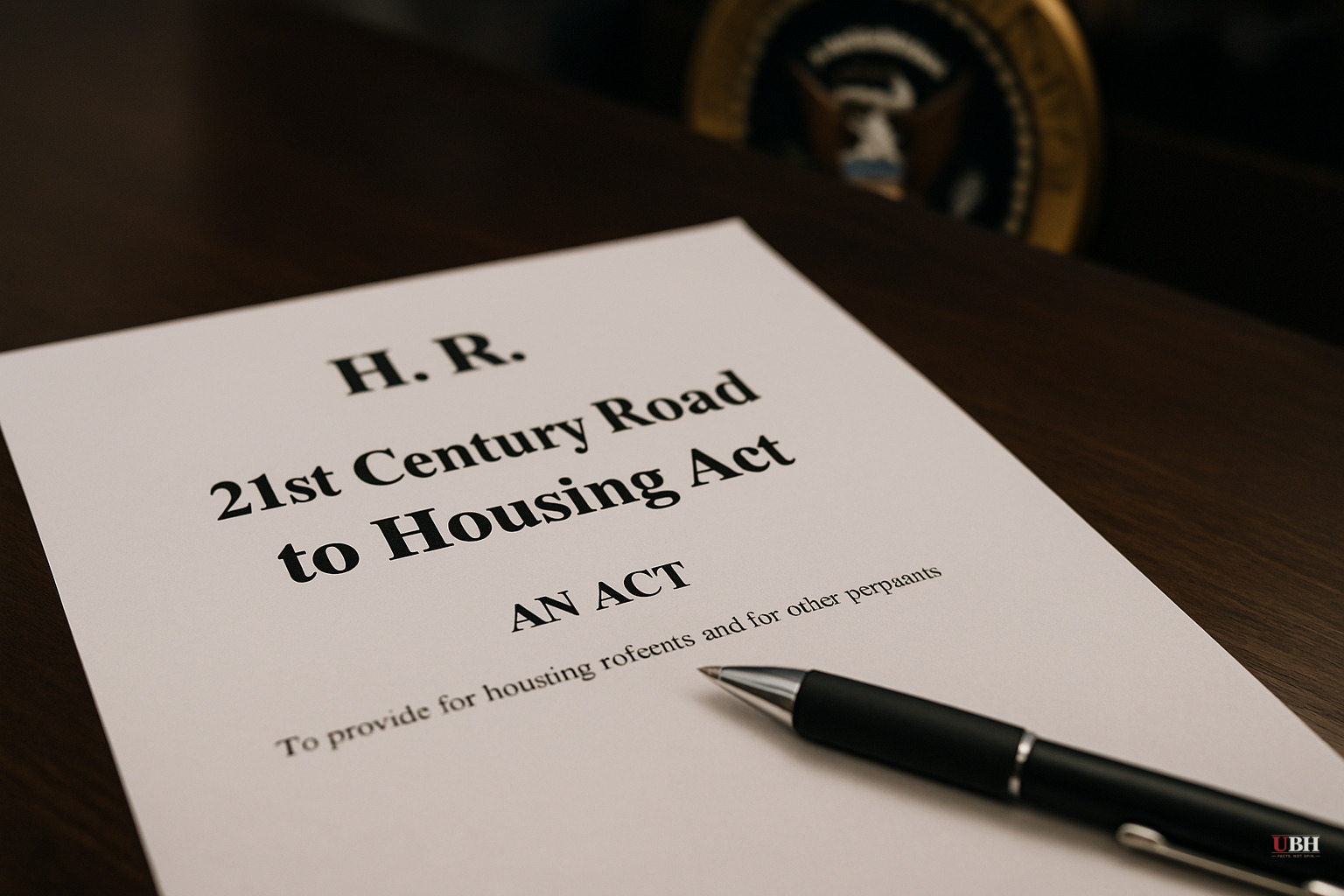
Since our June 22 coverage of the Senate's 85-5 passage of the 21st Century Road to Housing Act, the House completed the legislative process Tuesday with a 358-32 vote, according to NPR and Time. The bill now heads to President Trump, who is expected to sign it.
Only 32 House members voted no. The Senate had five dissenters.
What the Bill Does
The legislation contains more than 50 provisions. The core problem it is trying to solve is straightforward: the United States does not have enough homes. Realtor.com estimated last year's shortfall at more than 4 million units. The National Association of Realtors puts its own figure at 4.7 million, with roughly 310,000 missing homes in the sub-$261,000 range that working families can actually afford, according to NAR research.
Meanwhile, Redfin data cited by NPR shows a household needs about $117,000 a year to afford the typical home on the market. The median U.S. household income falls roughly $30,000 short of that. Mortgage rates, pushed back up to around 6.5% after the Iran war disrupted credit markets, are not helping.
Villanova University assistant professor Jeanna Kenney, who studies real estate economics, put the diagnosis bluntly to NPR: "Supply is the key problem here. Anything you can do to make supply easier is going to be helpful in the long term."
The bill's main supply-side tools include streamlining environmental reviews to speed construction, requiring HUD to issue guidance on zoning and land-use reform, expanding the legal definition of "manufactured housing," and publishing pattern books to reduce design and approval costs for small developers, according to Time's reporting citing Francis Torres of the Bipartisan Policy Center. Torres called it "the most serious that Congress has gotten about housing reforms in a generation."
The Corporate Landlord Provision
The bill includes a cap on corporate investors buying single-family homes to rent out. Under the measure, any entity that already owns 350 or more single-family rental homes cannot purchase additional ones, according to NPR.
Sen. Elizabeth Warren, D-Mass., a co-sponsor, backed it hard, framing it as stopping institutional landlords from using cash offers to outbid families in local markets. Her Republican Senate partner Tim Scott, R-S.C., and House leads Maxine Waters, D-Calif., and French Hill, R-Ark., all supported the final package.
The strongest case against this provision deserves a fair hearing. Ross Marchand, executive director of the Taxpayers Protection Alliance, told NPR the ban "chills investment, and we need more investment in housing stock, not less." His argument: corporate investors often purchase distressed homes that would otherwise exit the market entirely, fix them up, and return them to usable inventory. Capping their activity could actually reduce supply at the margin.
NPR's own reporting provides the relevant context: corporate investors currently account for only about 3% of the single-family rental market nationally. At 3% market share, the cap's impact on total supply is likely modest either way. Whether the political benefit of the optics outweighs the marginal chilling effect on investment is a legitimate debate the bill's passage does not settle.
How It Got Here
Earlier versions passed the Senate in March and the House in May, according to Time. Congressional leaders released a bicameral compromise version last week. The National Association of Realtors, which represents nearly 1.5 million members, has been pushing this legislation for nearly two years, including sending roughly 8,000 members to Capitol Hill last week for the Realtors Legislative Meetings, according to NAR's own account.
NAR executive vice president Shannon McGahn called it "the most significant housing legislation to pass Congress in nearly 20 years."
What It Cannot Fix
The bill does not touch mortgage rates, which are set by market forces and Federal Reserve policy. It does not address the construction labor shortage or materials costs. Zoning and land-use reform guidance from HUD is exactly that: guidance. Local governments are NOT required to follow it. The bill leans heavily on incentives and best-practice frameworks rather than mandates, which means outcomes will vary significantly by city and state.
Jeanna Kenney's framing to NPR was cautious: the supply tools are helpful "in the long term." That is an honest description of the timeline. Families struggling to afford a home in 2026 will not feel this bill's effects immediately.
The open question is whether Trump signs it as-is or requests modifications. No public objection from the White House has been reported by any of the four sources covering Tuesday's vote, but no formal signing ceremony has been announced as of Tuesday evening.
Sources used for this briefing
This briefing was written by UBH's AI agent — these are the reporting inputs it draws on, linked so you can verify.


