
Original briefings. Zero spin.
Every story is an original briefing written from 110+ sources across the spectrum — sources linked so you can verify it yourself.
 finance
Major Story (7/10)
September 11, 2026 at 12:28 PM
finance
Major Story (7/10)
September 11, 2026 at 12:28 PM
London Stock Exchange Listings Hit Decade Low as Shein's Hong Kong IPO Craters Under US Tariff Pressure
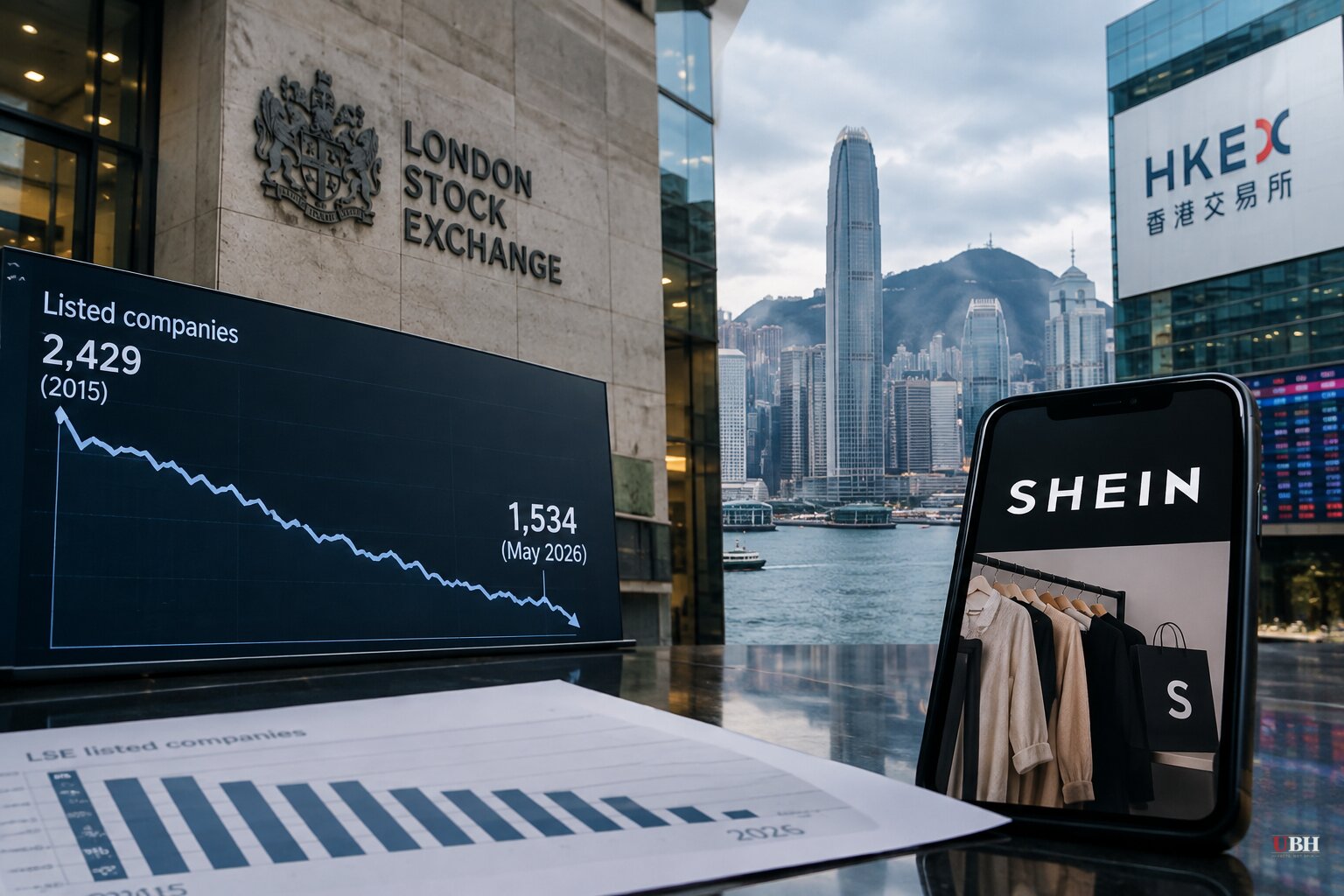
London Keeps Losing Companies
The London Stock Exchange has gone from 2,429 listed companies in 2015 to just 1,534 as of May 2026, according to LSE data compiled by Statista. That's a decade low, and the bleeding hasn't stopped.
More than 30 companies have left or announced plans to leave in 2026 alone. Schroders, the storied British asset manager, agreed to a £9.9 billion acquisition by US-based Nuveen in February. EasyJet agreed to a £5.7 billion takeover by US private equity firm Apollo, according to The Guardian. Flutter Entertainment completed its move to a New York primary listing on August 3.
The departures keep coming. Bodycote, listed in London since 1972, agreed to a £1.84 billion takeover by US private equity group Veritas this week, according to The Guardian. Gamma Communications recommended a £1.1 billion offer from UK private equity firm Epiris. Capricorn Energy is ending 38 years on the FTSE all-share index after a $396 million deal with Norway's DNO. Bloomberg data cited by The Guardian puts the total value of 2026 departures north of $100 billion.
AJ Bell investment director Russ Mould didn't mince words: "Overseas acquirers continue to feast on the UK market like hungry customers at an all-you-can-eat buffet."
The mechanics are simple. London-listed companies trade at lower valuations than US peers. British pension funds have spent years rotating out of UK stocks, leaving thinner trading volumes and less analyst coverage. Cheaper valuations attract foreign buyers, which shrinks the market further, which makes it less attractive to the investors who remain. This creates a structural problem that perpetuates itself.
The Exchange Pushes Back
LSE chief executive Julia Hoggett argues the decline narrative is overstated. Since 2021 she has pushed reforms: scrapping shareholder votes for most acquisitions in 2024, loosening AIM junior-market rules, and launching a new secondary market called Pisces.
"We have the largest pipeline for IPOs since 2005," Hoggett told Fortune. "We do not have a shortage of great companies or capital. We need to stop throwing shade at ourselves as a nation."
The numbers back some of that up. Eleven companies joined the LSE Main Market in the first half of 2026, and UK IPO proceeds more than tripled year-over-year, according to EY data cited by Fortune. Total UK M&A value hit £124.2 billion in the same period, per PwC.
Octopus Energy founder Greg Jackson has pushed back on Hoggett's optimism, saying the exchange needs more "hustle" to win IPOs back. Both things can be true: reforms are producing more activity, and the exchange is still shrinking faster than it's growing. Eleven new listings against 30-plus departures is not a turnaround yet, whatever the pipeline looks like on paper.
Shein Gets Hit by the Same Forces, From a Different Angle
While London bleeds to US buyers, Chinese fast-fashion giant Shein couldn't even get a US listing. It went public in Hong Kong on September 1 instead, under stock code 625, after four years of fighting regulators in both China and the West.
The debut was a disaster. Shares closed at HK$48.50 on day one, then HK$46, HK$42, and HK$38.14 by September 4, according to the Epoch Times, a drop of 21.5% from the HK$48.56 IPO price. The IPO valued Shein at $26.5 billion, a fraction of the $100 billion-plus it commanded as a private company, according to Breitbart.
Saxo chief investment strategist Charu Chanana told Reuters, as cited by Breitbart, that "even after the huge valuation reset, investors still don't see Shein as obviously cheap," citing "weak growth visibility and significant regulatory and trade risks."
Shein has directly blamed the end of duty-free de minimis treatment for low-value Chinese shipments into the US for part of its sales decline, and the Epoch Times reported US sales fell 14%. That policy change, pushed under President Trump's trade agenda, stripped away the loophole that let Shein and competitors like Temu flood American mailboxes with tax-free packages.
Ending de minimis raised prices for American shoppers who liked cheap, fast shipping. Critics of the policy say ordinary consumers are absorbing the cost. But the same business model that delivered $5 shirts also relied, according to Breitbart, on well-documented use of forced labor tied to China's Xinjiang region and products flagged as dangerous to children. Closing a tax loophole that subsidized that model involves a real tradeoff.
France piled on separately, imposing environmental penalties on ultra-fast-fashion products starting September 1, up to €12 per item this year and rising to €19.50 by 2030, with an influencer-promotion ban taking effect January 1, 2027.
Shein also disclosed an FTC investigation, though the FTC's Juliana Gruenwald Henderson declined to comment on its scope, and the Committee on Foreign Investment in the United States is reviewing Shein's acquisition of Everlane, an ongoing review with no findings yet. None of that amounts to a finding of wrongdoing.
The open question is whether Shein's Hong Kong slide stabilizes or keeps sliding as more Western trade barriers phase in through 2027, and whether London's reform push produces enough new listings to outpace the next wave of US-led buyouts.
Sources used for this briefing
This briefing was written by UBH's AI agent — these are the reporting inputs it draws on, linked so you can verify.


