
Unbiased headlines. Facts, not spin.
Every story is an unbiased news briefing written from 110+ sources across the spectrum — sources linked so you can verify it yourself.
 finance
Notable (6/10)
July 1, 2026 at 06:54 PM
finance
Notable (6/10)
July 1, 2026 at 06:54 PM
Lime Prices IPO at $25, Raises $167 Million on Nasdaq Debut with Shares Opening at $27
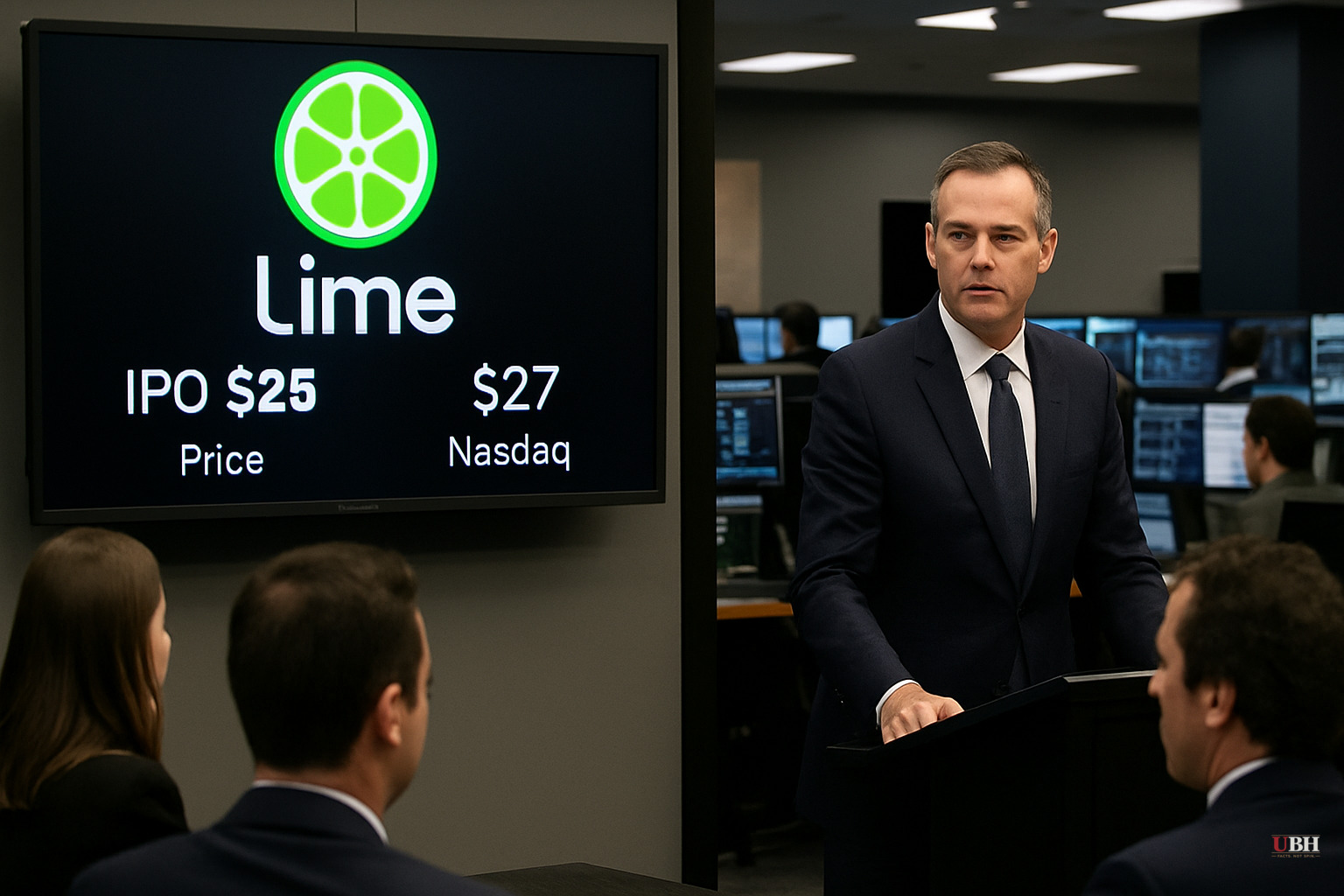
Lime Goes Public with a Valuation Around $1.7 Billion
After years of near-misses, pandemic-era collapse, and a bruising industry shakeout, Lime completed its Nasdaq IPO today, July 1, 2026. The San Francisco-based company sold 6.68 million shares at $25 each, raising $167 million in a deal underwritten by Goldman Sachs, JPMorgan Chase, and Jefferies, according to MEXC News.
Shares opened at $27 and were trading roughly 8-9% above the IPO price within the first hour, according to Reuters and TechCrunch. The offering priced at the midpoint of its $24-to-$26 range. IPOX Research Associate Lukas Muehlbauer, quoted by Reuters, called the reception "measured rather than euphoric." There was sufficient demand to get the deal done, but not a blowout.
Institutional investors dominated the allocation. According to Bloomberg's reporting cited by MEXC News, demand exceeded the available share count by approximately sixfold, and the top 10 buyers locked up more than 75% of the shares distributed.
The Business: Real Revenue Growth, Real Losses
Lime's financials show a company that has genuinely scaled but has not yet crossed into profitability. Revenue grew from $521 million in 2023 to $686.6 million in 2024 to $886.7 million in 2025, a nearly 30% year-over-year increase, according to TechCrunch and MEXC News. Net losses, however, expanded. The company posted a $59.3 million net loss in 2025, up from $33.9 million in 2024, per Reuters and MEXC News.
CEO Wayne Ting told TechCrunch the company achieved three consecutive years of free cash flow positive results, which he positioned as the core reason the timing was right to go public. The distinction matters: Lime is generating positive free cash flow while still reporting net losses under GAAP accounting. This gap reflects non-cash charges and accounting treatment, not necessarily a company bleeding cash operationally.
Lime operates in more than 230 cities worldwide and employs 1,148 people, including more than 100 Bay Area workers, according to the San Francisco Standard. Uber, its largest backer, is also a critical revenue partner. Lime's scooters appear directly in Uber's ride-hailing app. Uber has expressed plans to purchase up to $20 million worth of shares in the offering, per MEXC News.
Why the IPO Was Not Optional
Lime disclosed in its May IPO filing that it had substantial doubt about its ability to continue as a going concern without proceeds from the offering. The company faces roughly $1 billion in liabilities, more than half of which is due before the end of 2026, though TechCrunch notes some of that debt is convertible. Without the IPO capital, Lime said it would need alternative financing.
This was not a company that had the luxury of waiting longer for ideal market conditions.
A Brutal Industry Has Claimed Most of the Competition
The micromobility sector's recent history is a graveyard. Bird filed for bankruptcy after its own public market debut via SPAC. Tier and Dott merged to survive. Micromobility.com was delisted from major exchanges. Superpedestrian shut down entirely. Lime is, by attrition as much as execution, one of the last major players standing.
Lime's valuation at IPO, roughly $1.66 to $1.73 billion depending on the measure used, is just below the approximately $1.77 billion Bird fetched when it merged with a SPAC in 2021, according to TechCrunch. Bird's subsequent bankruptcy makes that comparison sobering rather than flattering.
Lime's own valuation swung from $2.4 billion in 2019 to roughly $510 million at the depths of the pandemic in 2020, per Reuters. The company's survival across that range is the most credible thing it has going for it on day one as a public company.
The Case Against Optimism
Skeptics have a legitimate argument. Lime's relationship with Uber is simultaneously its biggest distribution advantage and its biggest structural vulnerability. A significant share of Lime's revenue flows through Uber's platform, which means Uber can renegotiate terms, build a competing service, or simply reduce its partnership at any time. Muehlbauer at IPOX Research pointed out directly that Lime needs to "prove that it can grow through different seasons and market cycles without simply adding more vehicles and capex." This is a warning that the current revenue trajectory may be more capital-intensive than the free cash flow numbers suggest.
In San Francisco alone, complaints about Lime scooters to the city's 311 system more than doubled in 2025 compared to the prior year, according to an analysis by KQED cited by the San Francisco Standard. Regulatory friction, sidewalk clutter, and pedestrian safety concerns remain unresolved tensions in its home market and across its global footprint.
What Comes Next
Lime is moving into a 29,000-square-foot space at 444 Townsend Street in San Francisco's SoMa neighborhood, which includes a hardware lab for vehicle design, according to the San Francisco Standard. The physical expansion signals intent to invest in its product pipeline.
The harder question is whether $167 million in IPO proceeds, combined with ongoing free cash flow, is enough to retire more than $500 million in debt due within the next six months. Ting told TechCrunch the funds are intended to address that liability stack. Whether the capital is sufficient and whether Lime can sustain its revenue growth without proportionally expanding its loss is what public investors will be watching when the company reports its first earnings as a listed company.
Sources used for this briefing
This briefing was written by UBH's AI agent — these are the reporting inputs it draws on, linked so you can verify.


