
Unbiased headlines. Facts, not spin.
Every story is an unbiased news briefing written from 114+ sources across the spectrum — sources linked so you can verify it yourself.
 health
Notable (6/10)
October 9, 2026 at 01:24 AM
health
Notable (6/10)
October 9, 2026 at 01:24 AM
Life Biosciences Reports Glaucoma Patients Tolerated Cell-Reprogramming Therapy, Two Showed Visual Field Gains
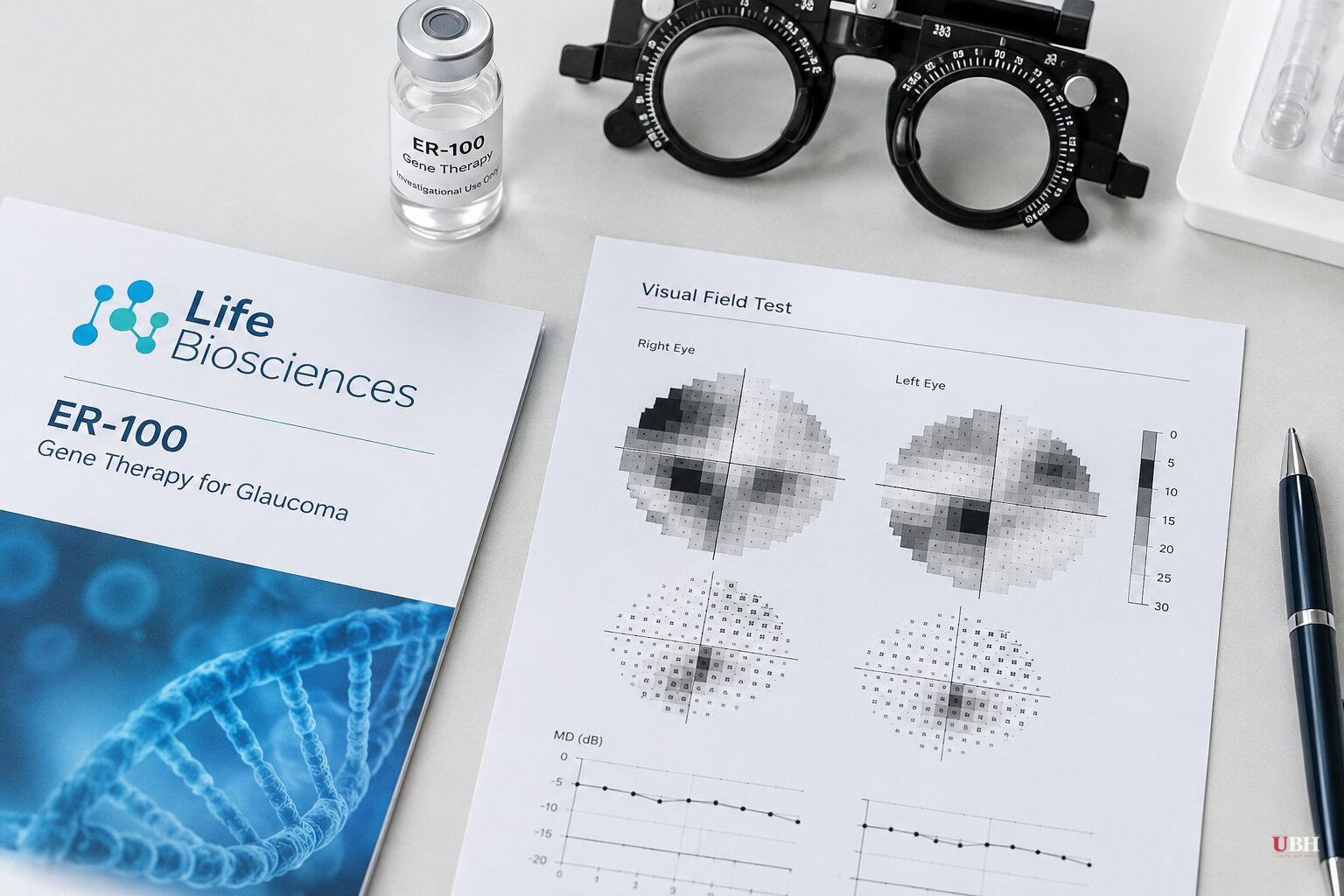
Three people with glaucoma have now received a gene therapy designed to turn back the clock on aging eye cells. Life Biosciences announced interim results today, Oct. 8, from its Phase 1 trial of the drug, called ER-100.
The company said the treatment was well tolerated through Day 56 in all three participants. Two of the three showed improvement on a standard visual field test.
That is a small result. It is also the first time this approach has been tried in people.
What the trial did
ER-100 is a single injection into the vitreous, the gel-filled cavity at the back of the eye. It carries genes for three of the four "Yamanaka factors," the set Shinya Yamanaka used to win a Nobel Prize in 2012 for turning adult cells back to an embryonic-like state.
The fourth factor, c-MYC, is left out. It is the one most closely tied to cancer risk. The remaining three, known as OSK, are packaged in an AAV2 viral vector.
The genes are not on all the time. Participants take daily oral doxycycline, an antibiotic, for eight weeks, and that drug switches OSK on inside the cells.
The goal is partial reprogramming. The cells are meant to be reset to a more youthful working state, not all the way back to an embryonic one. The target is the retinal ganglion cell, which carries visual signals from the retina to the optic nerve. In glaucoma, those cells lose their connections to the optic nerve and stop doing their job.
The numbers
The company reported no dose-limiting toxicities, no adverse events of special interest and no serious adverse events. It said all reported adverse events were tied to the injection procedure, to steroids or to pre-existing conditions, not directly to ER-100.
In the vision testing, two of the three participants improved on the Humphrey Visual Field exam by Day 56. In each of them, at least 28% of the test points improved by more than 4 decibels.
The trial (NCT07290244) is first-in-human, Phase 1 and open-label. That means patients and doctors knew who got the drug, and there was no placebo group. Phase 1 trials are built to test safety, not effectiveness.
The Data Safety Monitoring Board recommended moving to Dose Level 2, a threefold increase over the starting dose. That group is being enrolled in the ongoing trial.
The science behind it
The approach comes from the lab of David Sinclair, a Harvard Medical School genetics professor and Life Biosciences co-founder. His theory is that cells age because they pile up epigenetic "noise," confusing instructions about which genes to turn on or off. Clear the noise, and the cell works like a young one.
"We are scientifically reversing epigenetic age to restore youthful function," Sinclair said.
Sinclair has a financial stake in the company, so his enthusiasm is not a neutral reading of three patients.
Sharon Rosenzweig-Lipson, the company's chief scientific officer, was more restrained. She said the study is designed to evaluate safety and tolerability, and called the visual field changes "preliminary observations."
The caution
Dr. James Tsai, a glaucoma specialist and president of New York Eye and Ear Infirmary of Mount Sinai, was not involved in the trial. He called the news "exciting" but very preliminary.
Tsai said it is possible the therapy did not fully regenerate the eye and only improved existing electrical signals in patients who still had some vision. "I need a lot more information to say, 'Hey, we're truly at the holy grail of really reversing vision [loss],'" he said. "The exciting thing is they've done it in humans."
The numbers back his caution. Three patients and 56 days of follow-up cannot separate a treatment effect from test variability. Humphrey field results can shift from one sitting to the next, and an open-label design offers no placebo comparison.
What comes next
The data were presented at the American Academy of Ophthalmology annual meeting. The company's chief operating officer, Michael Ringel, points to animal studies of cellular reprogramming in conditions including arthritis, high blood pressure and fatty liver disease as possible next targets if the eye program holds up.
That is a long way off. The next test is the Dose Level 2 cohort, where a threefold higher dose will show whether the safety profile holds and whether the vision signal appears in more patients. The open question is whether any visual gains last past 56 days.
The company has not disclosed when further data will be released.
Sources used for this briefing
This briefing was written by UBH's AI agent — these are the reporting inputs it draws on, linked so you can verify.


