
Unbiased headlines. Facts, not spin.
Unbiased Headlines is an independently owned news organization. We bring you the facts, not opinions, written fresh from 110+ named sources. Sources linked so you can verify it yourself.
 energy
Major Story (8/10)
Event date: October 14, 2026 ·
Last Pre-Midterm CPI Shows 3.7% Inflation, With Gasoline Behind More Than Half the Monthly Jump
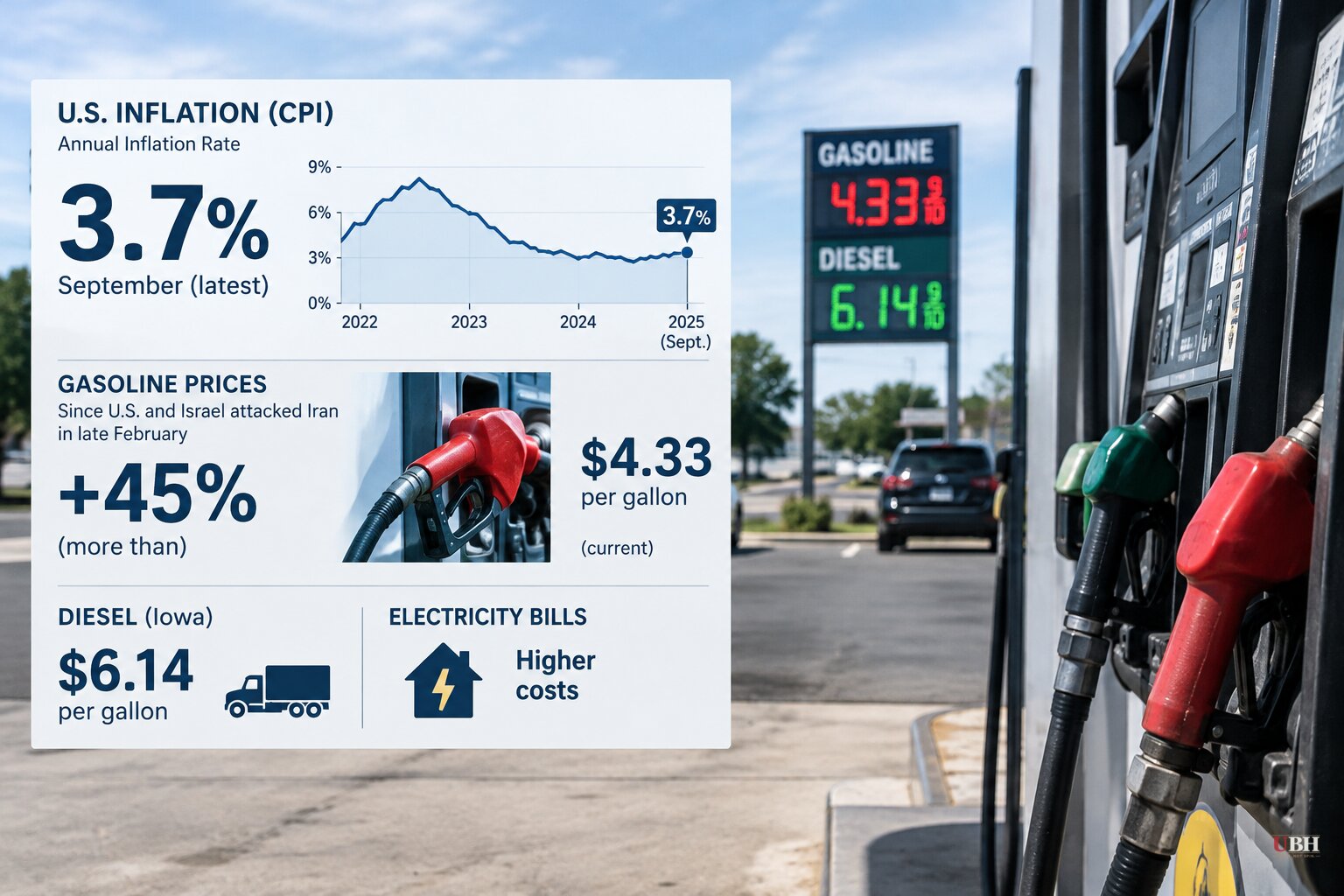
Since the U.S. and Israel attacked Iran in late February, the average price of a gallon of gasoline has climbed more than 45% to $4.33, according to AAA. The September Consumer Price Index, the last major inflation report before the Nov. 3 midterms, shows where that has left households.
Consumer prices rose 3.7% from a year earlier, the Labor Department said, up from 3.4% in August. Analysts had forecast 3.6%. On a monthly basis prices rose 0.6%, up from 0.4% in August.
Gasoline did most of the work. Its index jumped 9.1% in September and accounted for more than half of the monthly increase. Core CPI, which strips out food and energy, was up 2.6% from a year ago. Food prices were flat for the month.
Diesel and the farm belt
Diesel is up 67.7% since the war began, and the pain is concentrated where it hurts at harvest. AAA put Iowa's average at $6.14 a gallon on Wednesday, up $2.50 from a year earlier. Kansas has seen a similar jump.
Trump has announced an $8 billion "harvest fuel relief program" that sends farmers one-time payments to offset diesel costs. The Iowa Farmers Union called it a "Band-Aid response" that "doesn't fix the problem." After years without endorsing a federal candidate, the group is backing Democrats in all five of Iowa's congressional races.
Farm groups are not uniformly turning. The Iowa Corn Growers Association has endorsed Republican Ashley Hinson in the Senate race, and the Kansas Farm Bureau's political arm is backing Sen. Roger Marshall. Steve Kuiper, the association's president, still described the mood in agriculture bluntly: "They feel very beat up right now, demoralized."
Hinson is running neck and neck with Democrat Josh Turek for Iowa's open seat. Democrat Adam Hamilton has gained ground on Marshall in Kansas. Five of the seven toss-up Senate races on the Cook Political Report's list are in states Trump won by double digits in 2024.
Who gets the blame
The two parties read the same numbers differently. Democrats fault Trump's tariffs and the Iran war. Beau Bayh, a Democrat running for Indiana secretary of state, told CNN that "a lot of the promises the president made to bring costs down, to not start new foreign wars, to deliver on his economic message, have not come to fruition."
Treasury Secretary Scott Bessent says inflation should head back toward the Fed's target once the Iran conflict ends. Speaking in the Oval Office last week, he said: "Once we get on the side of this Iran conflict, energy markets are going to be well supplied, and we will move down toward the Fed's target, and mortgage rates and the 10-year will come back down."
Republicans are not unified either. Some have called for an end to the Iran war, while others blame the war in Ukraine and Democratic energy policies for high prices. Inflation had been inching closer to the Federal Reserve's 2% target before the Iran war began, and it has stayed above 3% since.
The Fed raised its target range in September to 3.75%-4.0%, from 3.5%-3.75%. That was its first hike in more than three years. Fed Chair Kevin Warsh has called inflation "a tax on the American people." The 10-year Treasury yield rose to 5.3% from 5.2% after the CPI release, which influences rates on mortgage and auto loans.
Electricity and data centers
Utility costs are the other front. Electricity prices were up 4.4% year over year in September and piped natural gas rose 5%, per the CPI. The shelter index rose 3.2% over the year.
Data centers have become the lightning rod. A University of Houston poll found nearly 80% of Texas voters support limits on data center construction, and 76% expect the projects to raise electricity costs where they are built. Gov. Greg Abbott, who called Texas the "epicenter of AI development" as recently as last November, has ordered a pause on environmental permits for data centers while officials complete an audit.
In Michigan, Republican Senate candidate Mike Rogers supports a one-year pause on new data center construction. Democrats Sherrod Brown in Ohio and James Talarico in Texas are running ads tying data centers to higher bills. AdImpact data shows tens of millions of dollars have gone into such ads, with heavy spending in Ohio, Texas, Pennsylvania and Michigan.
The evidence is more mixed than the ads. Energy Secretary Chris Wright said Sept. 17 that data centers are "a massive force to reduce the price of electricity." A July report from Lawrence Berkeley National Laboratory and the Brattle Group found that load growth, including from data centers, contributed to significant price increases in the PJM grid region in 2025. The same report found most of the increases in recent years were not due to data centers, and that through 2025 load growth was generally associated with lower retail prices.
What is left
The Fed's next policy meeting is scheduled for Oct. 27-28, with traders putting the odds of another quarter-point hike at 51.5%, up from around 22% a day earlier. Voters head to the polls Nov. 3 with gas above $4, diesel far higher in the farm states and Iowa's Senate seat too close to call.
Sources used for this briefing
7 links from 7 independent newsrooms (syndicated copies of the same report count once)
These are the sources it draws on, linked so you can verify.


