
Unbiased headlines. Facts, not spin.
Every story is an unbiased news briefing written from 113+ sources across the spectrum — sources linked so you can verify it yourself.
 economy
Major Story (7/10)
Event date: September 21, 2026
economy
Major Story (7/10)
Event date: September 21, 2026
LA and Long Beach Post Record August Volumes While China's Share of Cargo Keeps Shrinking
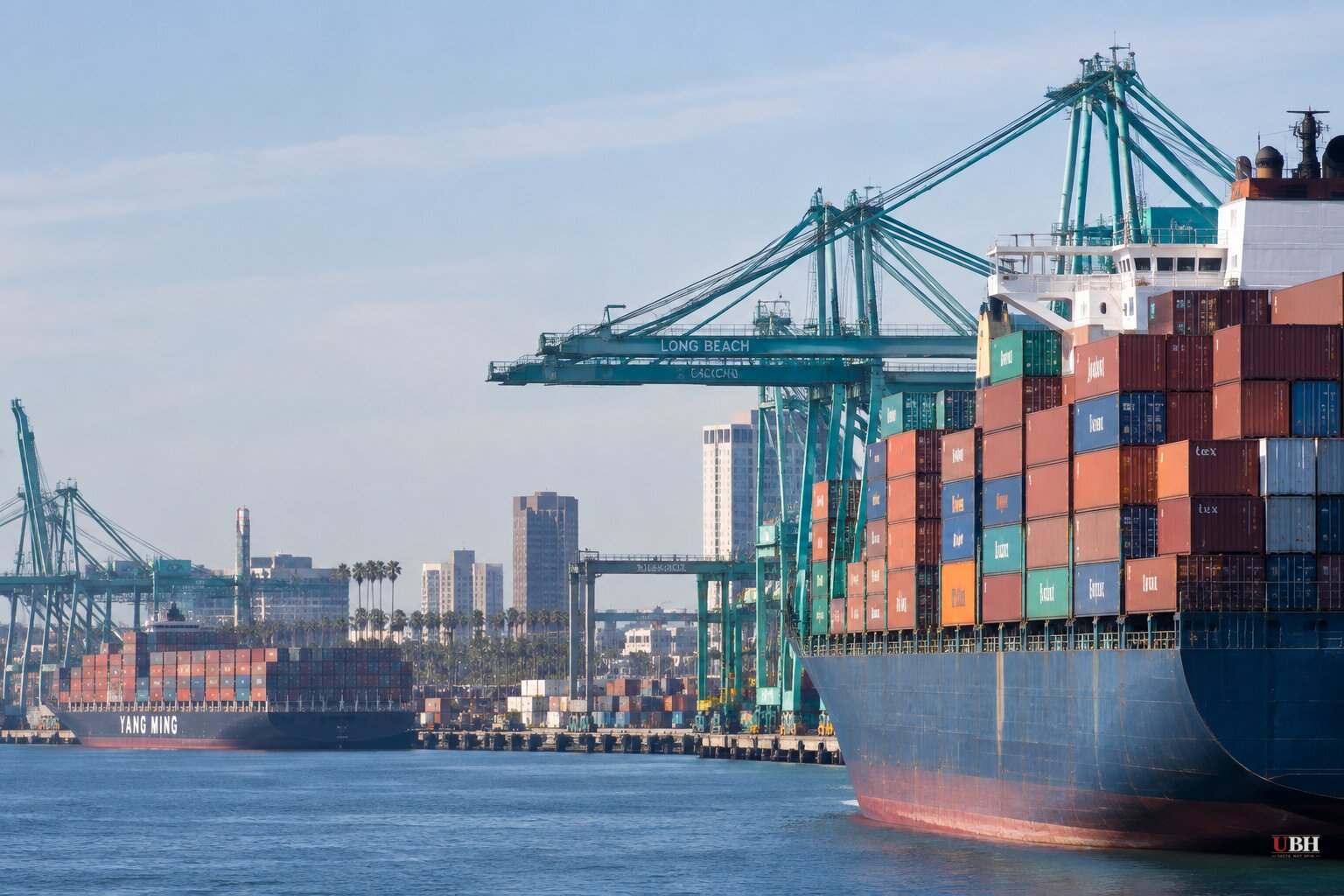
Since the Port of Long Beach's China cargo share peaked near 70% in 2019, it has slid to roughly 60% today, according to CEO Dr. Noel Hacegaba, who took over as CEO on January 1, 2026. Next door, the Port of Los Angeles has seen an even sharper drop: China's share of its throughput has fallen from 60% to 40% over the past decade, Executive Director Gene Seroka told Bloomberg Television.
Vietnam is the biggest beneficiary of that shift. It has become Long Beach's second-largest trading partner, according to Hacegaba, while its business with LA has quadrupled over the past ten years, Seroka said. Hacegaba credits "tariffs and geopolitical uncertainties" with accelerating that diversification as shippers pursue what's known as a China-plus-one sourcing strategy.
The shift isn't a clean break from Beijing. Many goods now routed through Vietnam still rely on Chinese components, according to Crypto Briefing, meaning supply chains have gotten longer and more complex rather than genuinely independent. Companies are cutting direct tariff exposure to China without necessarily cutting their dependence on Chinese-made inputs.
Record numbers, but not from organic growth
Long Beach handled 919,992 TEUs (twenty-foot equivalent units) in August, its best August ever and the fifth-busiest month in the port's 115-year history, according to logistics outlet tbgfs. Imports rose 3.6% year-over-year to 456,100 TEUs and exports climbed 4% to 99,754 TEUs. Year-to-date volume sits at 6.68 million TEUs, up 1.3% from 2025.
Los Angeles posted 955,907 TEUs in August, essentially matching the record set a year earlier, according to the Los Angeles Business Journal. The two ports together processed more than 1.87 million TEUs for the month and have moved 13.7 million TEUs so far in 2026. LA's June-through-August stretch was its best three-month run ever, at more than 2.9 million TEUs, according to The Loadstar.
Nationally, U.S. containerized imports hit 2.6 million TEUs in August, the third-highest monthly total on record, according to FreightWaves, citing Descartes Datamyne data. Only May 2022 and July 2025 were higher. Year-to-date imports nationwide are still down 0.4% versus last year, meaning the August surge narrowed a gap rather than erasing it.
Hacegaba and Seroka both point to the same drivers: retailers front-loading holiday inventory and carriers rerouting away from a constrained Panama Canal and a risk-laden Suez Canal. Seroka said Middle East disruptions and Panama Canal draft restrictions have already shifted more than 5% of cargo from Atlantic and Gulf coast ports toward the West Coast, and he expects a further 5% to 10% volume boost if canal restrictions persist. Nationally, East and Gulf Coast ports still gained share in August, rising to 40.7% of U.S. imports from 39.8% in July, per FreightWaves, driven by strong gains at New York/Newark and Savannah.
A cybersecurity front nobody's advertising
Port of LA fended off more than 120 million cyberattack attempts in August alone, Seroka told Bloomberg Television. The attempts included network intrusion, credential harvesting and malware, defended by a seven-layer digital system built with private-sector partners. "All they have to do is get it right one time," Seroka said. The disclosure came alongside separate reporting that U.S. officials are tracking cyber threats against nearly 20 ships worldwide, a reminder that the maritime sector's growing reliance on digital systems cuts both ways.
The catch nobody's celebrating
Hacegaba flagged an asterisk on his own record numbers. He noted the Conference Board's data was down in August for a second month in a row, with consumer confidence and new construction on the decline. Retail Industry Leaders Association CEO Brian Dodge told Seroka's briefing that shippers should already be stocked up for the winter holidays and that remaining shipments this year will mostly be replenishment. The National Retail Federation, meanwhile, has raised its September volume projections, saying peak season is running longer than expected.
Those two signals don't necessarily contradict each other, Hacegaba remarked, since sourcing decisions were made some time ago. The open question is whether September and October volumes, which Hacegaba expects to stay strong into early November on the strength of continued Panama Canal disruption and Asian port congestion caused by storms, reflect real consumer appetite or another round of defensive stockpiling. Long Beach is meanwhile targeting 20 million TEUs a year by 2050, a bet that will require the kind of sustained demand nobody in this data set is yet willing to promise.
Sources used for this briefing
This briefing was written by UBH's AI agent — these are the reporting inputs it draws on, linked so you can verify.


