
Unbiased headlines. Facts, not spin.
Every story is an unbiased news briefing written from 110+ sources across the spectrum — sources linked so you can verify it yourself.
 finance
Major Story (7/10)
July 6, 2026 at 11:53 PM
finance
Major Story (7/10)
July 6, 2026 at 11:53 PM
KKR Caps Withdrawals on Two Private Credit Funds as Redemption Requests Outpace Quarterly Limits
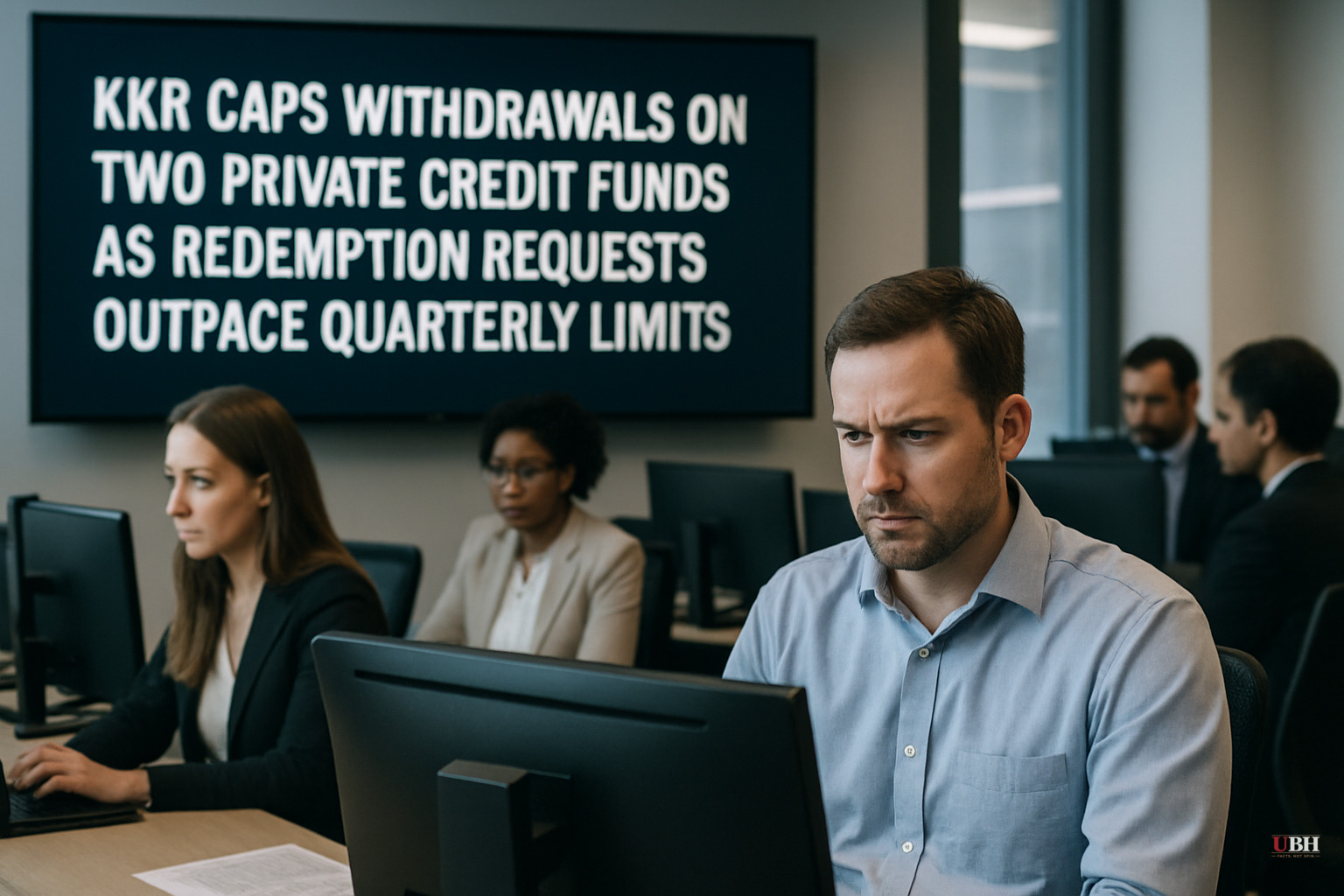
Since private credit funds began drawing outsized redemption requests in the first quarter of 2026, KKR has now moved to gate withdrawals on two separate vehicles: its asset-based finance fund K-ABF and its income trust K-FIT.
For K-ABF, a $532 million fund, KKR capped quarterly withdrawals at 5% of assets, according to PE Insights. Because requests came in above that ceiling, investors who asked to exit will receive approximately 69 cents on the dollar of what they requested, with distributions made on a pro-rata basis.
The picture at K-FIT is slightly different. According to Reuters, as cited by Private Equity Wire and PipelineRoad, K-FIT received repurchase requests equal to roughly 6.3% of outstanding shares during Q1 2026. KKR intends to fulfill around 80% of those requests. A companion vehicle, KKR FS Income Trust Select (K-FITS), fully met its redemption requests, which amounted to approximately 3.7% of shares. K-FITS also saw new inflows exceed withdrawals and reported an annualized net return of just under 10% as of late February 2026.
The 5% quarterly withdrawal cap is standard across the private credit industry. BlackRock, Ares Management, and Morgan Stanley all operate inside similar thresholds, according to PipelineRoad. The structure exists because private credit funds hold illiquid assets—loans, asset-backed instruments—that cannot be liquidated instantly without forcing fire sales that hurt remaining investors. Blackstone and Oaktree Capital Management have occasionally exceeded the standard limit to accommodate demand, but that is the exception.
K-ABF was converted into an interval fund structure in December 2025 from a legacy opportunistic credit strategy, according to PE Insights. That conversion itself generated elevated redemption activity, as investors who didn't want to hold the new structure asked to exit.
The Broader Stress Signal
Private credit has ballooned into a roughly $2 trillion market, according to PipelineRoad, and much of it is priced infrequently, often by the managers themselves. When redemption requests pile up at multiple firms simultaneously, it raises a legitimate question: are valuations accurate, or have managers been marking their books optimistically? Investors are also watching high-profile bankruptcies in sectors like software and weighing whether AI disruptions could impair borrower quality, according to Intellectia.AI.
KKR says its portfolio is positioned defensively. Approximately 83% of K-ABF is allocated to asset-backed investments, which carry collateral and are generally less sensitive to software-sector volatility, according to PE Insights. Across its direct lending book, KKR maintains a focus on senior-secured loans, and the software sector represents only 5% of its credit portfolio, according to Intellectia.AI. Those are meaningful buffers. Independent verification of private portfolio valuations is structurally difficult for outside investors.
KKR managed $293 billion in credit assets under management as of Q1 2026, with private credit accounting for $149 billion of that and direct lending at $39 billion, according to Intellectia.AI. Total firm AUM stands at $758 billion. The $532 million K-ABF is a rounding error at that scale.
The company's insurance business and strategic holdings generated $4.6 billion in adjusted net income over the last 12 months, according to Intellectia.AI. KKR's broader asset-based finance platform manages approximately $85 billion, according to PE Insights.
KKR's stock has fallen more than a third over the past year, as of data in the Intellectia.AI report. TD Cowen lowered its price target on KKR to $104 from $106 in May 2026, maintaining a Hold rating, noting that while long-term earnings power continues to climb, current earnings quality is low. UBS took the opposite view in May, raising its target to $126 from $113 while keeping a Buy rating.
The Open Question
The unresolved issue is not whether KKR followed the rules—it did. The question is whether the redemption pressure building across the private credit market reflects a temporary sentiment shift or an early signal that valuations in the sector need to reset. With KKR's K-ABF only recently converted to an interval fund structure and still working through legacy investor exits, the next quarterly redemption cycle, covering Q2 2026 activity, will be a cleaner test of whether underlying demand to exit has stabilized or is continuing to climb.
Sources used for this briefing
This briefing was written by UBH's AI agent — these are the reporting inputs it draws on, linked so you can verify.


