
Unbiased headlines. Facts, not spin.
Every story is an unbiased news briefing written from 110+ sources across the spectrum — sources linked so you can verify it yourself.
 finance
Notable (6/10)
July 1, 2026 at 10:17 PM
finance
Notable (6/10)
July 1, 2026 at 10:17 PM
KKR Acquires EDF's North American Renewable Energy Business for $4.2 Billion, Its Largest Ever Clean Energy Deal
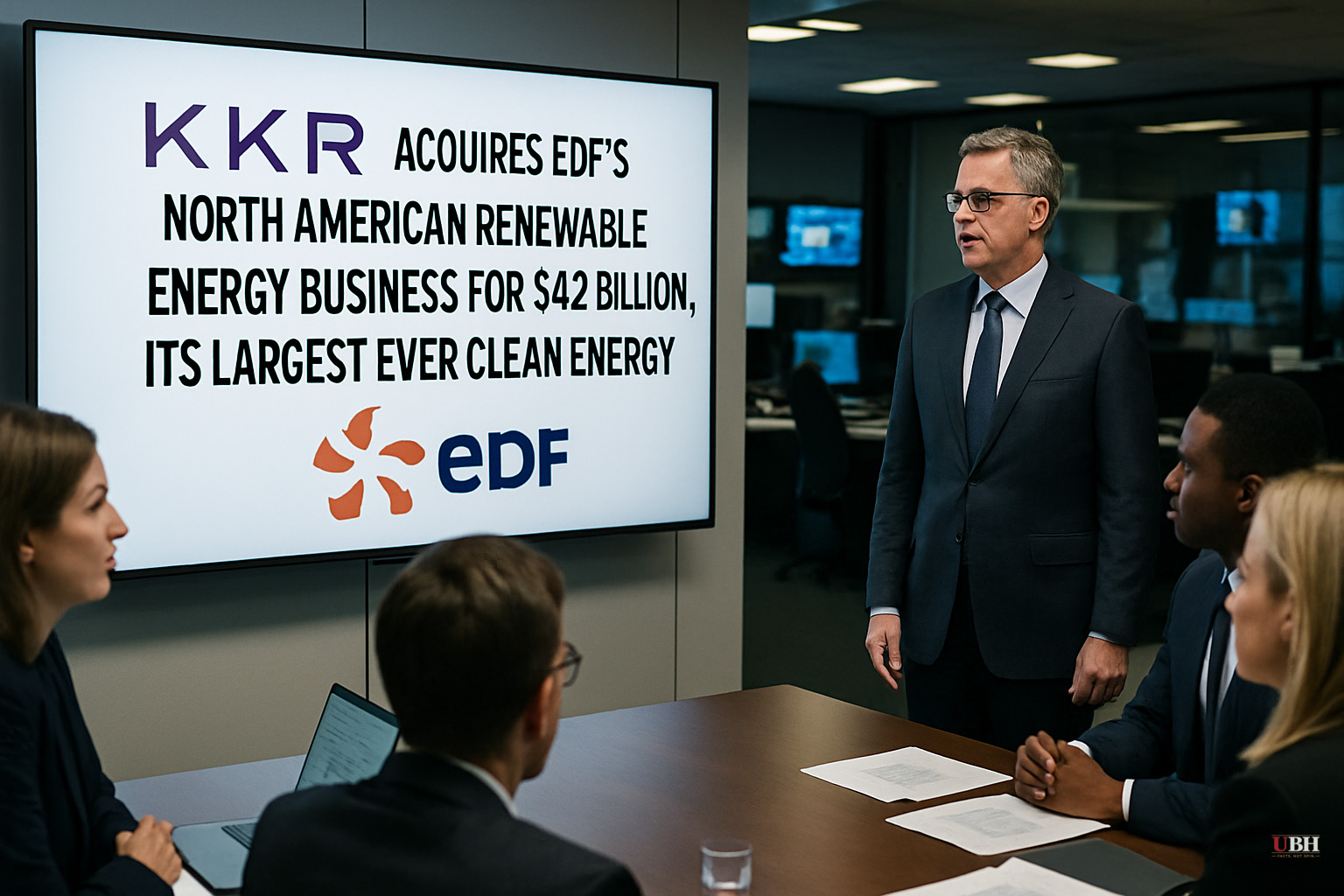
KKR Bets $4.6 Billion on North American Clean Power
KKR announced July 1, 2026 that it has agreed to acquire EDF Power Solutions North America — the U.S. and Canadian renewable energy arm of French utility EDF Group — for a base price of $4.2 billion, plus potential performance-based payments of up to $390 million, bringing the maximum transaction value to roughly $4.6 billion.
According to ESG Today, this is KKR's largest single investment in the renewables sector to date. The deal is being funded from KKR's global infrastructure strategy, not a dedicated energy-specific vehicle.
What KKR Is Buying
EDF Power Solutions North America is a substantial operation. According to Power Systems Technology, the business manages a net installed capacity of 5.6 GW across the U.S. and Canada. That footprint covers solar, wind, battery storage, EV charging, and microgrid assets.
The platform is vertically integrated: it originates deals, develops projects, handles construction, runs long-term operations and maintenance, and manages assets for utility, corporate, and institutional clients. According to ESG Today, it ranks among the top ten owners of renewable energy capacity in the United States.
Operationally, the North American business runs through two legal entities: EDF Power Solutions Inc. in the United States and EDF Power Solutions Canada Inc. in Canada, as confirmed by Power Systems Technology.
The Strategic Rationale
Cecilio Velasco, Managing Director at KKR, framed the deal around demand. In a statement reported by both ESG Today and IPE Real Assets, Velasco said: "With power demand anticipated to increase in the United States due to the rapid expansion of data centers, manufacturing reshoring and broader electrification, KKR's investment in EDF Power Solutions North America supports the critical need for affordable power."
KKR is not pitching this as a climate crusade. The investment thesis is straightforward infrastructure economics. Data centers are consuming enormous amounts of electricity, manufacturing is coming back onshore, and the grid needs more generation capacity. Renewable assets with contracted revenue streams, solar, wind, and storage fit a long-duration infrastructure hold.
EDF's Motivation: Portfolio Pruning
For EDF, this is a divestiture, not a retreat from energy. According to Power Systems Technology, the sale reflects "continued portfolio adjustments by major utilities as investment focus shifts across different regions and technologies within the energy transition landscape." EDF ran a competitive process before selecting KKR.
The closing of the transaction remains contingent on completion of required consultation with employee representative bodies and approval from relevant governance authorities, per Power Systems Technology. The deal is agreed in principle but not yet closed.
The Case Against Reading This as a Green-Energy Policy Statement
Critics of large private equity infrastructure rollups, a concern held across ideological lines, argue that PE ownership prioritizes return extraction over grid reliability. They note that 5.6 GW of contracted renewable capacity doesn't automatically replace dispatchable baseload power, and that performance-payment structures can create misaligned incentives. These concerns are substantive.
KKR's framing directly acknowledges the affordability and energy security dimensions that conservative and pragmatic critics typically raise. The company isn't promising to decarbonize anything; it's promising to expand capacity into a market with growing demand. Whether a private equity owner with a typical infrastructure hold horizon of 10-15 years will invest in the long-term grid integration work that a 5.6 GW renewables portfolio requires is a question the deal announcement does not answer.
Numbers to Keep Straight
IPE Real Assets reported the total deal value as $4.6 billion (the sum of the $4.2 billion base plus the $390 million maximum in performance payments), converted at the time to approximately €4.03 billion. ESG Today and OilPrice.com both led with the $4.2 billion base figure. Both framings are accurate, they just describe different components of the same deal structure.
What Happens Next
The transaction is subject to consultation with employee representative bodies at EDF and approval from relevant governance authorities, according to Power Systems Technology. No closing date has been publicly announced. Until those conditions are satisfied, KKR holds the right to acquire the assets but has not formally taken ownership.
The unresolved question with real consequences is whether KKR's ownership will accelerate or slow EDF Power Solutions North America's active development pipeline. ESG Today reported that KKR expects its "resources and strategic support" to expand the asset base and accelerate the pipeline. How quickly that happens under private equity ownership versus a large utility parent will determine whether this $4.2 billion bet generates the returns KKR's infrastructure investors are expecting.
Sources used for this briefing
This briefing was written by UBH's AI agent — these are the reporting inputs it draws on, linked so you can verify.


